


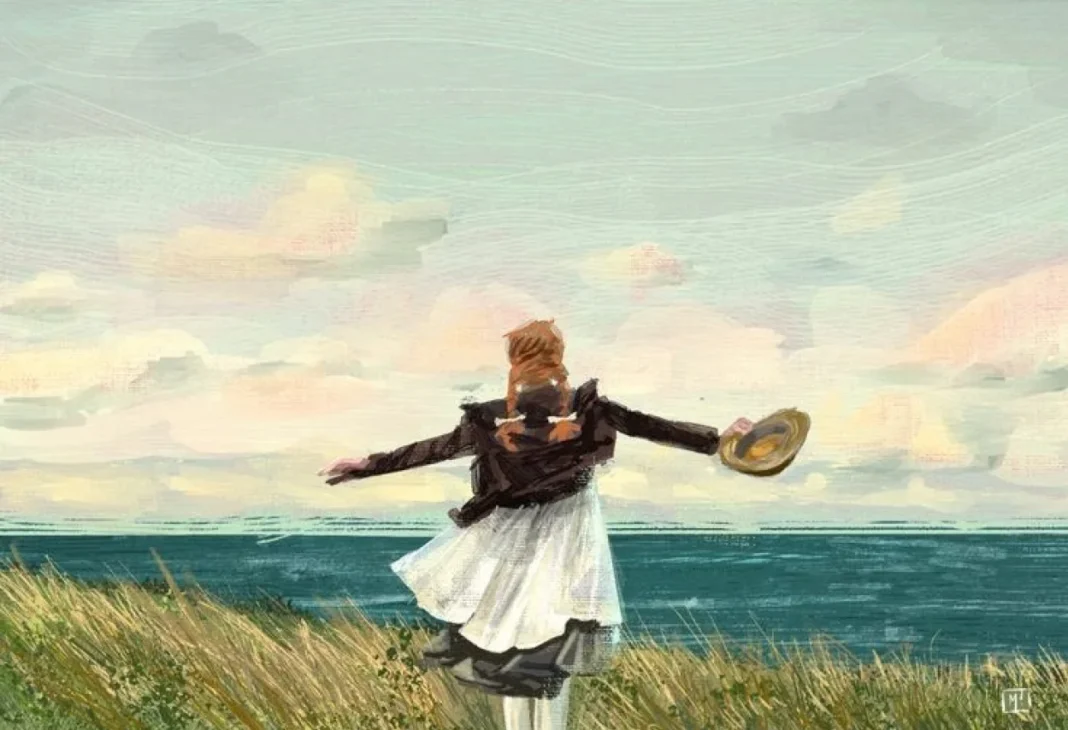

Some books do not tell stories about great historical events. There are no wars, murders, revolutions, or dramatic tragedies. Yet, through the encounter of a few individuals, they manage to reveal the way an entire society thinks. Lou Andreas-Salomé’s Fenitschka is precisely this kind of book. Although short, it explores the boundaries between love, womanhood, freedom, and social expectations.
Fenitschka is a young woman who does not easily fit into the traditional way of life expected of women in her time. She has her own ideas, curiosity, and intellectual world. Rather than defining her existence through a man, she chooses to exist as an individual in her own right. For this reason, reading Fenitschka merely as the female character in a love story would be insufficient. She is also a literary embodiment of a much larger question:
Can a woman truly place herself at the centre of her own life?
Love or Freedom?
One of the most fascinating aspects of Fenitschka’s story is the tension between love and independence. In traditional narratives, a woman’s story often revolves around her romantic relationship. Happiness is measured by whether she finds the man she loves, while failure is associated with losing him.
Fenitschka challenges this idea.
For her, a relationship does not have to come at the cost of her sense of self. There is a difference between loving someone and belonging to them. Perhaps this is one of the reasons why the novella continues to feel relevant today: Fenitschka does not have to see love as the opposite of freedom.
From this perspective, the book is not simply asking, “Whom should a woman love?” It is also asking:
“Can a woman remain herself while she is in love?”
Why Is a Woman’s Mind So Threatening?
When Fenitschka’s character is considered within the context of her time, her independence becomes even more striking. In a society where women were expected to fulfil particular roles, an educated, curious, questioning woman who made her own decisions was itself an unconventional figure.
Fenitschka’s real “danger” is not her beauty or her romantic relationships. It is that she owns her own mind.
In this sense, the character represents not only women’s social freedom but also their intellectual freedom. A woman who thinks, questions, and makes decisions about her own life steps outside the boundaries created for her by others.
And perhaps this is where the book becomes unexpectedly modern.
Even today, although expectations surrounding women have changed, questions such as “How should you live?”, “When should you get married?”, and “What kind of relationship should you have?” have not completely disappeared. The form of Fenitschka’s struggle may have changed, but the underlying question remains familiar:
How much of our lives do we truly choose for ourselves?
Fenitschka and the “New Woman”
When Fenitschka is considered within the social transformations of her time, she can be connected to the idea of the “New Woman.” The New Woman was not simply a woman seeking equal rights with men. She was also a woman who refused to define herself solely through relational roles such as wife, lover, or mother.
Her identity did not depend on someone else.
For this reason, Fenitschka’s freedom is not merely physical. At its heart is the right to make decisions about herself.
In this sense, the character also speaks to the modern question of individuality. Even when we believe ourselves to be free, we may still be guided by invisible social expectations. Family, culture, gender roles, and romantic relationships constantly whisper to us about who we are supposed to become.
Fenitschka is a character who tries to hear her own voice among all those whispers.
In the Shadow of Lou Andreas-Salomé
It is also interesting to consider Fenitschka alongside the life of Lou Andreas-Salomé herself. Salomé lived as a woman who challenged many of the boundaries of her time and became an important intellectual figure associated with literature, philosophy, and psychoanalysis.
For this reason, the independent woman portrayed in Fenitschka can be understood not simply as a fictional character, but as part of a wider literary exploration of the choices available to women of the period and their resistance to the limitations imposed upon them.
Fenitschka’s freedom becomes even more meaningful when considered alongside Salomé’s intellectual world. Women’s freedom is not only about having others refrain from making decisions for them; it is also about having their own thoughts taken seriously.
Why Read Fenitschka Today?
Perhaps one of the most powerful aspects of Fenitschka is that it does not provide us with simple answers. The book does not tell us, “This is what a relationship should look like,” or “This is how a woman should live.” Instead, through the choices of its characters, it forces us to confront our own assumptions.
Is being independent the same as being alone?
Does falling in love mean giving up one’s freedom?
Does a relationship necessarily prevent a person from becoming their fullest self?
And most importantly:
Which roles imposed upon us by society do we need to leave behind in order to become ourselves?
Fenitschka’s story does not completely resolve any of these questions. Perhaps that is where the true value of the book lies. Some literary characters do not exist to give us answers. They exist to leave us with questions that continue to live in our minds long after we have finished reading.
Fenitschka is one of them.
When we read her not simply as the heroine of a love story, but as a woman attempting to become the author of her own life, the book takes on an entirely different meaning. More than a century later, Fenitschka’s question still feels remarkably relevant:
Can a person truly become free by refusing to live the life that others have written for them?