



In November 2025, a groundbreaking study by Mousley and colleagues (2025) was published. The researchers analyzed diffusion MRI (dMRI) data from a total of 4216 individuals aged between 0 and 90. The results revealed four major structural turning points across the human lifespan: approximately at ages 9, 32, 66, and 83. In other words, according to this study, there are five key developmental periods throughout human life: childhood (ages 0–9), adolescence (ages 9–32), adulthood (ages 32–66), early aging (ages 66–83), and late aging (83 and beyond).
Yes, you read that correctly, Mousley and colleagues suggest that adolescence ends around the age of 32, which they describe as the individual’s “peak” period.
Why might this be the case? Let’s take a closer look at the study.
How Diffusion MRI Helps Us Understand Brain Structure
The dataset used in this research was created by combining nine different dMRI datasets. Unlike conventional MRI, which provides structural anatomical images, dMRI specifically maps white matter structures in the brain (Katti et al., 2011; Ordinola et al., 2025). How does it do this? By examining the movement of water molecules within brain tissue.
Water molecules move continuously and randomly within living tissue; however, their movement is constrained and shaped by cellular structures. In white matter, this movement is therefore not random but directional.
Why White Matter Matters For Development
So, why is examining white matter important when studying developmental periods?
White matter plays a crucial role in human cognition. It makes up roughly half of the brain and is responsible for communication between different brain regions (Filley & Fields, 2016). Working together with gray matter, it enables us to use our cognitive capacities. Gray matter consists of neuronal cell bodies and is primarily responsible for information processing. Deficits in white matter are associated with many neurological disorders (e.g., Alzheimer’s disease).
Synapses, Pruning, And What They Reveal About Brain Development
What do white matter and gray matter tell us about brain development?
In the early years of life, learning large amounts of new information leads to the formation of many new synapses (the connection points between neurons). This phase is known as synaptogenesis and is associated with an increase in gray matter. However, the brain is a pragmatic organ, and over time it eliminates unused synapses. This process is called synaptic pruning and is accompanied by a reduction in gray matter. As we age, the brain also seeks to speed up communication between neurons, which leads to an increase in white matter. In short, the amount of white matter is positively related to cognitive processing speed. The efficiency of the brain’s “network” is reflected in how effectively information is transmitted (Latora & Marchiori, 2001).
Interpreting Brain Networks Through A New Algorithm
With this background in mind, let us return to the study.
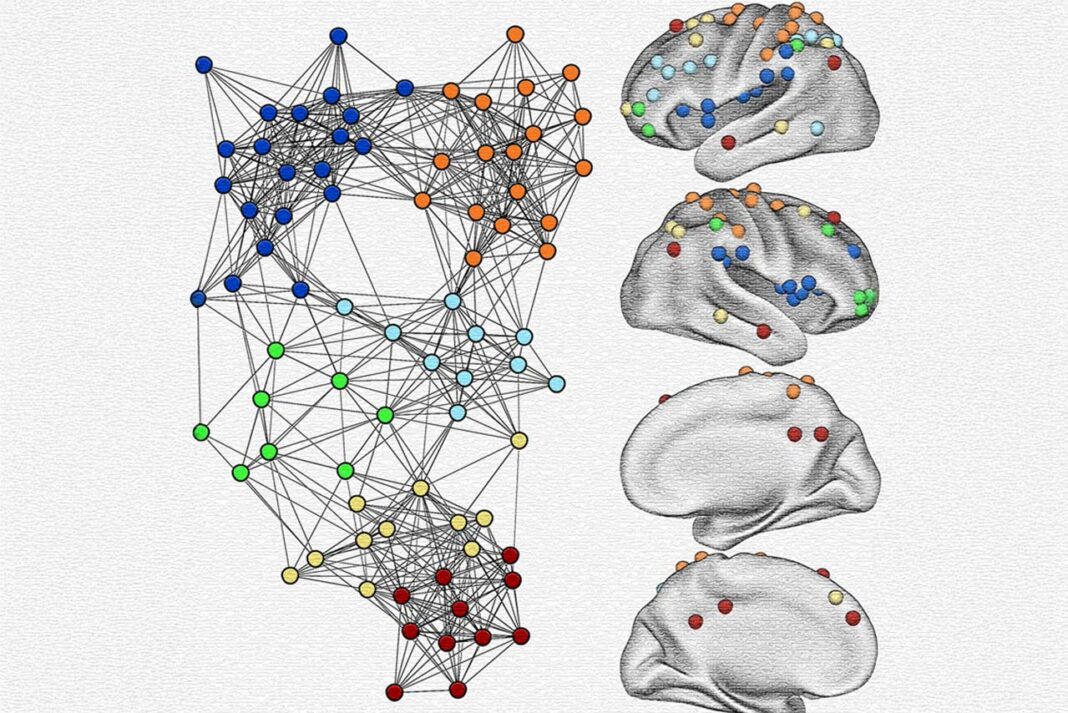
To make sense of their complex dMRI data, the researchers developed their own algorithm. Using this algorithm, they created a representation of how the brain’s network connectivity changes with age. They then examined the direction of lines in this structure to identify peak and trough periods. Points at which the lines changed direction were defined as “turning points.”
The Five Developmental Periods Identified In The Study
Period 1: Ages 0–9 — Infancy Into Childhood
During this period, overall brain efficiency and the strength of connections between regions and neighboring regions increase. The turning point observed around age 9 is the most frequently observed turning point across participants.
Period 2: Ages 9–32 — Adolescence
During this period, the brain simultaneously develops stronger communication between different regions while also forming smaller, specialized subsystems within itself. In other words, the brain becomes both more globally integrated and more locally specialized. During this period, the brain becomes more interconnected at a general level while also developing greater specialization in specific areas.
This second life stage ends around the age of 32. Around this age, a phase in which brain network development is more efficient and more adaptive comes to an end. In other words, age 32 marks a turning point at which brain networks reach their peak in terms of efficiency and integration. This finding contradicts the widely accepted view that late adolescence ends with the maturation of the prefrontal cortex around age 25 and instead proposes a new age range for adolescence.
Period 3: Ages 32–66 — Adulthood
Between the ages of 32 and 66, overall communication between brain regions gradually decreases, while the brain begins to break down into smaller, more tightly interconnected units. Unlike earlier stages, the most important age-related change during this period is suggested to be the strengthening of connections between neighboring regions.
Period 4: Ages 66–83 — Early Aging
During this age range, age-related changes in brain networks become more limited compared to previous periods. The most prominent change in this stage is the increasing division of the brain network into more independently functioning modules.
Period 5: Ages 83 And Beyond — Late Aging
Between ages 83 and 90 (the maximum age in the dataset), age-related changes in brain networks become markedly weaker compared to earlier periods. The most prominent change during this stage is the increasing prominence of connections between certain brain regions and their immediate surroundings. Rather than a generalized increase in connectivity across the brain, this period is characterized by more pronounced local connections in specific regions. However, the strength of these findings is limited due to the small sample size in this age group.
Conclusion: Does Adolescence Truly End At 32?
In conclusion, this study suggests that structural brain development extends over a much longer period than previously assumed and that the neurological traces of adolescence may persist into the early 30s. This finding once again reminds us how difficult it is to divide the human lifespan into sharp age-based categories. However, this does not mean that individuals in their 30s are still “adolescents.” Rather, it supports the idea that the maturation of brain connectivity networks is a gradual, staged process that unfolds over time.
This study once again highlights that the brain is an organ that continues to change and reorganize itself throughout life. As a developmental psychologist, the most powerful takeaway of this study for me is that development never truly comes to an end.
References
Filley, C. M., & Fields, R. D. (2016). White matter and cognition: making the connection. Journal of Neurophysiology, 116(5), 2093-2104. https://doi.org/10.1152/jn.00221.2016
Katti, G., Ara, S. A., & Shireen, A. (2011). Magnetic resonance imaging (MRI)–A review. International Journal of Dental Clinics, 3(1), 65-70.
Latora, V., & Marchiori, M. (2001). Efficient behavior of small-world networks. Physical Review Letters, 87(19), 198701. https://doi.org/10.1103/PhysRevLett.87.198701
Mousley, A., Bethlehem, R. A., Yeh, F. C., & Astle, D. E. (2025). Topological turning points across the human lifespan. Nature Communications, 16(1), 10055. https://doi.org/10.1038/s41467-025-65974-8
Ordinola, A., Abramian, D., Herberthson, M., Eklund, A., & Özarslan, E. (2025). Super-resolution mapping of anisotropic tissue structure with diffusion MRI and deep learning. Scientific Reports, 15(1), 6580. https://doi.org/10.1101/2023.04.04.535586