



Henry Gustav Molaison: Life Before the Surgery
Henry enjoyed what could be described as a happy childhood in Hartford in 1926. However, a bicycle accident he suffered at the age of 7 set off a chain reaction that would change the course of his life. His epilepsy, which began with minor seizures, became uncontrollable by the time he reached adolescence. By the time he graduated from high school, he was working as an apprentice mechanic, but the seizures made it difficult for him to keep his job. In 1953, at the age of 27, he went under the knife for Dr. William Scoville, hoping to be rid of the now unbearable seizures. Unfortunately, this hope would turn into the tragedy that would make him one of the most famous patients in the history of science.
The Scientific Revolution: Insights Into The Anatomy and Function Of Memory
Henry’s brain marked a turning point in the history of neuroscience. The research led by Dr. Brenda Milner overturned many previously unquestioned assumptions about memory. The first major finding was that memory depended on a specific region of the brain, particularly the hippocampus. Henry could not form new memories because he lacked a hippocampus. Memory was not, as we had assumed, a diffuse network; this small structure was necessary for encoding.
The second revolution came with Milner’s mirror drawing test. Although Henry couldn’t recall drawing the same shape every day, he was gradually improving. This proved the existence of two distinct memory systems: declarative memory, which knows “what” something is, and procedural memory, which knows “how” to do it. One was dead; the other was alive and well.
The third revelation was that while short-term memory was intact, the inability to transfer this information to long-term memory demonstrated that these two processes operate through distinct mechanisms. Henry taught us that memory is not a single, unified entity, but an orchestra composed of independent systems.
Permanent Present Tense: Long-Term Work With Suzanne Corkin
The most significant figure in Henry’s life was neuroscientist Suzanne Corkin, who worked with him for nearly 50 years. This was no ordinary researcher-patient relationship; Corkin had taken on the responsibility of caring for Henry and had become a window into his silent world.
Corkin’s 2013 book, “Permanent Present Tense”, is a firsthand account of this unique journey. The book’s title encapsulates Henry’s experience of time: a present moment where memories cannot accumulate, and every moment is lived anew and in isolation. Corkin conveys Henry’s daily life, personality, and participation in the research with complete sincerity.
As the years passed, Henry’s brain revealed another secret. It was discovered that, alongside aging, he also bore signs of Alzheimer’s. This allowed researchers to trace the signs of neurodegenerative diseases even in a damaged brain. Henry continued to shed light on science even after his death.
Brenda Milner’s Pioneering Contributions To The Henry Gustav Molaison Case
Neuropsychologist Brenda Milner’s work on the H.M. case laid the groundwork for modern memory science. Milner’s introduction to this case occurred after she and Wilder Penfield of the Montreal Neurological Institute presented on two amnesic patients (P.B. and F.C.) in 1955; they were subsequently invited by Hartford-based neurosurgeon William Scoville.
During his first visit with H.M., Milner encountered a striking picture: The patient forgot daily events almost as soon as they occurred, underestimated his own age, apologized for immediately forgetting the names of people he had just met, and described his condition as “like waking from a dream… all on my own every day.” However, Milner’s genius lay in recognizing that, despite this severe amnesia, H.M.’s general intelligence and perceptual abilities remained intact.
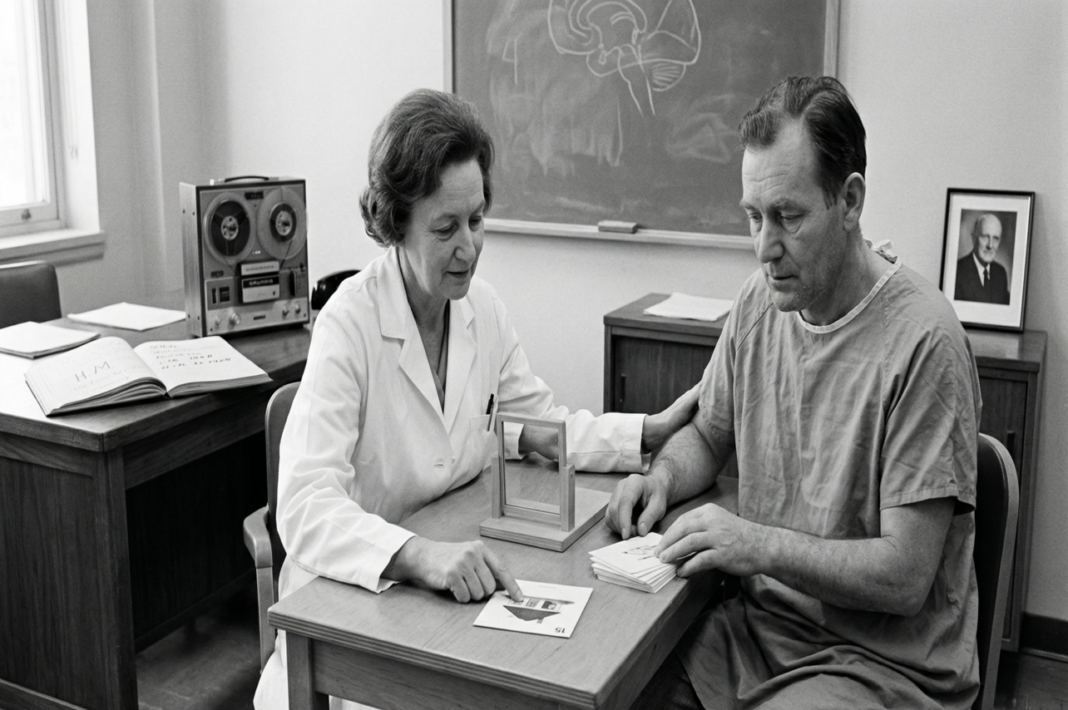
Milner’s most significant discovery came through the mirror drawing test. H.M. was asked to trace the outline of a star by following only its reflection in a mirror. Although H.M. claimed every day that he had never done this task before, after three days of practice, his performance improved significantly and the number of errors decreased. This finding proved that memory is not a single system but consists of two distinct systems: “declarative (explicit) memory” and “procedural (implicit) memory.” H.M. could not encode new events (explicit memory) but could acquire motor skills (implicit memory).
Milner also demonstrated that H.M.’s short-term memory was intact; with constant repetition, he could retain information for up to 15 minutes, but forgot everything when his attention wandered. This finding revealed that short-term and long-term memory operate through distinct mechanisms. The paper Milner co-authored with Scoville in 1957 became one of the most cited works in the history of neuroscience and ushered in the era of modern memory research.
Debates That Flared Up After His Death: The Issue Of Ethics and Consent
When Henry’s identity was revealed to the public following his death in 2008, it became clear that he had left behind not only a scientific legacy but also weighty ethical questions. The first question concerned informed consent: Had 27-year-old Henry been sufficiently informed about the risks of the surgery? Even more complex was the question of whether an individual without memory could provide valid consent to participate in years of research.
The second question concerned the balance of benefits and harms. The surgery had stopped his epilepsy but left him unable to live independently, trapped in a perpetual “present moment.” In unpublished surveys brought to light by Luke Dittrich, Henry expressed fear, disappointment, and anger. Contrary to popular belief, his inner world was far from serene.
All of this raises a troubling question: To what extent are individual sufferings acceptable as the price of scientific progress? Henry’s tragedy has etched this question into our memory.
Conclusion: Henry Gustav Molaison’s Legacy To Science and Ethical Understanding
Henry Gustav Molaison entered the history of science as a case number, but he left behind a multifaceted legacy. His brain became one of the cornerstones of modern neuroscience. We owe it to him that we understand there are different types of memory and that the hippocampus is indispensable for forming new memories. Neuropsychology and cognitive neuroscience took their current form thanks to Henry.
However, his legacy is not merely scientific. Henry’s story marks a turning point in medical ethics. The importance of informed consent, the responsibility of working with vulnerable groups, the boundaries of the researcher-patient relationship… All these discussions gained depth because of his experiences. Today, one can see Henry’s influence in the meticulousness of ethics committees.
But beyond all this, Henry was a human being. Even though his memories have faded, his sorrowful smile, his patience, and the fifty years he dedicated to science are the true legacy that must not be forgotten. His life will also be the source of questions we will ask forever about the price of knowledge.