


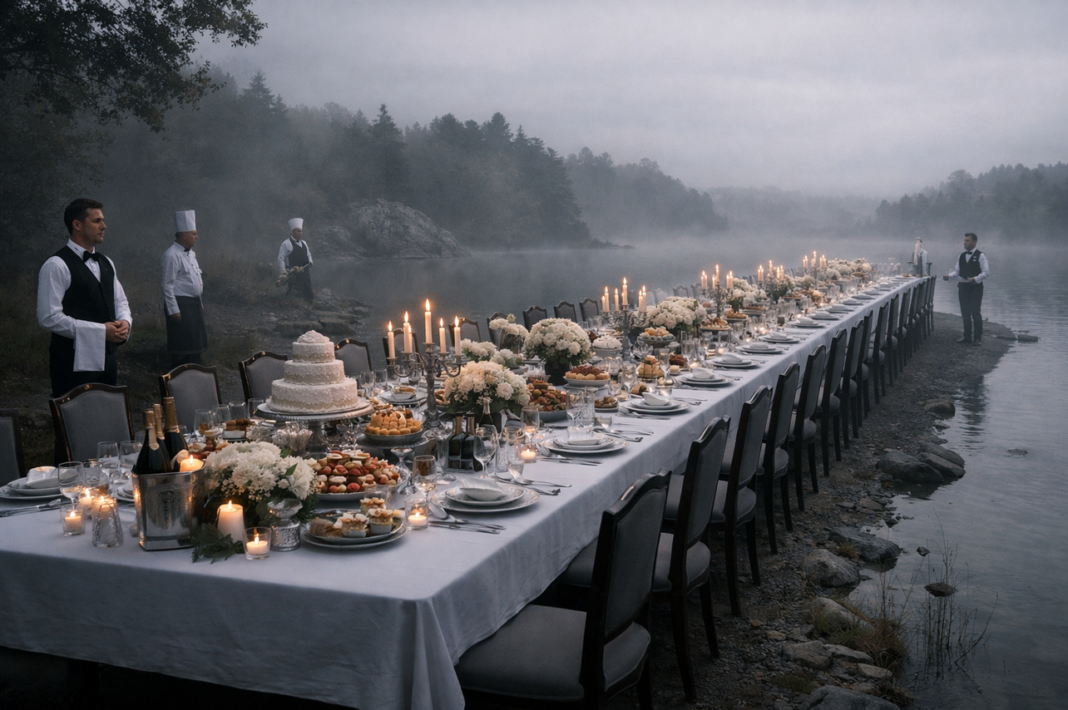

Celebrations should not be seen as mere interludes; they are, in fact, the moments we retreat into to say, “I am here.” By celebrating life’s milestones, humans carve symbolic notches into the relentless flow of time. Birthdays, graduations, or achievements are essentially cries of “I was here and this mattered” flung out into the world. In this sense, celebrations are more than just social events; they are existential mechanisms of validation. However, Belgian artist Hans Op de Beeck’s video work, Celebration, turns this mechanism upside down, confronting us with a jarring void. There is a flawless celebratory arrangement: waiters, chefs, food, cakes… Yet, instead of generating meaning, this order personifies the very absence of it.
The vast table presented in the video is in absolute harmony. The plates are symmetrical, the food is appetizing, and the service runs like clockwork. Chefs and waiters remain at their posts as if serving an invisible host. Yet, the area around the table is desolate. This absence triggers an immediate sense of the uncanny in the viewer; our minds possess an innate intolerance for unfinished scenes or those lacking a subject. The prospect of an event remaining suspended forever in a state of “about to begin” creates an unresolved psychological tension. Rather than soothing this tension, Celebration transforms it into a contemplative experience.
This stillness also calls into question the function of celebrations in the modern world. Society imposes a “duty to be happy” on the individual during moments of celebration; the emotion to be felt is prescribed in advance. Yet, for the modern individual, the abyss between this social expectation and inner reality is steadily widening. Many struggle with a familiar sense of detachment and meaninglessness even in the midst of extravagant festivities. Celebration presents this alienation not as an exceptional or pathological state, but as a naked reality at the heart of contemporary life.
The video’s slow, deliberate tempo further deepens this internal void. Time seems almost frozen. Under normal circumstances, celebrations are moments where the perception of time vanishes—where we say, “I don’t know how it passed so quickly.” Op de Beeck does the exact opposite, making time visible, heavy, and inescapable. This shatters the defensive relationship the individual has built with time. While celebrations are often held to mask transience, Celebration drops the mask.
At this point, the scene pays homage to the “vanitas” tradition in art history—the reminder of the fleeting nature of life. No matter how rich the table, the food will spoil and the order will crumble. Even if no one ever sits at that table, time will continue to flow. This confrontation we psychologically evade—the silence of death and finitude—is infused into every frame of the video. Celebratory moments are designed to make us forget death; Celebration is a reminder that refuses this forgetting.
In today’s “performance society,” we insistently avoid this confrontation. With the rise of social media culture, celebrations have shifted from felt emotions to displayed frames. Happiness is no longer a process lived, but a “status” to be documented. Celebration renders this performative understanding of happiness obsolete. There is no joy to exhibit, no crowd to share with; there is only a meticulously decorated emptiness.
The choice of setting also fuels this alienation. That ostentatious table set in the middle of nature stands like a meaningless seal stamped by the rational human mind upon the wilderness. This man-made artificial order remains incredibly fragile against the wild nature surrounding it. This contrast pushes the viewer toward a fundamental question: Why do we build so much order? Do these rituals truly provide security, or do they merely nourish our illusion of control?
The camera’s positioning makes the viewer neither a full guest nor a total stranger. This liminal state pulls the spectator out of passivity and into their own inner world. Every empty chair at the table is filled with the viewer’s own unfinished business, disappointments, and silent moments. The video acts as a mirror, whispering to us: Celebrations do not always sanctify happiness; sometimes, they exist to make its absence more visible.
The human urge to “compartmentalize life” as a way of coping with uncertainty finds no footing here. There is no clear finish line where we can say, “I have completed this stage, now I move to the next.” This brings with it an intense anxiety. Celebrations are safe harbors where we know exactly how we are supposed to feel. Celebration destroys this harbor and leaves us without a compass.
Ultimately, the work is a melancholic critique of the modern human’s “compulsion to produce meaning.” For those of us who view life as a project of accumulating meaningful moments, this video represents the bankruptcy of that project. Meaning does not arrive automatically through ritual or a set table. Sometimes everything is ready, the waiters are waiting, the table is perfect, but meaning never shows up. At that moment, the viewer is left with the honest and raw question that haunts the video from start to finish: If even the grandest celebrations cannot fill the void within us, what truly can satisfy us?