


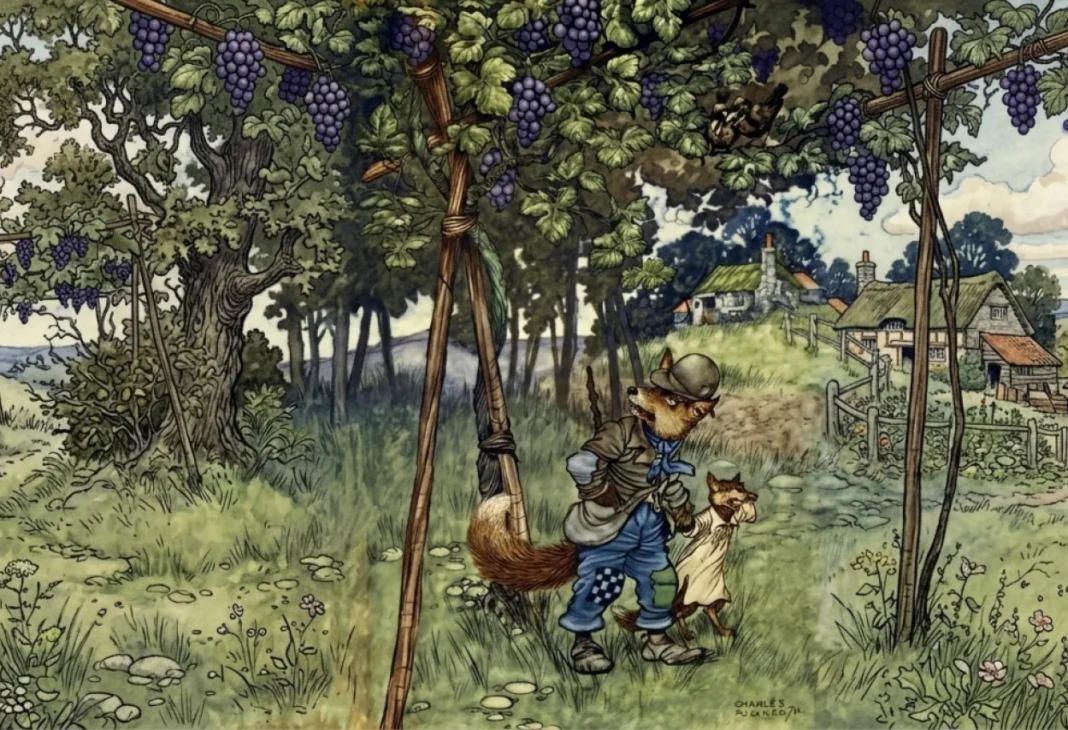

Have you ever read Aesop’s fables? There is one about a fox who spots a bunch of grapes hanging high on a vine. He wants them badly. He jumps again and again, but no matter how hard he tries, he cannot reach them. Eventually, he gives up, turns away, and says, “The grapes were sour anyway.” And that is where the fable ends.
The fox’s reaction feels familiar because foxes have long been associated with cunning and cleverness in stories. It therefore seems almost perfectly “fox-like” that he would dismiss something simply because he could not have it. He has failed, but instead of admitting the loss, he changes the story in his own favor. Charles Folkard’s 1912 illustration for Aesop’s Fables, shown above, captures precisely this moment: the grapes are still there; what has changed is the way the fox sees them.
But what if it is not quite that simple? What if the fox is not lying to himself? What if, after realizing that he cannot reach the grapes, he genuinely begins to want them less? Perhaps what makes him cunning is not that he distorts reality, but that when reality cannot be changed, he can change how much he wants it. And perhaps the human mind has a quieter version of the same ability: changing the taste of what it cannot have.
When we want something, we rarely want only the thing itself. We place an entire unwritten life inside it. Wanting to attend a particular university may mean more than being accepted; it can contain the years we imagine spending there, the people we expect to meet, and the person we believe we might become. Wanting a career can mean more than wanting the work itself; it can also mean wanting the identity we imagine that career will give us. Wanting a relationship can contain the possibility of being loved, chosen, and becoming important to someone else.
This is why, when certain desires remain unfulfilled, what we lose is not always just the outcome we wanted. Sometimes we also lose the future we had built around it.
Perhaps that is why giving up on a desire is not always as simple as it sounds. We want something for a long time. We think about it, wait for it, and imagine the future in which it happens. Then time passes, and waiting becomes exhausting. Eventually, we think about it less, stop waiting as much, and one day, when someone asks, “Do you still want it?”, the answer seems obvious: “Not anymore.”
That answer may be completely genuine. People change; as our experiences and priorities change, our desires can change with them. Sometimes we give something up because, after looking at it more closely, we realize it was never truly ours to begin with. But there is another possibility: perhaps giving up on something is sometimes a way of adapting to the pain of continuing to want it.
In psychology, the “sour-grape effect” describes the tendency to devalue an unattainable goal after it becomes difficult or impossible to achieve. The idea has a longer intellectual history as well: Jon Elster’s Sour Grapes (1983) examined how people may alter their desires when reality makes those desires difficult to fulfill. Later psychological research has similarly explored how people may downplay the value of goals and rewards that become unattainable.
This does not necessarily involve consciously deceiving ourselves. We can tell ourselves, “I don’t really want this anymore,” and genuinely believe it. There is a difference between living with “I want it, but I cannot have it” and being able to say, “I no longer need it.”
But something more interesting may happen here. We may not only change the value of what we wanted; we may also change the story we tell about why we wanted it in the first place.
We may once have desperately wanted a relationship and no longer want one. The fact that we no longer want a relationship does not mean we never truly wanted to be loved in one. We may once have built our life around a particular career and now want something entirely different. That does not prove that the person who wanted that career was mistaken.
No longer wanting something today does not mean we never truly wanted it yesterday.
The distinction may seem small, but it can change the way we relate to our own past. Accepting that something we genuinely wanted never happened requires more than acknowledging the loss. It also requires acknowledging that the version of ourselves who wanted it was real.
Perhaps this is why it can be easier to diminish our past desires. Saying, “It was never really for me,” or “I never actually wanted that kind of life” creates distance between us and an unrealized future. Neither statement has to be false; people genuinely change. But sometimes these statements quietly redefine what we once wanted.
What happened does not change; what it means to us can. We do not simply remember our lives; we also narrate them. Whenever we remember our past, we connect what happened then with who we are now. As our sense of self changes, so can the way we understand who we used to be.
We might look back on something we once desperately wanted and think, “I was so naïve then,” or, “I had no idea what I really wanted.” These interpretations may even be true. But sometimes something else may be happening: rather than accepting the distance between who we were and who we are, we reconstruct who we were so that they fit more comfortably with who we are now.
Because saying, “I really wanted this once, and it did not happen,” requires us to acknowledge a loss. Saying, “I never really wanted it,” makes the loss itself smaller. If I never truly wanted that life, then there is no life to mourn. If that relationship never really mattered to me, then not having it is not a loss.
Perhaps this is one reason why it can be so difficult to grieve for things that never happened. We can grieve a relationship we never had, a city we never lived in, or a version of ourselves we never became, yet we have very little shared language for what such grief is supposed to look like.
So sometimes, instead of grieving, we reinterpret. “I never really wanted it” can be easier to live with than “I wanted it, but it never happened.” The second sentence contains a loss; the first contains only a preference. Such reinterpretation is not always conscious denial. Sometimes it may simply reduce the emotional weight of disappointment.
And it is here that the way we reinterpret a past desire can begin to serve a defensive function.
Yet an important distinction remains: not every act of letting go is a defense mechanism. People genuinely change. We can outgrow a desire, discover that another life suits us better, or learn something about ourselves that changes what we want. The point is not to distrust change, but to avoid automatically treating our former desires as invalid simply because they no longer belong to us.
Our past selves do not have to want what we want today. Their desires do not have to remain our desires. But the fact that they are no longer ours does not make them unreal.
Perhaps we truly outgrow some things. Perhaps we simply become accustomed to their not happening. Perhaps a desire that we initially diminished to protect ourselves eventually becomes something we genuinely no longer want. We may never know exactly which process took place. What matters is that we do not erase what we once wanted simply because we no longer want it.
We may have genuinely wanted it once and genuinely not want it now. We do not have to choose between those two truths. Changing today does not mean that the person we were was wrong. Accepting what we once desired does not mean that we have to return to it.
Perhaps this is where a more honest relationship with ourselves begins: the fact that something did not happen does not make our earlier desire for it unreal. When we reshape the story of our former selves to fit the life we have now, we can begin to erase the person who carried that desire.
When we say, “I never really wanted that,” we leave no room for the disappointment experienced by the version of ourselves who truly did. Yet their story does not have to be the same as ours today. We may have felt one way then and feel differently now; both can be true.
Returning to Aesop’s fox, perhaps he really was deceiving himself. Perhaps the grapes really were sour. Perhaps, after realizing he could not reach them, they genuinely became less valuable to him. Perhaps he simply changed with time. We cannot know.
But perhaps the more interesting question is the one the fable leaves unanswered: If the fox remembered those grapes years later, would he still recognize himself as the fox who once wanted them?
Because sometimes what we do is not simply leave an unattainable thing behind. We leave behind the version of ourselves who wanted it. First we say, “It did not happen.” Then, “I do not want it anymore.” Eventually, perhaps, “It was never really for me.” And finally, we may arrive at, “I never wanted it at all.”
In this way, instead of grieving an unrealized future, we can construct a new past in which that future was never something we truly wanted.
Perhaps we do not have to. We do not have to deny the person who once wanted something simply because it never happened. The ending of a desire does not make that desire false in retrospect. We may be different people today, but that does not make the person we were wrong.
I really wanted it once, and I do not want it anymore. These two sentences do not contradict each other.
Perhaps growing up is not about making our former selves resemble who we are today, but about being able to accept that what they once wanted was real, even when we no longer want it.
Maybe Aesop’s fox really did believe the grapes were sour. Maybe they were never sour at all.
Maybe what he changed was not the taste of the grapes, but the story of the self who wanted them.
Kaynakça
- Aesop. (1912). Aesop’s Fables. Illustrated by Charles Folkard. London: Adam and Charles Black.
- Elster, J. (1983). Sour grapes: Studies in the subversion of rationality. Cambridge University Press.
- Sjåstad, H., Baumeister, R. F., & Ent, M. (2020). Greener grass or sour grapes? How people value future goals after initial failure. Journal of Experimental Social Psychology, 88, 103965.