
When Football Becomes a Cultural Conversation: Belonging, Identity, and the Türkiye–Australia Match in Vancouver

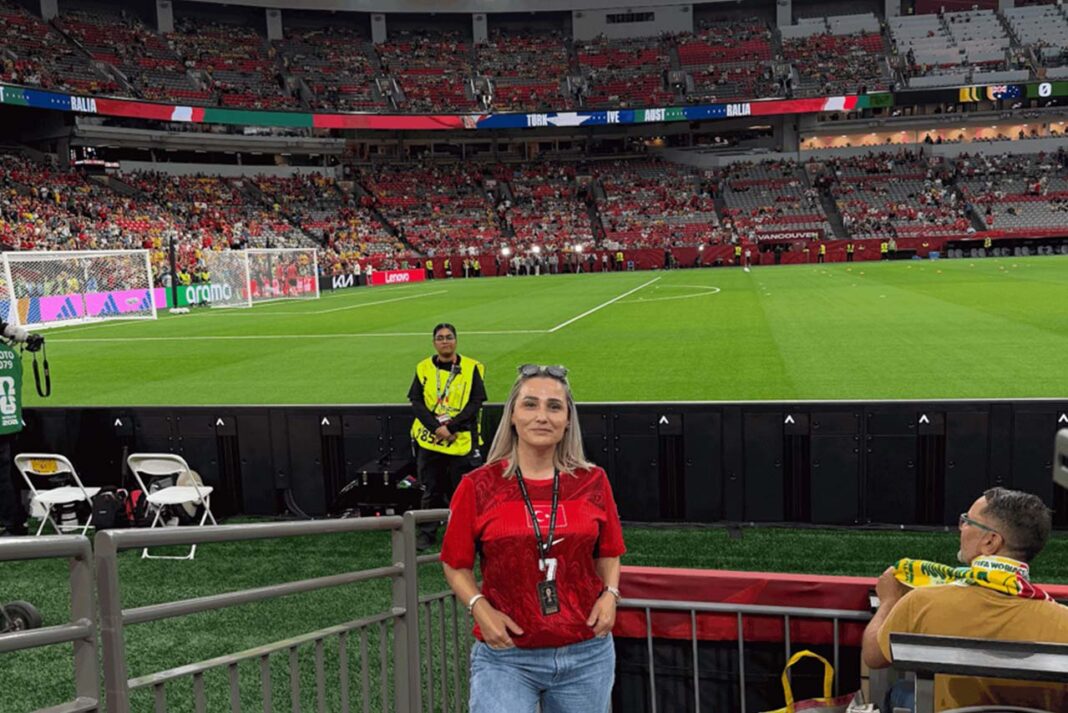
VANCOUVER — Hours before the first whistle was due to sound, a remarkable atmosphere had already taken shape around BC Place Stadium. Turkish supporters dressed in red stood side by side with Australian fans wearing green and gold. Children carried flags almost larger than themselves, while conversations in different languages blended into a shared excitement. Thousands of people were moving toward the stadium with the same anticipation.
As I walked through the crowd, I found myself thinking less about football and more about the concept of belonging. For many members of the Turkish diaspora, this was far more than a football match. It was an opportunity to celebrate their roots, reconnect with their cultural identity, and share a piece of home with family and friends.
Inside the stadium, we supported our National Football Team until our voices were hoarse. For Turkish-Canadian immigrants, the red and white colours represented much more than a team jersey; they reflected memories left thousands of kilometres away—family gatherings, holiday mornings, childhood experiences, and a deeply rooted sense of home.
As we approached the stadium, Turkish conversations echoed through the streets. Flags draped across supporters’ shoulders and fans singing together created what felt like a small island of Türkiye in the heart of Vancouver.
When the Turkish National Anthem began, the atmosphere intensified. Many of you may have seen the live footage I shared. Thousands rose to their feet simultaneously, placing their hands over their hearts. The voices rising from the stands were so powerful that, for a brief moment, you could have believed you were in a stadium somewhere in Türkiye rather than on Canada’s west coast.
The pride and emotion of the supporters spread throughout every section of the stadium. It was not only a national team being supported; a shared history, collective memory, and cultural identity were finding their voice together.
Psychological literature describes experiences such as these through the concept of Collective Effervescence. Research grounded in Social Identity Theory suggests that participating in emotionally charged rituals with members of one’s cultural group can significantly reduce feelings of loneliness and strengthen a sense of belonging among people living abroad. Human beings possess a fundamental need to form meaningful interpersonal bonds and to feel connected to a group (Baumeister & Leary, 1995).
The relationship works both ways. Sports psychology research demonstrates that synchronized emotional support from spectators can reduce athletes’ stress levels while enhancing concentration, confidence, and performance. Studies conducted during the COVID-19 pandemic found that when stadiums were empty, football’s traditional “home advantage” declined considerably. The absence of supporters revealed just how influential collective energy can be on athletic performance (Leitner et al., 2022).
As the match began, that collective energy in the stands merged with the passion on the field, and BC Place Stadium seemed to shake with excitement.
Last night, we were there in the stands.
The result was not what we had hoped for. Türkiye was defeated 2–0 by Australia.
As Turkish supporters, we are naturally disappointed. We know the potential of this team, and at times we have seen glimpses of that potential on the pitch.
Many Turkish fans had followed Australia’s previous matches and were aware of their physical strengths. Against a team whose defensive line featured players averaging close to or above 1.85 metres in height, it became especially important to utilize technically gifted and agile players such as Kerem Aktürkoğlu in the right areas and at the right moments. It would not be unfair to say that questions arose regarding certain tactical decisions, player positioning, and substitution choices.
After returning to the World Cup stage for the first time in 24 years, Head Coach Vincenzo Montella had a talented squad at his disposal. Yet some of the timing of substitutions and the roles assigned to certain players did not produce the expected impact. In football, the challenge is not always the quality of the squad itself, but how effectively that quality is deployed at the right time and in the right place.
At the same time, football is not won by talent alone. It is won through discipline, preparation, adaptability, and consistency. Rather than viewing this defeat as a disaster, it may be more productive to see it as an important lesson and an opportunity for growth.
Yet this is also what makes football beautiful: every match offers a new beginning.
We may have lost on the scoreboard last night, but in the stands we witnessed something equally important. No matter where we live in the world, we remain a community capable of coming together around the red flag and the crescent star.
We criticize. We feel disappointed. We hold high expectations.
Because we care.
Sometimes sport does not remind us of the joy of victory—it reminds us of the power of belonging.
In good times and in difficult times alike, we stand with Türkiye. 
As Psychology Times Türkiye/UK, whether through psychology, art, or the unifying power of sport, we remain committed to bringing people together through shared stories and celebrating the human need for connection, belonging, and collective identity.
References
Baumeister, R. F., & Leary, M. R. (1995). The need to belong: Desire for interpersonal attachments as a fundamental human motivation. Psychological Bulletin, 117(3), 497–529.
Leitner, M. C., Daumann, F., Follert, F., & Richlan, F. (2022). The “ghost games” in European professional football during the COVID-19 pandemic: A data-driven analysis of home advantage. Frontiers in Sports and Active Living.