



Think about this for a second. There is a pen that has been sitting in your drawer for years. It barely writes, and the tip is a little bent, but somehow you just cannot throw it away. Even when there is a brand-new one within arm’s reach, you do not reach for it. Sound familiar? Of course it does. Because we all do this. There is a name for it: status quo bias.
Human beings resist letting go of what they have and picking up something new in a strangely stubborn way. And here is the thing: that resistance usually has nothing to do with the old thing actually being better. It is just familiar. Over time, we cling to what we own as if it were a part of us. Letting it go feels like tearing off a piece of ourselves.
So what dissolves this stickiness?
This is where it gets interesting. The answer is an emotion you would never expect: disgust.
“Disgust is the most ancient of moral emotions; in protecting the body, it also redefines the soul.” — Martha Nussbaum
A Toilet from Trainspotting and a Box of Office Supplies
Seunghee Han from Chung-Ang University in South Korea, along with Jennifer Lerner and Richard Zeckhauser from Harvard, set up an experiment. First, they handed participants a box. No one knew what was inside; they were simply told it contained “office supplies.” The participants were asked to shake the box, guess its contents, and take ownership of it. So now the box was “theirs.”
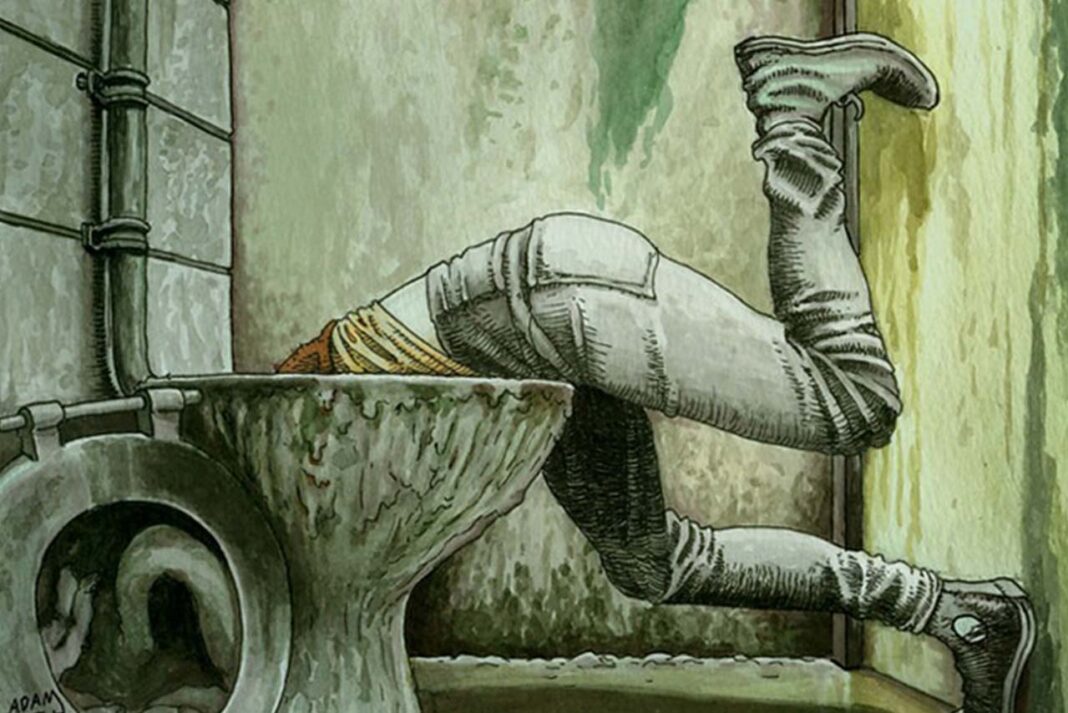
Then the researchers split the group in two. One group watched a calm nature documentary about the Great Barrier Reef. The other group watched that infamous, stomach-turning scene from the film Trainspotting, where a man uses a filthy toilet. If you have seen it, you know.
Afterward, everyone received the same offer: “If you would like, you can swap your box for a new one of the same value, with the contents still unknown.”
The result? Among those who watched the disgusting scene, 51% traded their box away. Among those who watched the calm documentary, only 32% did (Han, Lerner & Zeckhauser, 2012).
Stop and think about that for a moment. Both boxes were identical. The disgusting scene had nothing whatsoever to do with the box, the office supplies, or anything in the participants’ hands. What could a toilet scene possibly have to do with the pens someone owns? Nothing at all.
But the brain does not see it that way.
Why Does the Brain Do This?
Here is where it gets genuinely fascinating. The researchers’ explanation goes like this: disgust is an ancient alarm system, evolutionarily speaking. For millions of years, it kept us away from spoiled food, disease, and the things that “should not enter the body.”
When we feel disgust, what is the body’s first reaction?
“Get rid of it. Move away. Throw it out.”
But there is a margin of error here. The brain cannot always route disgust to the correct address. You are disgusted by the toilet in the film, but for a moment, that feeling of disgust bleeds onto everything around you, and that innocent box, guilty of nothing, lands on the “things to get rid of” list.
It is as if the brain says: “There is something unpleasant around here, so I might as well dump what I am holding too.”
So disgust does not just turn our stomach. It loosens the tight bond we have with the things we own. It dissolves the glue of the status quo bias.
“Disgust… is a warning system that keeps us away from what would contaminate the body.” This logic is very close to Antonio Damasio’s idea of the “somatic marker.”
And here is the most cunning part: in a second version of the experiment, the researchers warned participants. “Listen, the film you just watched might affect your decisions, so be careful,” they said.
Guess what happened?
Nothing changed.
The disgust effect continued exactly as before. Even when people said, “I know the film is not affecting me,” they were being affected anyway. So this is not a conscious decision. It is a decision the body makes quietly, on its own.
So What Good Is Knowing This?
We need to pause here, because we could slide somewhere dangerous. Someone might think: “Well then, to sell people something, just disgust them first.” Advertisers and salespeople have probably already thought of this.
But that is not the point, or rather, that should not be the point.
I think the real lesson here is not a recipe for manipulation, but a lesson in self-awareness. Because the finding tells us this: many of the moments when we say, “I decided this entirely of my own free will, perfectly rationally,” were actually decided in the shadow of whatever emotion we happened to be feeling at that moment; the aftershock of something we saw, smelled, or felt a minute earlier.
Next time you are about to make a big decision, ask yourself this:
“Am I deciding this because I genuinely want to, or am I under the influence of something else that is bothering me, turning my stomach, or making me uncomfortable right now?”
That small question is far more valuable than you might think.
Because disgust pushing us toward the new is not actually a bad thing. It is a force that gets us up off the couch, that breaks us out of the “it has always been this way and always will be” comfort zone. It shows that the gentle nudges Thaler and Sunstein describe in Nudge (Thaler & Sunstein, 2008) can sometimes come from a source as primitive as a single film scene.
As Bargh and Williams remind us, much of our social life already runs on autopilot, flowing along without our even noticing (Bargh & Williams, 2008). The problem is not that these instincts exist. The problem is that we let them run our lives without ever noticing them.
Maybe it is as simple as this: the things our nose has already decided, our mind learns about much later. And wisdom begins in those rare moments when the two of them finally sit down at the same table and talk.
References
Bargh, J. A., & Williams, L. E. (2008). The automaticity of social life: Advances and extensions. Current Directions in Psychological Science, 17(1), 1–4.
Damasio, A. R. (1994). Descartes’ Error: Emotion, Reason, and the Human Brain. New York: Putnam.
Han, S., Lerner, J. S., & Zeckhauser, R. (2012). The disgust-promotes-disposal effect. Journal of Risk and Uncertainty, 44(2), 101–113.
Lee, S. W. S., & Schwarz, N. (2012). Bidirectionality, mediation, and moderation of metaphorical effects: The embodiment of social suspicion and fishy smells. Journal of Personality and Social Psychology, 103(5), 737–749.
Nussbaum, M. C. (2004). Hiding from Humanity: Disgust, Shame, and the Law. Princeton University Press.
Thaler, R. H., & Sunstein, C. R. (2008). Nudge: Improving Decisions About Health, Wealth, and Happiness. New Haven: Yale University Press.