


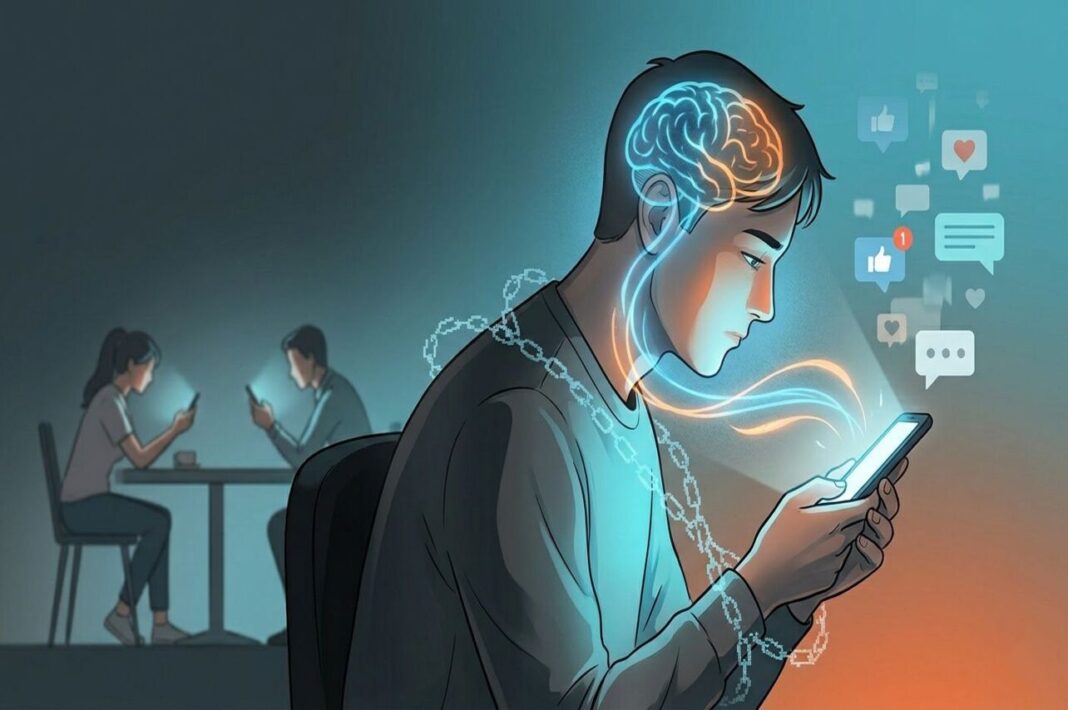

The digital landscape of the modern era has triggered one of the most significant behavioral shifts in human history. Screens, which we once turned to merely for information or communication, have today become an appendage as natural as breathing—and just as painful to let go. The phrase “I can’t live without my screen” is no longer just an exaggeration; it is the expression of a reality that has settled at the very center of an individual’s social, academic, and emotional world.
However, screen addiction is not simply a habit-related problem measured by screen time alone. Beneath this phenomenon lies a complex psychological structure ranging from dopamine cycles and the need for social validation to avoidance mechanisms and neurobiological changes. In this article, we will go beyond the visible face of screen addiction to examine its reflections on the individual’s inner world and the invisible psychological costs of this digital captivity.
The most powerful, concrete, yet insidious face lying at the foundation of screen addiction is the reward system in our brain. Smartphones, applications, and social media platforms are designed according to the principle of “variable ratio reinforcement” in light of neuropsychological data (Alter, 2017). It is impossible to predict when a notification will arrive, how many likes a photo will receive, or what content will appear in the infinite scroll feature. This uncertainty triggers dopamine secretion by creating a state of constant curiosity and expectation in the brain.
Studies conducted by Kuss and Griffiths (2017) show that social media use stimulates reward centers in the brain in a manner similar to gambling. With every touch of the screen, the individual receives a small reward reinforcer, which leads to the development of tolerance over time. In other words, while 15 minutes of screen use initially provides satisfaction, the need to stay on the screen for hours arises later to reach the same level of pleasure. This situation brings about a state of trance we call “digital numbness,” where the person loses their sense of time.
The Screen As A Sanctuary: Emotional Regulation and Escape
It is also necessary to recognize that the issue is not merely a biological urge, but actually an effort to fill a deep emotional void. Based on clinical observations, it is possible to see that screen addiction is frequently used as an “emotional regulation” strategy. For individuals who struggle to cope with the stress, anxiety, loneliness, or feelings of inadequacy brought about by daily life, the screen becomes the safest harbor and an easily accessible “quick fix”.
The digital world offers an opportunity to escape from the complex and sometimes harsh face of real life. Behind the screen, the individual is in control; they can suppress unwanted emotions, showcase an idealized “self,” or simply distance themselves from disturbing thoughts by numbing their mind and switching to “nothingness” mode. However, this temporary relief creates a paradoxical cycle: the individual who takes refuge in the screen to escape from problems loses their problem-solving skills over time, which in turn makes them more dependent on the screen and weakens their ties with the real world.
Social Comparison and FOMO: The Shackles Of The Modern Age
Another invisible face of the screen is the paradox of “Social Comparison” and “Isolation” that targets an individual’s self-esteem. Appearing to be in interaction with thousands of people can, paradoxically, drag an individual into a deep loneliness. The “filtered lives” presented on social media platforms cause individuals to find their own lives inadequate and lead to the damaging of their self-esteem. In addition to this, “Fear of Missing Out” (FOMO) is an invisible shackle that condemns the individual to remain at the screen. The constant need to check what others are doing, where they are, and what entertainment they are involved in destroys a person’s capacity to be “here and now”.
Turkle (2011) defines this situation as “alone together”. Even if people are in the same room, or even at the same table, their minds are in pursuit of a digital reflection somewhere else. This situation leads to a deterioration in the quality of face-to-face relationships, a decrease in empathy skills, and the triggering of social anxiety.
Screen addiction is both the greatest comfort and the most invisible shackle of modern humans. For an individual who has reached the point of saying “I can’t live without my screen,” the recovery process begins not just by restricting screen time, but by understanding the emotional void that the screen fills. Although digital detoxes or restrictions provide a physical start, the real solution is for the individual to increase their self-awareness and rebuild social support mechanisms in the real world.
In conclusion, completely rejecting the presence of screens in our lives is not a realistic approach. However, instead of the screen managing us, our management of the screen is a necessity rather than a luxury for the protection of our psychological health. We can find the true colors of life not on high-resolution screens, but in an eye we make contact with, in the soil we touch, and in the depth of the real moment we live.
References
-
Alter, A. (2017). Irresistible: The Rise of Addictive Technology and the Business of Keeping Us Hooked. Penguin Books.
-
Kuss, D. J., & Griffiths, M. D. (2017). Social Networking Sites and Addiction: Ten Lessons Learned. International Journal of Environmental Research and Public Health.
-
Turkle, S. (2011). Alone Together: Why We Expect More from Technology and Less from Each Other. Basic Books.