



Introduction
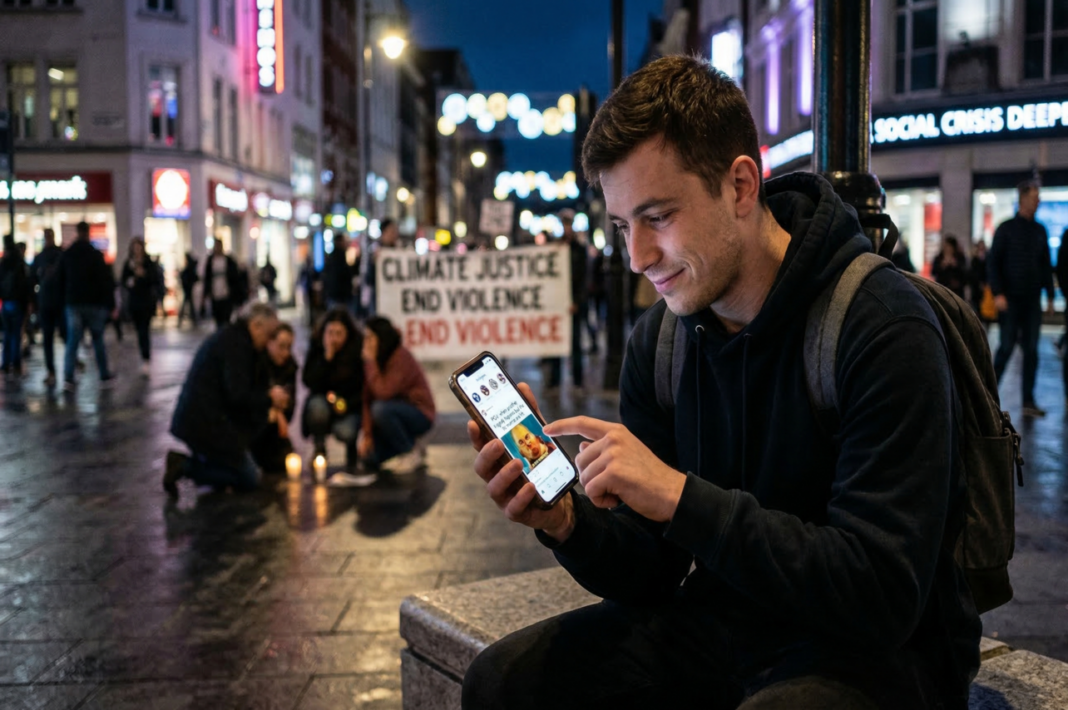
In this digital age, the internet runs on jokes and memes. While memes are often seen as a harmless vehicle of online humor, a growing body of research suggests they play a significant role as a tool that desensitizes and distracts us from social issues. This article discusses the process of desensitization via memes, and its severe consequences for us as a society.
Desensitization and The Media
Desensitization is a psychological process where repeated exposure to a stimulus reduces emotional responsiveness (Shaffer & Lazarus, 1952). In media studies, the phenomenon of desensitization has been extensively documented across apps, games, the news, and of course, memes. For example, in Bushman and Anderson’s (2009) game studies, the participants who played violent video games took significantly longer to help an injured person in a staged emergency compared to those who played non-violent games. They were less likely to notice the emergency and rated it as less serious. This “emotional numbing” shows that media violence does not just stay on the screen; it also affects how we behave in the real world.
Mrug et al. (2015) expanded on this by examining both real-life and media violence. They found that adolescents exposed to high levels of real-life violence showed diminished empathy, and, especially for males, decreased emotional distress when viewing violent scenes. Importantly, they identified a curvilinear relationship where moderate exposure to violence was linked to higher empathy, but excessive exposure led to emotional blunting, suggesting that there is a point after which repeated exposure becomes harmful.
The thing with memes particularly, is that their impact on social media users were underestimated and understudied for a long time compared to other media tools like video games. But it is now possible to argue that memes are actually one of the most effective ways to accelerate desensitization, since they package serious issues in repetitive, humorous formats. Gandhi (2025) provides a powerful example. In 2025, the murder of Saurabh Rajput, whose body was dismembered and stuffed in a blue drum, was quickly turned into a meme. The blue drum became a joke template, with people calling it “men’s biggest fear.” The popular meme essentially stripped the crime of its emotional weight, turning a gruesome case into a spectacle for entertainment. As Gandhi argues, when humor is attached to serious messages, “a cognitive transformation occurs, rendering material that might otherwise be considered grave as whimsical.”
Hate Speech Masked As Humor
Digital and social psychology has already proved that frequent exposure to hate speech leads to desensitization, which in turn increases prejudice against targeted groups (Soral et al., 2017). And when hate speech is delivered through memes, the harm is compounded by humor’s disguising effect. Schmid et al. (2025) analyzed 1,200 far-right memes on Telegram and made a crucial discovery: While extreme far-right narratives on their own received fewer views, and humor on its own also reduced views, combining extreme narratives with humor significantly increased a meme’s reach. This finding shows that humor acts as a “mask” that makes an extremist ideology more palatable to a mainstream audience.
Peters and Allan (2022) conceptualize this as “mimetic weaponization,” the purposeful deployment of memes to attack, undermine, or exclude. Their analysis of Pepe the Frog shows how a harmless cartoon character was transformed into an alt-right hate symbol used to promote white nationalism under the disguise of internet humor. When Donald Trump tweeted an image of himself as Pepe, the symbol was further mainstreamed, demonstrating how memes can bridge fringe communities and politics. The usage of such memes by famous figures adds up even more to the risk of perpetuating prejudice.
Getting Distracted From What Really Matters
Desensitization does not only numb our emotions; it also redirects our attention. When a serious issue becomes “memeified,” it reaches an attention threshold where the public, saturated with humorous versions of the problem, disengages from its substance. The conversation shifts from seeking solutions to sharing jokes. Li et al. (2017) found evidence for this in their longitudinal analysis of tweets about gun violence. While overall negative emotions declined over time, anxiety regarding gun violence actually increased. People became numb to specific tragedies but developed a vague, unfocused unease. Their attention was diverted from concrete policy issues to a generalized anxiety, which is far less likely to inspire civic action.
Social media algorithms amplify this diversion as well. As Gandhi (2025) notes, platforms are designed to maximize engagement through features like infinite scroll and push notifications. Humorous content is highly engaging, so algorithms promote funny memes over thoughtful analysis. The trivialized version of an issue reaches a wider audience than serious discourse, effectively drowning out substantive conversation. Users become trapped in loops, scrolling past tragedy after tragedy without pausing to reflect or act.
Conclusion
In today’s day and age, memes are not just jokes. They are powerful cultural tools that shape how we perceive the world. Through the mechanics of humor and repetition, they can desensitize us to violence, prejudice, and suffering, making the unusual seem ordinary. At the same time, they can divert our attention away from serious issues, replacing critical engagement with passive entertainment. The research is clear, and the findings point to a troubling trend. We must learn to recognize when a meme is more than a joke and choose to look beyond the punchline at the reality it conceals. Only then can we engage meaningfully with issues that truly matter.
References
-
Li, J., Conathan, D. & Hughes, C. (2017). Rethinking emotional desensitization to violence: Methodological and theoretical insights from social media data. Association for Computing Machinery, https://doi.org/10.1145/3097286.3097333
-
Soral, W., Świderska, A., Puchała, D., & Bilewicz, M. (2024). Desensitization to hate speech: Examination using heart rate measurement. Aggressive Behavior, 50, e22118. https://doi.org/10.1002/ab.22118
-
Peters, C., & Allan, S. (2022). Weaponizing Memes: The Journalistic Mediation of Visual Politicization. Digital Journalism, 10(2), 217–229. https://doi.org/10.1080/21670811.2021.1903958
-
Schmid, U. K., Schulze, H., & Drexel, A. (2025). Memes, humor, and the far right’s strategic mainstreaming. Information, Communication & Society, 28(4), 537–556. https://doi.org/10.1080/1369118X.2024.2329610
-
Gandhi, S. (2025). Memification of serious issues: Irony and desensitization in digital culture. The Criterion, 16(6), 1305–1319. https://www.the-criterion.com/V16/n6/2025V16n6018.pdf
-
Bushman, B. J., & Anderson, C. A. (2009). Comfortably numb: Desensitizing effects of violent media on helping others. Psychological Science, 20(3), 273–277. https://doi.org/10.1111/j.1467-9280.2009.02287.x
-
Mrug, S., Madan, A., Cook, E.W., & Wright, R. A. (2015). Emotional and physiological desensitization to real-life and movie violence. J Youth Adolescence, 44, 1092–1108. https://doi.org/10.1007/s10964-014-0202-z
-
Shaffer, G. W., & Lazarus, R. S. (1952). Psychotherapeutic devices. In G. W. Shaffer & R. S. Lazarus, Fundamental concepts in clinical psychology, 315–344. McGraw-Hill Book Company. https://doi.org/10.1037/11047-010