



The wind of Anatolia blows differently. It has swept across the same plains a thousand years ago, just as it does today. It has touched the same stones and carried the same stories carved into the soil. Yet there are certain stones that possess such a profound memory that even the wind seems drawn to them. The Ayran Stone in Taşlıca is one of these. From afar it appears ordinary—just another rock among many. But as you approach, a strange, ancient warmth touches your face, reaching into the most fragile corners of the human heart. A stone can hold only so many stories, and this one tells them in silence. Perhaps the stones that speak the least carry the heaviest truths.
Sometimes the essence of history is not preserved in grand chronicles but in the quiet narratives passed down at the edge of a village fountain or through the trembling voice of an elder. The story of the Ayran Stone is one of the finest inheritances of this oral tradition.
A Miracle In The Hands Of Red Midwife (Kırmızı Ebe)
The tale goes as follows: During his campaign toward the Rum fortress in Başköy, the Seljuk Sultan Alaeddin Keykubad stopped in the village of Taşlıca. It was a time when Anatolia was shaping its identity, when communities found spiritual grounding through the guidance of revered figures. Women mystics played a particularly significant role; they served as pillars both in the home and in the spiritual fabric of society.
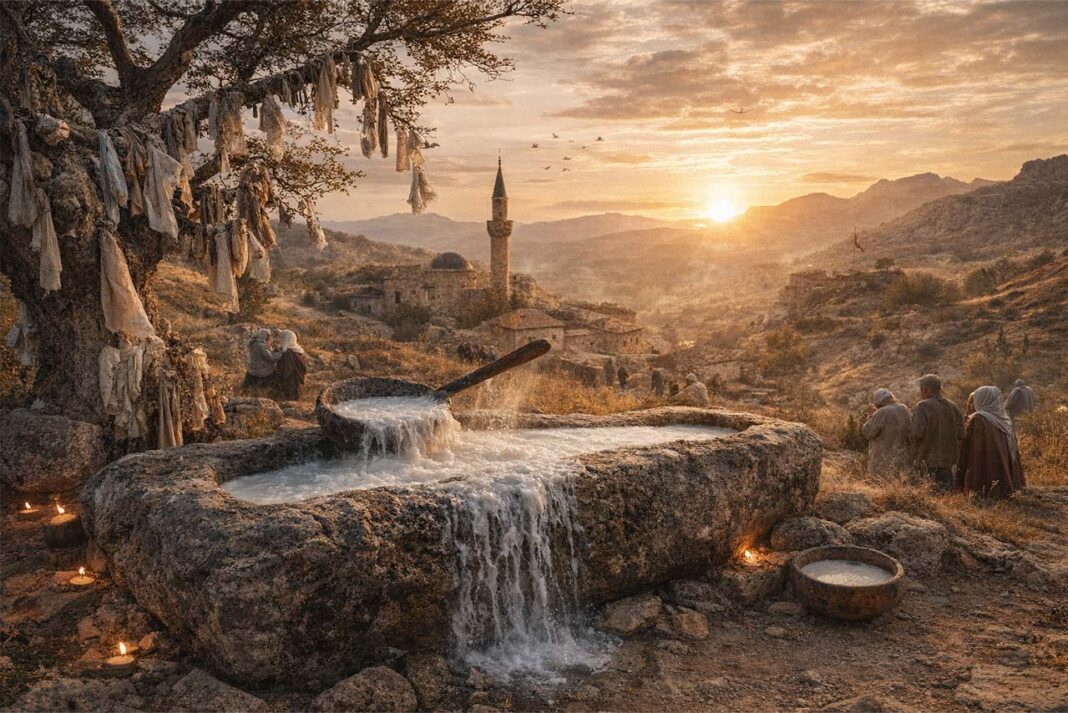
Kırmızı Ebe was one of these pillars. Living with her son Oruç, she was known for her wisdom as much as for her compassion. Upon seeing the soldiers, she opened her door—not merely her home, but her heart. She poured the freshly churned ayran from her churn into the stone trough above the village. And then, according to the legend, a miracle occurred: No matter how much the soldiers drank, the trough continued to fill. The ayran never diminished; the blessing never waned.
Perhaps it was the prayer of a mother sensing the fear in a soldier’s eyes, feeling the weight he carried on his shoulders. Sometimes a mother’s prayer lightens a burden that an entire army cannot bear. Or perhaps it was simply the truth that whatever is touched with genuine goodness tends to multiply.
Their brief exchange still warms the heart, centuries later:
— “Fill your bowls, brave ones.”
— “Fill them, mother.”
— “Drink, my sons.”
— “Mother… it stays full.”
These words are not merely a dialogue but an illustration of how humanity clings to itself in the shadow of war. A mother’s voice folds into the soldier’s voice; fear finds refuge in maternal grace; and grace rests gently upon the weary shoulder of a soldier.
The Unending Ayran: The Hidden Stream Of The Human Spirit
Psychology teaches us that in moments of uncertainty, the human mind first reaches for meaning. Anxiety is an invisible hand that trembles within us; safety is the warm touch that steadies it. Thus, the offering of ayran to soldiers was far more than quenching thirst.
Perhaps the stone whispered something into their hearts:
A sanctuary.
A strengthening.
A quiet assurance: “You are not alone.”
The never-emptying ayran became a metaphor for inexhaustible hope—the inner reservoir that empties yet fills again, a source of resilience long before the modern world named it. When the soldiers drank from that trough, what they found was something universal: the human heart expanding when touched by another.
Today, what we term psychological resilience was, in the language of that era, a simple bowl of ayran.
The Enduring Imprint Of An Ancient Ritual
The Ayran Stone is still visited today. Visitors tie pieces of cloth to the modest hawthorn tree beside it, offering wishes, leaving burdens behind. A hope is voiced to the earth; a heaviness finds release. This enduring tradition reflects a simple truth:
Centuries have passed. The world has changed. Cities grew; distances shrank.
But the most fundamental human need remained the same.
Those who touch the Ayran Stone—perhaps without even realizing it—seek to replenish a part of themselves that has run dry. They leave a quiet prayer: “Let my path open. Let my heart find ease.”
This is, in essence, the outward expression of humanity’s timeless search for meaning.
The shrine, restored in 2001, remains a resting point in the village’s collective memory—part sanctuary, part time bridge. Few leave without visiting the Gelin Kayası, offering a prayer at the tomb, or placing a hand upon the Ayran Stone. For some places are not mere stone; they hold the grief, faith, and endurance of a community.
The Whisper That Crosses Centuries
Perhaps the most moving aspect of this story is that it does not simply recount a miracle—
it reminds us what nourishes the human spirit:
Compassion,
A sense of belonging,
Solidarity,
And hope that grows through sharing.
Perhaps the Ayran Stone’s true secret is not that it never empties, but that it never lets us forget something essential:
“A homeland is shaped by human words and human touch.”
And the stone has whispered the same message for centuries:
“Let your heart be filled;
let your fears flow out,
and let hope rise within you.”