


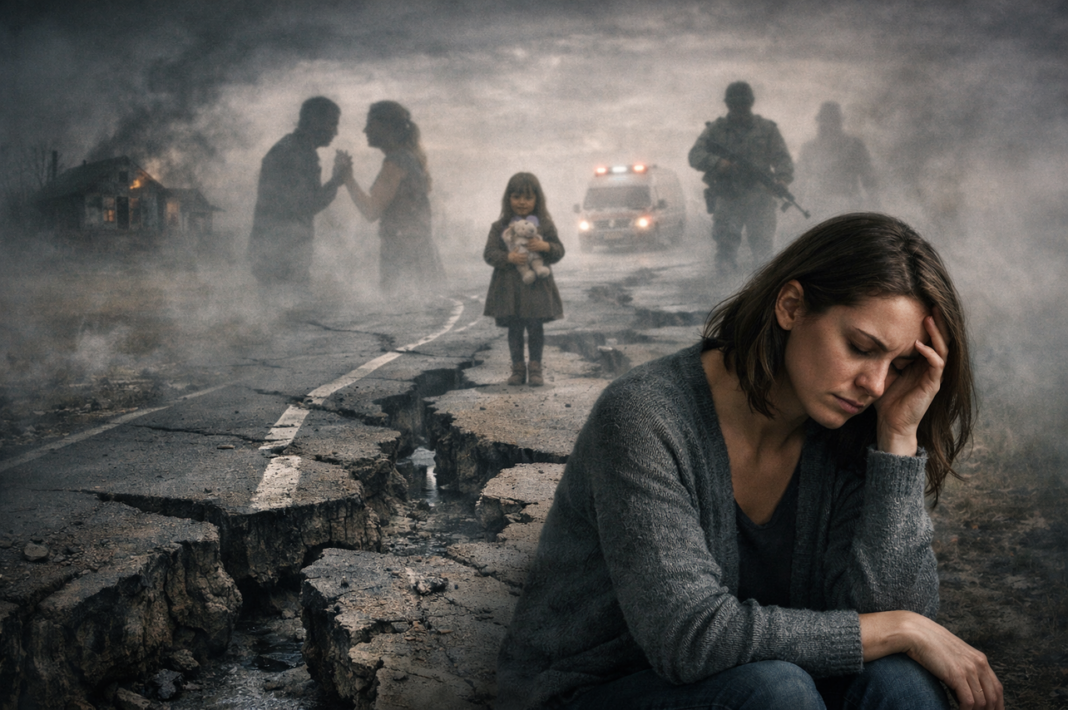

Trauma is often searched for in the wrong place. People tend to measure trauma by the magnitude of what happened: a major loss, severe neglect, violence, or a sudden threat. Yet two individuals may be exposed to the same event, and only one becomes traumatised. This is because trauma is not defined by the event itself, but by the imprint it leaves within the person’s inner world. The incident in the external world has ended; however, the process that begins internally may never reach completion.
The Crucial Difference Between What Happened and What It Meant
Experiences can be described at an objective level: a separation occurred, a boundary was violated, or a danger was survived. But the human mind does not register experiences solely by asking “What happened?”. The determining question is “What does this mean for me?”. When an event threatens a person’s sense of safety, self-worth, or existential integrity, it ceases to be an ordinary experience. As the layer of meaning deepens, the experience becomes far more than a mental memory.
Emotional Load and the Nervous System’s Alarm
When threat is perceived, the body takes over. The autonomic nervous system initiates automatic survival responses to ensure continued existence. Fighting, fleeing, or completely freezing are not conscious choices; they are biological reflexes. Their purpose is to protect the organism from danger and restore balance. Under normal conditions, this cycle completes itself: the threat passes, the body relaxes, and the system reorganises.
The problem begins when this cycle cannot be completed.
Incomplete Responses and Moments Left Unfinished
If a person cannot defend themselves, escape, or fully express their bodily response at the moment of threat, the mobilised energy cannot be discharged. This energy is held within the body. From the outside, the event appears to be over; yet for the nervous system, the process is still ongoing. Trauma emerges precisely here: when an event that has ended externally cannot be completed emotionally and physically.
For this reason, trauma does not function like a memory that belongs to the past. It does not settle on a timeline. It seeps into the present, becomes triggered, and is re-experienced.
The Body Does Not Forget the Past
Traumatic experiences are not limited to mental images. A racing heart, muscular tension, constricted breathing, or sudden numbness are all bodily responses to memory. Even when the mind says “we are safe now”, the body may not believe it. This is because the body operates not through words, but through sensory records. For this reason, traumatic memory cannot easily be soothed by logic.
This is why the body remembers trauma even when the mind understands that the danger has passed.
The Illusion That “It is Still Happening”
Individuals who have experienced trauma often say, “I know it’s over, but it feels as if it’s still happening.” This is not an exaggeration; it is the lived reality of the nervous system regulation process. The bodily system continues to interpret an unfinished defensive response as an ongoing threat. As a result, although trauma occurred in the past, it belongs to the present in experiential terms.
Healing: Regulation Before Meaning
Healing from trauma does not occur through repeatedly recounting the event, but through allowing the body to complete the response that was left unfinished. Within a safe context, the nervous system can reorganise, trapped energy can be released, and the body can register that “it is over now”. Only then can the process of meaning-making become truly transformative.
Healing is not about forgetting. Rather, it is about being able to remember what happened without it constituting a threat.
Conclusion: Trauma is not a Weakness, but a Biological Response
Trauma does not occur because a person is incapable of coping, but because the resources available at that moment were insufficient to do so. This is not a pathology, but a natural outcome of the survival system. Understanding trauma allows individuals to relinquish self-blame. The essential question is not “Why did I become like this?”, but rather “How was my body trying to protect me?”.
Recognising trauma healing as a biological and relational process opens the door to compassion, safety, and recovery.
References
Levine, P. A. (2010). In an Unspoken Voice: How the Body Releases Trauma and Restores Goodness. North Atlantic Books.
van der Kolk, B. (2014). The Body Keeps the Score: Brain, Mind, and Body in the Healing of Trauma. Viking.
Porges, S. W. (2011). The Polyvagal Theory: Neurophysiological Foundations of Emotions, Attachment, Communication, and Self-Regulation. W. W. Norton & Company.
Herman, J. L. (1992). Trauma and Recovery. Basic Books.