


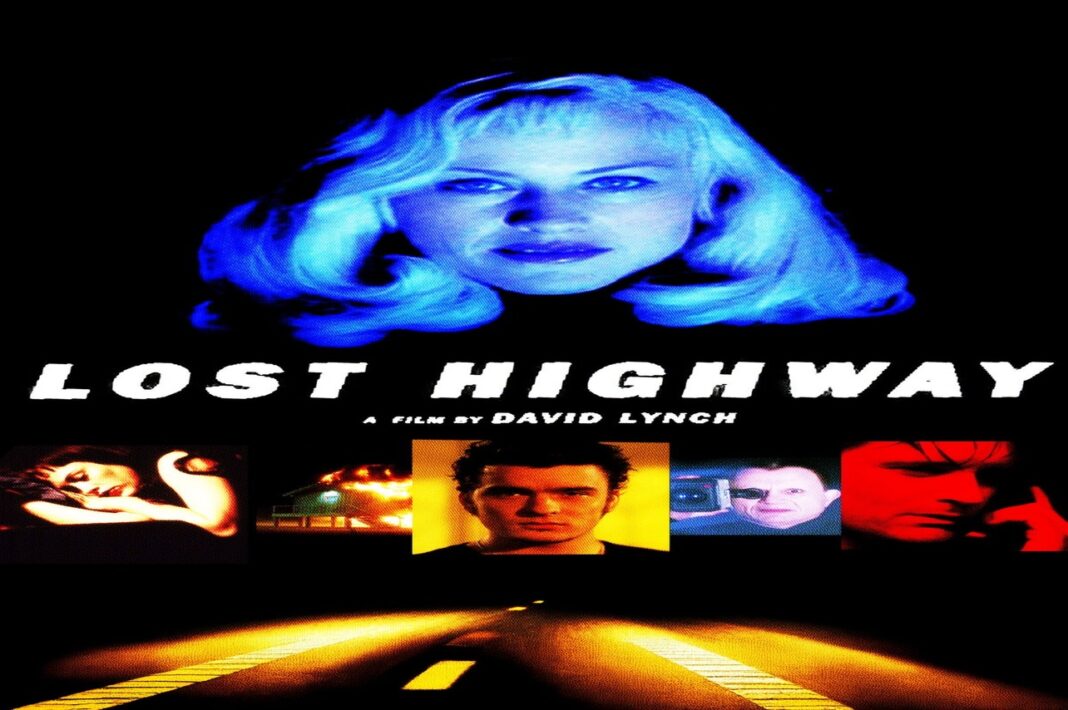

According to Jacques Lacan, the subject is not a unified or coherent entity but a structurally split being. A fundamental lack is inscribed at the core of subjectivity. In David Lynch’s Lost Highway, Fred Madison’s identity is likewise presented as fragmented. Throughout the film, Fred appears alternately as a seemingly ordinary husband (Fred), a young mechanic (Pete), and a silent killer (the Mystery Man). This multiplicity of identities corresponds to Lacan’s concept of the barred subject (le sujet barré). It becomes apparent that the Mystery Man represents Fred’s repressed unconscious, and by the end of the film, Fred, Pete, and the Mystery Man are revealed as different manifestations of the same subject. In this way, Lost Highway concretizes Lacan’s model of the split subject.
The Imaginary, The Symbolic, and The Real
In Lacan’s theory of subjectivity, experience is structured through three orders: the Imaginary, the Symbolic, and the Real. These orders are interwoven and together constitute the subject’s psychic reality. In Lost Highway, the tension and disjunction between these orders are particularly evident. The first part of the film corresponds to Fred’s existence within the Symbolic order, shaped by everyday discourse and social relations. Fred leads a mechanized life and appears relatively “adapted” to the Symbolic.
In the middle section of the film, however, Fred seems to inhabit the Imaginary order, unable to fully enter or sustain the Symbolic. Through his transformation into Pete, he embodies an image of excessive sexual potency that compensates for the loss associated with castration, thus externalizing his internal lack. In the final part of the film, the Real comes into play. A traumatic reality emerges that lies beyond the Symbolic and resists articulation. The Real is that which absolutely resists symbolization. In the film, this Real manifests in moments related to Fred’s confrontation with the murder of his wife and in the transformations that occur in the prison scenes. The interventions of the Mystery Man disrupt Fred’s symbolic coordinates and open a passage toward the Real. In this sense, the film enables the viewer to perceive Lacan’s tripartite distinction between the Imaginary, the Symbolic, and the Real simultaneously.
Repetition and Cyclical Narrative
Repetition occupies a central place in psychoanalytic theory. What is repressed returns in a cyclical manner. As Slavoj Žižek points out, the cyclical narrative of Lost Highway reveals the circular structure of the psychoanalytic process. Throughout the film, phrases such as “Dick Laurent is dead” recur insistently. This key sentence initially creates a sense of tragic anticipation, but as the film progresses, it repeatedly returns, destabilizing the subject’s perception of reality. According to Žižek, this recurring signifier constitutes a disturbing message of the Real that prevents symbolic closure.
In terms of temporal structure, Lost Highway resembles a Möbius strip, a surface with only one side. Even as the narrative approaches an ending, it folds back onto its beginning. For example, the film completes its loop by moving from Pete’s world back to Fred’s prison cell. This cyclical structure emphasizes the operation of repetition and points toward repetition compulsion.
Jouissance and Objects Of Desire
Lacan’s concept ofjouissance refers to an excessive form of enjoyment that lies beyond the pleasure principle and intertwines pleasure with pain. In Lost Highway, the Renée/Alice duality is constructed as an impossible object of desire for Fred. According to Žižek, Renée functions as the impossible object of Fred’s fantasy and enjoyment: Fred is obsessively fixated on the idea that she has a “pornographic past,” and this opacity marks a point of jouissance that resists representation. Renée/Alice thus functions as objet petit a, the cause of Fred’s desire. She appears throughout the film as the central object of desire but remains fundamentally unattainable. Fred’s attempts to fill this lack generate endlessly repeating fantasies. When Fred, in the guise of Pete, attempts to unite with Alice, the surreal mirror imagery ultimately collapses. Alice’s statement, “You’ll never have me,” articulates the structural impossibility of satisfying desire. Consequently, the film’s sexualized and violent scenes signal an excess of jouissance. Fred’s excessive desire is prohibited by the Symbolic order and persists as a void within the Real.
Lynch’s frequent use of videotapes and cameras further points to the tension between fantasy and reality. Fred’s statement, “I like to remember things my own way,” reveals his fear of confronting reality and his reliance on fantasy as a defensive structure. The dark videotapes and fragmented images contradict the subjective reality that Fred constructs by distorting his memories. In particular, scenes involving photography and video disrupt fantasy at moments when Fred shifts into Pete’s psychic position, functioning as signs of the Real. Thus, Lost Highway articulates Lacan’s concepts of desire, lack, and jouissance through symbolic representations. Fred’s attempts to restore a lost unity—whether as a husband with Renée or as Pete with Alice—never achieve fulfillment. Each cycle is inevitably doomed to collapse.
Identity Shifts and The Perpetrator/Victim Dichotomy
The film presents an extreme instance of the subject’s internal division: Fred experiences himself simultaneously as both perpetrator and victim. The Mystery Man represents the visible emergence of Fred’s unconscious. He functions as both witness to and avenger of Fred’s crime. At the same time, Fred ultimately confronts symbolic judgment as the primary suspect in the murder. Renée/Alice appears in two different bodies as both Fred’s object of desire and the sign of his insufficiency; in Lacanian terms, they function as his objet petit a.
Fred’s position as both victim and killer demonstrates that the subject is responsible both for his actions and for the suffering that results from them. The film concludes within a closed loop in which catharsis is impossible. As Fred is once again summoned into the Symbolic order, the symbolic father figure (Dick Laurent) is declared “dead,” and the subject returns to his initial state of paranoid loss.
Conclusion
Lost Highway successfully brings together the fragmentation of the subject, narrative repetition, the lack inherent in objects of desire, and the confrontation with a Real that exceeds pleasure. In doing so, the film visualizes Lacan’s theoretical framework. Within Lynch’s structural–psychoanalytic universe, the subject continuously attempts to reconstruct itself within the triad of the Symbolic, the Imaginary, and the Real, yet never achieves a stable equilibrium. Lost Highway thus stands as a dark projection of this perpetual struggle.