


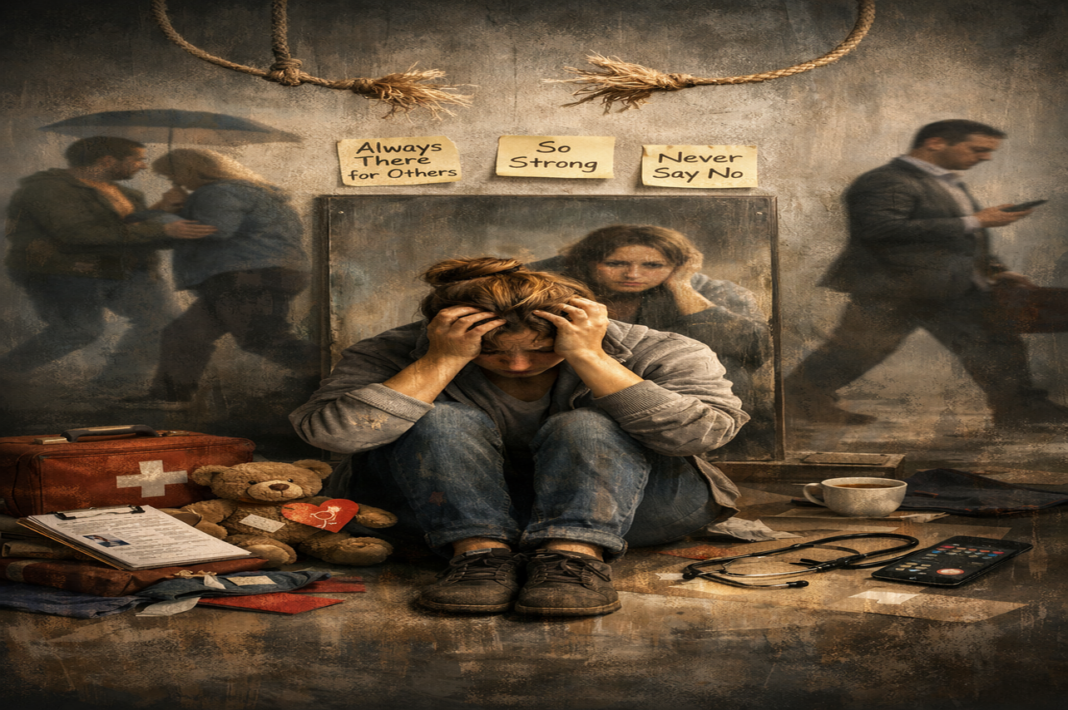

Some people cannot stop showing “pure compassion” to others without expecting anything in return, often even feeling that this diminishes their own value. They are decisive in helping you through difficult times, even if you haven’t asked for help. Saying no is not in their nature. They cannot maintain a balance of giving and receiving in relationships; this often results in disappointment and resentment. After experiencing disappointment, only one sentence escapes their lips: “If I were them, I wouldn’t have treated them like that.”
These individuals have difficulty setting boundaries. This attitude is not only directed towards loved ones; it continues even more towards people they don’t know, don’t love, and will never see as anything special. They pay the price for their compassion by being deeply hurt. Because time doesn’t carry such a safe path to healing most of the people they encounter. This person’s capacity is quite high; they leap over the situation like a warrior. Having become accustomed to solving problems on their own, they had come to believe that it was explainable how money-hungry individuals could solve them, and after a while, they convinced the people around them of this as well.
The Learned Strategy Of Childhood
However, being a super helper is often not a character trait, but a learned conformity strategy from an early age. When the way to be loved, accepted, or seen in childhood is to “be good,” “not cause problems,” and “manage everyone,” helping ceases to be a choice and becomes an obligation. Even recognizing one’s own contribution is made to feel like selfishness. While working with each other, these individuals inwardly whisper this sentence: “I also hide the fact that someone should come to me.”
Super helpers are often labeled as “strong” by those around them. So much so that the possibility that they too can get tired, break, give up, or want something doesn’t occur to anyone. Because their help seems to have always been there, not when it’s requested, but when it’s given. Being strong, after a certain point, is no longer a compliment, but a transformation into silent loneliness. A person cannot be protected as much as they can be strong. For these individuals, saying “no” is not just a word; rejection is equivalent to not being loved or to intense guilt. They think that by saying no, they will leave someone incomplete, that they will be seen as bad when someone needs them.
The Cost Of Neglecting Self-Compassion
Expert psychologists Jess Baker and Rod Vincent use “super-helper” terminals to calculate individuals who have the means to help while being unable to meet their own needs. In their book, they state: “We have treated others better than we have treated ourselves. In fact, if we had treated them as we have, they would rightfully have stopped seeing us. Yet we deserve the compassionate love we offer ourselves. I’m talking about being kind to yourself.”
This quote reveals how super-helpers unconsciously withhold the improvements they offer from themselves. The self-criticism of super-helpers usually operates on two levels: They offer blame for not being helpful enough, or they become tired at the end of their selfless work, realize their feelings of hurt and exploitation, and still blame others. However, there is no fault or blame here. There are only the single pieces of the problem’s direction. Self-compassion is the emotion most alien to super-helpers. When they turn the comforting words they say to others towards themselves, a harsh voice rises within them: “You’re exaggerating,” “You should have endured it,” “Others are in a much harder situation.”
The Physical Language Of Burnout
Yet you don’t differentiate; it either exists or it doesn’t. The compassion we offer to others is not healing, but exclusionary, unless it also reaches us. Remaining in the role of super-helper for too long creates not only emotional but also physical exhaustion. Burnout, chronic fatigue, unexplained pain, frequent illness… The body begins to express the unspoken “I can’t do it anymore” in its own language. Because as the soul falls silent, the body speaks.
When one gives up on oneself to the point of being unable to ask “why?” to the other person, one finds no one else to blame but the reflection in the mirror. Perhaps being a super-helper isn’t the purest form of kindness; it’s the point where kindness forgets itself. And perhaps healing begins to turn inward for the first time, completely abandoning the pursuit of others. This is because it only truly increases when it exists within boundaries. From a psychological perspective, the super-helpful behavior often becomes central to a person’s way of relating. These individuals feel more secure, more valued, and more stable in relationships when they are helping others. Helping is not only an act done for the sake of others; it also becomes a tool used to avoid abandonment, to be loved, and to remain in relationships. Therefore, allowing or restricting helping behavior creates intense anxiety. Clinical observations show that super-helpers experience deep disappointment when they don’t receive as much help as they offer.