



Abstract
Love is a complex emotion that has fascinated humans throughout history. Recent research in psychology and neuroscience has revealed that love involves biological, cognitive, and behavioral processes. This review focuses on passionate love, examining its definition, neural correlates, and physiological effects. Additionally, similarities and differences among various types of love are discussed. Findings suggest that love is not a simple emotion but a multi-layered phenomenon involving neurobiological, psychological, and social components.
Introduction
Love has long been one of the most complex and intriguing emotions in human history. Research in psychology and neuroscience shows that love is not merely an emotional experience but emerges from the interaction of biological, cognitive, and behavioral processes. This review specifically focuses on passionate love, aiming to explore its definition, neural correlates, and physiological effects. Furthermore, similarities and differences between different types of love are evaluated.
What Is Love?
Love has many definitions. In this study, love is considered an emotional state encompassing chemical, cognitive, rewarding, and goal-directed behavioral components. Passionate love is defined as “a state characterized by an intense desire to unite with another person” (Hatfield & Rapson, 1987). It is also considered a motivational and goal-directed mental state (Hatfield & Sprecher, 1986; Hatfield & Rapson, 2009). In other words, passionate love involves strongly desiring someone, wanting to merge with them, and feeling a powerful attachment. Recently, psychologists have debated whether passionate love is a basic emotion or a complex emotion (Ekman & Cordaro, 2011; Russell et al., 2011). Ekman does not consider love a basic emotion because it lacks the distinctive facial expressions that are characteristic of basic emotions (Sabini & Silver, 2005). Social neuroscience research, however, demonstrates that love is associated with specific brain networks that govern complex cognitive processes. These findings support the notion that love is a complex emotion. Based on this, passionate love can be defined as: “A rewarding emotional state that involves basic and complex emotions, goal-directed motivations, and cognition” (Ortigue et al., 2010).
Neural Correlates Of Love (fmri Findings)
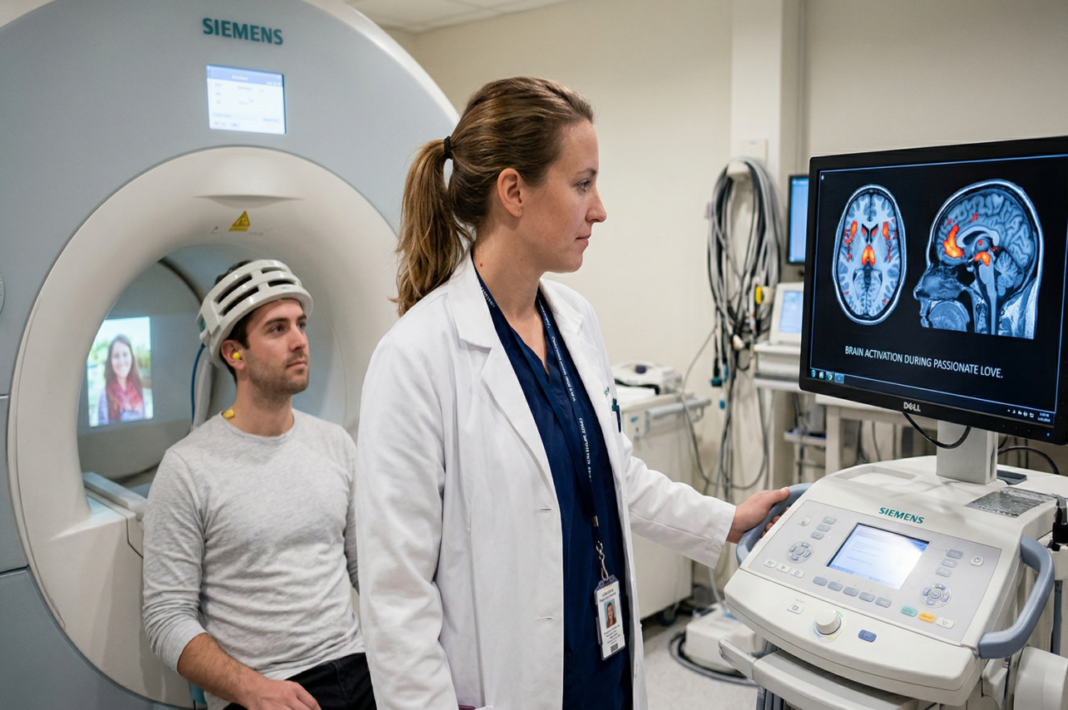
The first functional magnetic resonance imaging (fMRI) study investigating brain regions associated with passionate love was conducted by Bartels and Zeki (2000). The researchers recruited participants who were “deeply and intensely in love” from London and internationally. Out of 70 applicants from 11 countries, 17 participants aged 21–37 were selected. Participants were asked to describe their feelings of love and complete the Passionate Love Scale. During fMRI scanning, participants were shown color photographs of their romantic partners alternating with photos of friends. Brain images were compared to determine which areas were more or less active when thinking about their partner. This study provided the first scientific evidence of brain regions activated during passionate love. Findings indicate that passionate love involves multiple brain networks, not a single region:
-
Reward and motivation systems: Brain reward centers are activated during love, increasing dopamine release. This makes love rewarding, which is why falling in love resembles addiction.
-
Cognitive and social processes: Brain regions managing complex mental processes, such as understanding the partner, focusing on them, and empathizing, are activated. Additionally, prefrontal cortex activity decreases in individuals in love (Tarlacı, 2012), which may lead to riskier or illogical decisions and prioritization of emotion over reason.
Physiological Effects Of Love
Love has not only psychological but also physiological effects. These include decreased appetite, increased heart rate, sweating, trembling, changes in bowel movements, increased stomach acid, and faster swallowing. Historically, these reactions contributed to the belief that love is felt in the heart (Tarlacı, 2012). These effects are largely due to the neurotransmitter norepinephrine (NE), which increases heart rate, blood pressure, and arousal. Consequently, individuals interpret these physical signs as “my heart is racing, I must be in love.”
Challenges Of Unrequited Love
Unrequited love is difficult because the brain’s reward system expects reciprocation, but the anticipated reward is absent. Dopamine remains active, leading to frustration. This may increase obsessive thoughts and contribute to depressive symptoms. In some cases, the brain processes unreciprocated love similarly to grief.
Sex Differences In Love
fMRI studies reveal sex differences in love experiences. Men show greater activity in the right dorsal insula and visual processing regions, while women exhibit higher activity in attention, memory, and emotional processing areas (Marazziti et al., 2010). This suggests that men are more visually and physically stimulated, whereas women focus more on emotional and cognitive aspects of love.
Passionate Love And Other Types Of Love
-
Friendship love: A calm, secure, and long-term attachment. Oxytocin and vasopressin are primary hormones involved.
-
Unconditional love: For example, love toward individuals with special needs, involving both reward and emotional brain areas.
-
Maternal love: The mother–child bond activates specific brain regions, some of which overlap with romantic love (Cacioppo et al., 2012).
Conclusion
Passionate love activates the brain’s reward system, cognitive processes, and social functions simultaneously, reflecting a complex, multi-layered phenomenon. Research demonstrates that love is not a simple emotion but involves neurobiological, psychological, and social components. Different types of love activate different brain regions, yet some mechanisms are shared. Understanding love has significant implications for psychology, mental health, and relationship therapy. While science has advanced in explaining love’s chemical, neurological, and behavioral aspects, many elements of love remain unresolved. As John Keats expressed, a part of love always remains “mysterious and enchanting” (Tarlacı, 2012).
References
Cacioppo, S., Bianchi-Demicheli, F., Hatfield, E., & Rapson, R. L. (2012). Social neuroscience of love. Clinical Neuropsychiatry, 9(1), 3–13.
Ekman, P., & Cordaro, D. (2011). What is meant by calling emotions basic. Emotion Review, 3, 364–370. Hatfield, E., & Sprecher, S. (1986).
Measuring passionate love in intimate relationships. Journal of Adolescence, 9, 383–410. Hatfield, E., & Rapson, R. L. (1987).
Passionate love/sexual desire: Can the same paradigm explain both? Archives of Sexual Behavior, 16, 259–278.
Marazziti, D., Consoli, G., Albanese, F., Laquidara, E., Baroni, S., & Catena Dell’Osso, M. (2010). Romantic attachment and subtypes/dimensions of jealousy. Clinical Practice & Epidemiology in Mental Health, 8(6), 53–58.
Ortigue, S., Bianchi-Demicheli, F., Patel, N., Frum, C., & Lewis, J. (2010). Neuroimaging of love: fMRI meta-analysis evidence towards new perspectives in sexual medicine. Journal of Sexual Medicine, 7, 3541–3552.
Tarlacı, S. (2012). The brain in love: Has neuroscience stolen the secret of love? NeuroQuantology, 10(4), 744–753.