


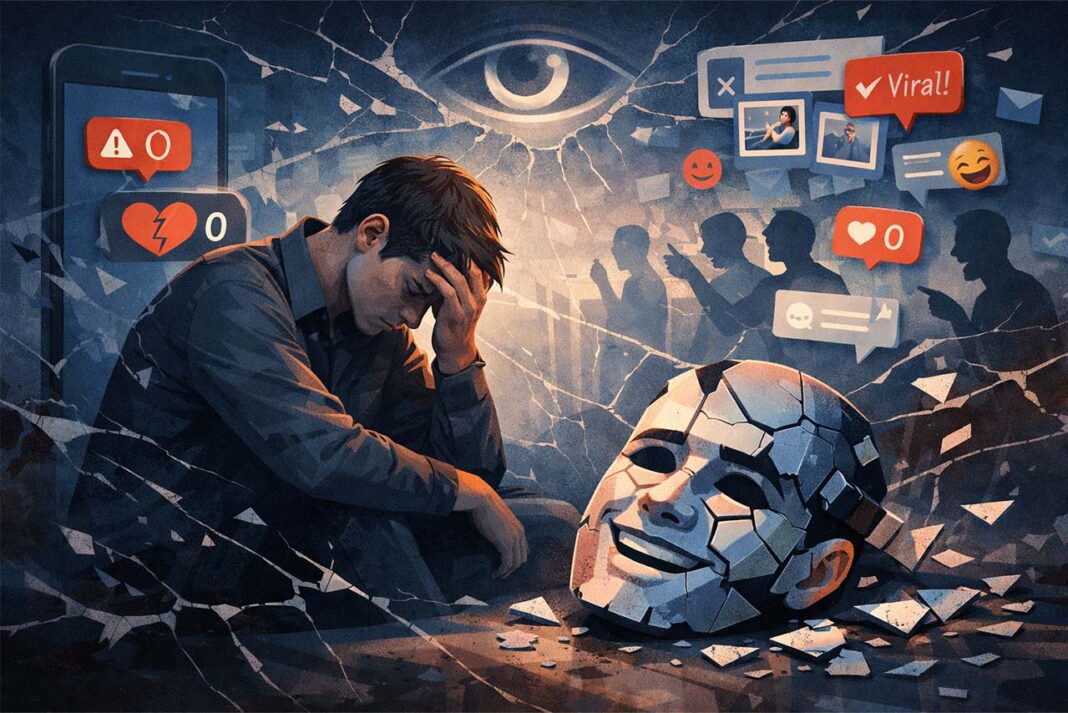

In today’s rapidly digitalizing world, individuals construct and maintain not only their social relationships but also their identities within online spaces. Social media profiles, shared content, messages, and digital interactions have become central components of how individuals present themselves to others. Along with this transformation, the experience of shame has acquired a new context. Beyond the shame traditionally encountered in face-to-face interpersonal relationships, a form of shame specific to digital environments has emerged.
Digital shame can be defined as a psychological experience characterized by intense feelings of worthlessness, inadequacy, and social withdrawal in response to a perceived threat to one’s online identity.
In psychological literature, shame has long been conceptualized as a self-conscious emotion directed toward the self. According to Tangney and Dearing (2002), shame is associated not with evaluating one’s behavior as wrong, but with perceiving the self as flawed, defective, or unworthy. Within digital contexts, this self-focused evaluation becomes even more pronounced. Online environments are spaces in which individuals constantly feel exposed to the evaluations of others. The reactions received to a post, an unanswered message, or the unexpected circulation of content can directly affect an individual’s sense of self.
For example, when a photograph shared on social media does not receive the anticipated level of engagement, this experience is often not merely about the number of “likes.” For some individuals, it may translate into self-referential interpretations such as “I am not good enough” or “People find me insignificant.” This is where the core mechanism underlying digital shame becomes apparent: it is not the event itself, but the identity-related meaning attributed to the event that determines the emotional impact.
The Structural Fragility Of Online Identity
The fragility of online identity largely stems from the structural characteristics of digital environments. As articulated in Goffman’s (1959) theory of self-presentation, individuals perform certain roles in social life in order to create desired impressions on others. Digital platforms transform this stage into one that is continuous, recorded, and accessible to a vast and often undefined audience.
While this may increase individuals’ perceived control over their self-presentation, it simultaneously intensifies shame when that control is perceived as lost. An accidentally shared message or an inappropriate comment may be experienced as an irreversible “loss of reputation” within the individual’s internal narrative.
One of the most distinctive features separating digital shame from traditional shame experiences is its sense of permanence and uncertainty. While moments of shame in face-to-face interactions often diminish over time, a mistake made in a digital context may remain psychologically vivid for an extended period. Even if the content is deleted, questions such as “Who saw it?”, “Did someone save it?”, or “Are people talking about me?” often remain unanswered. This uncertainty leads to the repetitive mental re-experiencing of shame.
Research by Fox and Moreland (2015) demonstrates that feelings of loss of control in social media environments are significantly associated with psychological stress.
Cognitive And Emotional Mechanisms Of Digital Shame
Cognitive distortions play a central role in this process. Individuals experiencing digital shame frequently exhibit patterns such as mind reading (“Everyone is making fun of me”), catastrophizing (“This mistake ruined everything”), and overgeneralization (“I always embarrass myself”). Leary’s (2007) sociometer theory suggests that when individuals perceive a risk of negative evaluation by others, their sense of self-worth can rapidly decline. Because digital environments continuously activate this perception, shame becomes more easily triggered.
Digital shame manifests not only cognitively, but also through bodily and behavioral responses. When a shame-inducing digital experience is recalled, individuals may exhibit lowered shoulders, downward gaze, blushing, or withdrawal. At the behavioral level, individuals may disengage entirely from social media, excessively monitor their online activity, or choose to become invisible in digital spaces.
Although these avoidance behaviors may provide short-term relief, they tend to prevent the processing of shame in the long term, thereby increasing its persistence. Tangney and Tracy (2012) emphasize the strong association between shame and avoidance and withdrawal behaviors.
Clinical Perspectives On Working With Digital Shame
From a clinical perspective, one of the most critical steps in working with digital shame is legitimizing and making sense of the experience. Clients often minimize their digital experiences when describing them, reflecting the inherently concealing nature of shame. Emphasizing within the therapeutic context that digital shame is a common and understandable experience helps reduce feelings of isolation.
Furthermore, clarifying the boundaries between online identity and the core self serves as an important protective factor, preventing shame from spreading across the entire sense of identity.
Conclusion
In conclusion, digital shame is an increasingly visible phenomenon in contemporary psychology, closely linked to the fragile structure of online identity. Pressures of visibility, perceived permanence, and ambiguous social evaluation amplify the intensity of this emotion. However, digital shame should not be understood as a fixed characteristic of the individual’s identity. Rather, it is a contextual and modifiable psychological experience.
The primary aim of clinical work is to support individuals in maintaining their sense of self-worth in digital spaces without reducing it to isolated online experiences.
References
Tangney, J. P., & Dearing, R. L. (1995). Shame and guilt. Annual Review Of Psychology, 46, 125–153. https://doi.org/10.1146/annurev.ps.46.020195.001013
Tangney, J. P., & Dearing, R. L. (2002). Shame and guilt. Guilford Press.
Tangney, J. P., & Tracy, J. L. (2012). Self-conscious emotions. In M. R. Leary & J. P. Tangney (Eds.), Handbook of self and identity (2nd ed.). https://doi.org/10.4324/9780203838782
Leary, M. R. (2007). Motivational and emotional aspects of the self. Annual Review Of Psychology, 58, 317–344. https://doi.org/10.1146/annurev.psych.58.110405.085658
Fox, J., & Moreland, J. J. (2015). The dark side of social networking sites: An exploration of the relational and psychological stressors associated with Facebook use. Computers In Human Behavior, 45, 168–176. https://doi.org/10.1016/j.chb.2014.11.083