


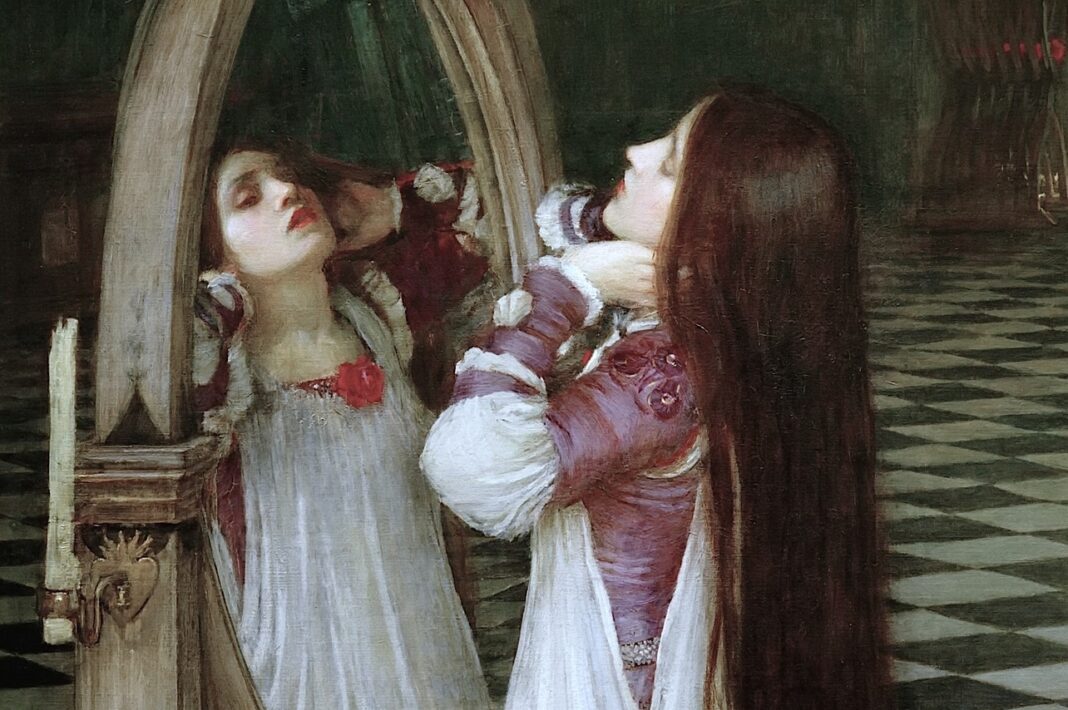

You know that woman everyone envies from afar. She is always impeccably groomed, meticulous in her work, indispensable in her social circle, boundless in her altruism, and masterful at managing every crisis… Yet, when the crowds disperse and she closes the door behind her, behind that shimmering reflection in the mirror remains a silent, deep, and insatiable void.
When most of us hear the word “narcissism,” we picture arrogant figures captivated by their own reflection, believing the world revolves around them. However, Bärbel Wardetzki, through the concept of “Female Narcissism,” reveals a much sadder and more hidden side of the coin. This is not about massive self-confidence; on the contrary, it is a desperate attempt to repair a profound “sense of worthlessness” rooted in childhood through external success, beauty, or “goodness.”
Life On A Seesaw: All Or Nothing
At the heart of female narcissism lies what Wardetzki defines as the Narcissistic Splitting model. This mechanism functions exactly like a seesaw: on one end are grandiose fantasies (I can do anything, I am the most special), and on the other are deep feelings of inferiority (I am worth nothing, I am a nobody). For these women, there is no middle ground—no state of being “ordinary yet valuable.”
They are either at the very top of the seesaw feeling magnificent, or they crash to the bottom into a pit of worthlessness at the slightest criticism. A successful presentation or a compliment might make you feel like the most chosen person on earth one day; yet, a delayed text from a friend or a minor critique can slam you back down the next. This sharp oscillation forces the woman into a never-ending performance just to avoid falling into that “void.” Resting is not a luxury—it is a terrifying threat. The moment the performance stops, the dark side of the seesaw takes over, and the suppressed whisper of “I am inadequate” begins to fill the room.
A Masked Childhood
Why is this seesaw built in the first place? Wardetzki leads us back to the Emotional Mirroring a parent provides to their child. In healthy development, a mother should be a mirror that validates the child’s emotions as they are. However, in a narcissistic family structure, when the child looks into that mirror, they see the expectations and needs of the parents instead of their own reality.
This is defined as the “Representation of Performance, Prestige, and Success.” The child becomes a “project,” tasked with achieving the goals the parents couldn’t reach or “representing” them to the outside world. A girl growing up in such a climate develops an emotional survival strategy: “To be seen by my mother (and thus the world), I must be who she wants me to be.” Under this pressure, the child throws her real needs, anger, and disappointments into a deep well, replacing them with a “compliant and successful” mask applauded by family and society. In Wardetzki’s words, this child must fit someone else’s picture. But that well never closes; it only grows deeper with everything thrown inside.
The Body As A Battlefield
Wardetzki pays special attention to the physical manifestations of female narcissism. Today’s thinness ideals and imposed beauty standards cause women to index their self-worth solely to their outward appearance. At this point, the body is no longer a peaceful “home” for the individual; it is an object that must be constantly controlled, shaped, and perfected.
In her book Mothers, Daughters, and Body Image, Hillary L. McBride points out a similar issue: the way mothers and society approach their bodies is passed down as an inheritance. The body is no longer a sanctuary to live in, but a “project” that needs constant repair. For many narcissistic women, dieting, excessive exercise, or an endless drive for success act as shields hiding deep-seated insecurity. This Self-Objectification—where they relate to their bodies only through “how they look”—causes them to observe their bodies from the outside like a stranger, ignoring real signals such as hunger, fatigue, or sadness.
Behind this performance lies a tragic knot: Thinking that if one is not admired, one is not loved. The woman feels valuable only when she produces, shines, or looks physically flawless. This “tragic entanglement of admiration and love” drives her to work and be perfect without pause; for the moment she stops shining, she finds it difficult to even tolerate her own existence. When the applause stops or the lights go out, she is terrified of being alone with herself.
We Can’t Be Together, But We Can’t Be Apart: The Magnet Of Familiar Pain
The most concrete reflection of female narcissism acts like a magnet in interpersonal relationships. Unlike male narcissism, female narcissism often exists under a mask of “adaptation and self-sacrifice” rather than outward aggression. This connects strongly to the theme of “Women Who Love Too Much”: these women attract partners who are emotionally unavailable, grandiose, or who make them feel worthless.
Why? Because it is a familiar pain. The girl who struggled to gain her parents’ approval carries that same “battle for validation” into her adult relationships. The partner’s arrogance feeds the woman’s inner worthlessness, while the woman’s sacrifice and quest for perfection feed the partner’s narcissism. It is an endless dance where both parties rub salt in each other’s wounds.
Within this dance lies a jarring paradox: “We can’t be together, but we can’t be apart.” When the relationship begins, the narcissistic woman may attach herself symbiotically to her idealized partner to find the self-worth she lacks. But as the intimacy grows, the fear of losing her boundaries kicks in. To protect her autonomy, she creates distance or begins to devalue the partner. It is like two people shaking a seesaw simultaneously; balance is impossible because both expect the other to fill their own void of self-worth.
The Journey Of Healing: Seven Steps Of Change
To escape this vicious cycle, Wardetzki mentions seven steps of maturation:
-
Dropping the Mask (Detaching from the False Self): Giving up the false, idealized mask that suppresses the true self; this process can feel as intense as a struggle for survival.
-
A Date with Fear and Insecurity: Facing the unknowns within oneself—the core fears and insecurities.
-
Safe Havens and Support Mechanisms: Healing flourishes only in a space of trust; finding emotional anchors to restore internal balance is critical.
-
Resisting Temptations: Throughout the process, the mind may be lured back by old perfectionist obsessions and grandiose thoughts.
-
New Vitality and Responsibility: Taking responsibility for one’s own healing revitalizes the individual and brings them back to life.
-
Establishing Healthy Relationships: Exploitative relationships give way to mutual intimacy and love; the “other” is no longer a tool used to boost the ego.
-
Reaching Inner Peace: When the true self rises above feelings of inferiority and false grandiosity, the individual escapes the emotional void and attains genuine peace.
The most important thing Bärbel Wardetzki reminds us is this: Emotional hunger cannot be satisfied by external applause. No matter how much weight you lose or how many promotions you get, that inner void only begins to fill when you make contact with your “true self.” Healing lies not in polishing the outer mask, but in embracing the tired, angry little girl underneath who needs to be convinced that she doesn’t have to achieve anything to be loved.
Living in the mirror of others is a prison. And the key to that prison is not found in the reflection of others, but in the eyes of the silent child within. Real freedom is not swinging between extremes; it is the courage to say, “I am valuable as I am, with my mistakes and my ordinariness.”
References
McBride, H. L. (2017). Mothers, daughters, and body image: Learning to love ourselves as we are. Post Hill Press. Wardetzki, B. (2007). Female narcissism: The hunger for recognition. Kösel.