


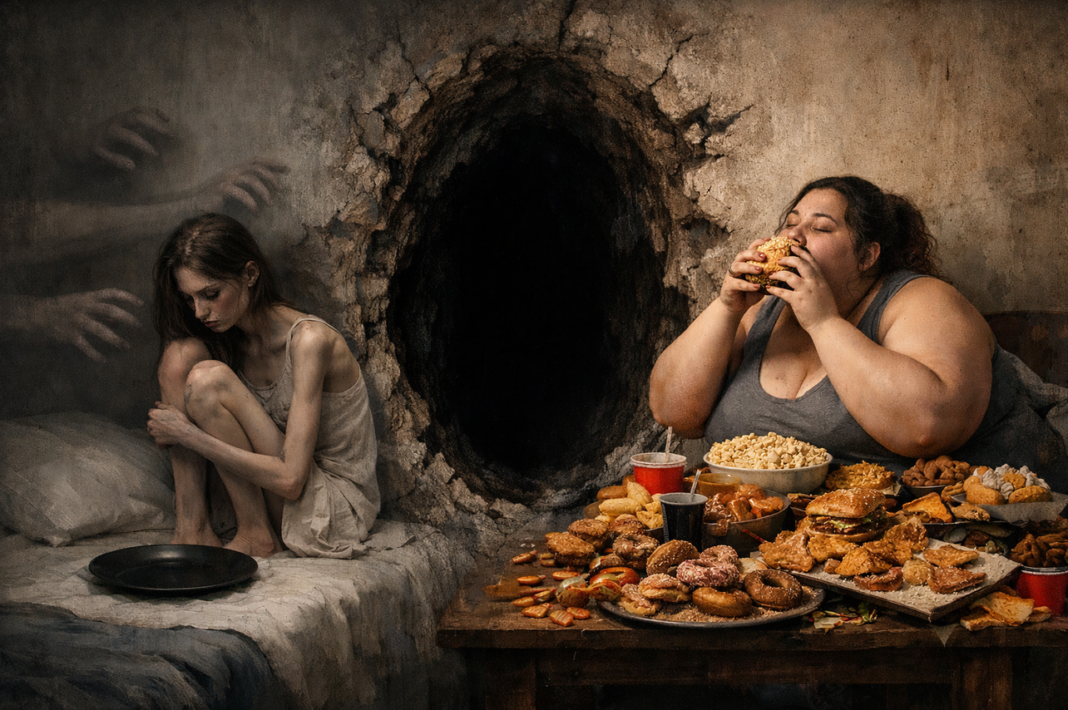

Anorexia, beyond being a clinical “disorder,” is a radical declaration regarding the subject’s position within language and desire. Lacanian psychoanalytic theory reads this symptom not as a biological hunger crisis, but as a vital negotiation the subject enters into with the Other. Lacan’s most striking observation on anorexia is not that the patient “eats nothing,” but that they are “eating nothingness” (le rien) (Lacan, 1956-1957/2021). Here, “nothing” is not a passive deprivation; it becomes an object of desire actively consumed by the subject. Especially in early childhood, let us consider a representation of a suffocating Other (mother) who “gives everything” and satisfies every need of the child before that need even arises. This state of fullness is uncanny for the subject; because if the Other gives everything, there is no “void” left for the subject to desire. The anorexic subject responds to this devouring invasion of the Other by “eating nothingness”. Through this act, they open an impenetrable field—a “hole”—within themselves. When we proceed through “eating nothingness,” the relationship with food—much like the attempt to achieve completion through pleasure (jouissance)—can be analyzed as parallel to the relationship established with an object of addiction; similarly, unlike a meal, nothingness can be examined as an object of pleasure that can never be taken away from the subject.
Distinction Between Need and Desire
To understand the logic of anorexia, it is necessary to distinguish between need and desire. While medical discourse defines the body through biological needs, psychoanalysis views the body as a “site of desire”. Need is directed toward the object required for survival (food) and can be satisfied. As for desire, if we proceed from Lacan’s formulation: “Desire is what remains when one subtracts need from demand” (Lacan, 1958/2006). If we proceed from the mother-child example, the mother perceives every cry of the child as a “sign of hunger” (need) and, by thrusting the breast/food into the mouth, does not allow the child to produce “desire”. This “abundance” prevents the subject from recognizing their own lack. The anorexic attempts to open a “hole” in the Other by rejecting this abundance.
The Hyper-Modern Other and Resistance
Now let us move to an abstract level; Recalcati is a figure who discusses this issue of “suffocating satiation” in modern anorexia studies (Recalcati, 2002/2013). According to him, contemporary society and the “hyper-modern Other” constantly attempt to satiate the subject with consumption and objects. This creates a “saturation” (over-saturation) that stifles the subject’s desire. Recalcati views anorexia as a resistance against this promise of “having everything”. The subject’s “No” is actually an effort to tear through that false fullness offered by the Other and create a real void.
The Structure Of The Drive In Anorexia
If we were to consider the subject from a Freudian perspective, we could examine the structure of the drive. The oral stage, in the Freudian sense, is not merely about “nutrition”. The drive is a circuit that turns around an object and returns to the center by circling a void every time (Lacan, 1964/1998). In anorexia, the object of this circuit is the very void at its center. The issue here is not the filling of the stomach, but the symbolic equivalent of the act of swallowing/not swallowing. For the anorexic, not swallowing is a refusal to incorporate the world, language, and demands offered by the Other. This is a defensive act that protects the boundaries of the body. Here, the oral drive targets not the food, but the pleasure (jouissance) of being able to say “no”.
Comparison Between Anorexia and Overeating
When looking at a parallel between eating nothingness and eating too much, in both cases, the subject is dealing not with biological food, but with a symbolic void. The anorexic subject adopts “nothingness” as an object to protect their desire. They remain hungry to preserve the void (the lack). The overeating subject, however, cannot endure the anxiety created by the void and tries to “plug” that void with food (Recalcati, 2002; Cosenza, 2014). Both subjects are attempting to cope with a fundamental question related to lack. One survives by glorifying the lack (anorexia), while the other survives by denying and covering it up (overeating). Of course, from this perspective, both are a cycle of pleasure (jouissance). In the anorexic, pleasure is the pleasure of saying “no” and being able to control the body. In the overeater, pleasure is the pleasure of “swallowing” and the anxiety-relieving pleasure of that momentary fullness. In both cases, the subject goes beyond the Symbolic (language, rules) and becomes trapped in a bodily, “Real” field of pleasure.
The Crisis Of Subjectivization
Consequently, the anorexic subject’s ‘eating of nothingness’ and the overeater’s ‘swallowing of everything’ are twin responses to a crisis of subjectivization. In both clinical pictures, the subject turns the body into a battlefield to cope with the anxiety created by a Symbolic lack. While the anorexic defends the lack (nothingness) like a fortress to escape the invasion of the Other, the overeater tries to fill the silence of the Other by suffocating the lack with objects. These two extremes essentially revolve around the same point: the inability to face the lack of desire. One sanctifies the lack as ‘nothingness,’ the other destroys it as ‘excess’. In both cases, the symptom is a radical response established by the subject to avoid being swallowed or lost in the appetite of the Other.
References
Cosenza, D. (2014). Le refus dans l’anorexie [The refusal in anorexia]. Presses Universitaires de Rennes. Lacan, J. (2021). The seminar of Jacques Lacan, Book IV: The object relation, 1956–1957 (A. R. Price, Trans.; J.-A. Miller, Ed.). Polity Press. (Original work published 1994). Lacan, J. (2006). Écrits: The first complete edition in English (B. Fink, Trans.). W. W. Norton & Company. (Original work published 1958). Lacan, J. (1998). The seminar of Jacques Lacan, Book XI: The four fundamental concepts of psychoanalysis (A. Sheridan, Trans.; J.-A. Miller, Ed.). W. W. Norton & Company. (Original work published 1973). Recalcati, M. (2013). Boşluk kliniği: Anoreksiya, bulimia ve bağımlılıklar [The clinic of the void: Anorexia, bulimia, and addictions]. (E. Sayın, Trans.). Bağlam Yayınları. (Original work published 2002).