


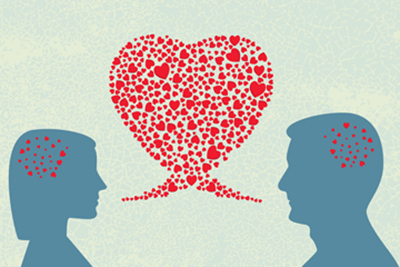

For centuries, we’ve associated love with the heart — yet this may be one of humanity’s most beautiful delusions. The racing pulse, the uneasiness in our chest, the way logic fades while emotions grow louder — none of it is a romantic miracle. It is the result of the brain’s chemical choreography. From an evolutionary perspective, romantic love is not simply a feeling but a mechanism designed to ensure the survival of our species. What feels infinite and transcendent is, in fact, an efficient biological program. But defining love in scientific terms is not to belittle it; it is to understand it. Because the emotional and neurological dimensions of love are deeply intertwined — one cannot truly exist without the other.
When love begins, the brain’s reward system becomes highly active, flooding us with dopamine. This chemical surge drives us toward the “source of pleasure,” much like in the early stages of addiction. Simultaneously, oxytocin and vasopressin — the neuropeptides responsible for attachment — come into play, strengthening emotional and physical closeness. In this state, the brain constructs a kind of bonding code: the beloved becomes not only an object of affection but also a signal of safety and belonging. Being near them brings calm; their absence, unease.
This neurochemical storm deepens our romantic experience while quietly reshaping perception. Activity in the frontal regions of the brain — those linked to critical thinking — decreases. As a result, we overlook flaws, excuse contradictions, and rationalize behavior that would otherwise seem unreasonable. What appears as emotional blindness is actually the brain’s way of preserving attachment. The irrationality of love is not a flaw; it is a feature — a biological safeguard meant to keep us connected.
But here emerges a paradox: if love is a biological necessity, where does free will fit in? Do we truly choose the people we love, or are we guided by the silent algorithms of our neurochemistry? This question lies at the heart of neuropsychology’s most debated frontiers. Understanding the neural mechanisms of love does not erase its meaning; instead, it forces us to see consciousness itself as part of the equation. Perhaps to study love is not to dissect it but to witness the delicate balance between biology and awareness.
The person we fall for often feels unique, almost destined. Yet from a neuropsychological point of view, this sense of uniqueness may be a projection of the self. Our choices are shaped by memory, early attachment models, and emotional familiarity. The brain tends to return to what it already knows — to recognizable emotional patterns that once felt safe. What we call “chemistry” may sometimes be nothing more than the comfort of repetition. Familiarity masquerades as attraction, and we call it fate.
Still, to reduce love solely to a chemical reflex would be an oversimplification. Love is also an act of meaning-making — a bridge between biology and consciousness. Humans do not just seek connection; they seek significance within connection. The brain transforms the biological need for attachment into something symbolic, something that gives the chaos of existence a sense of order. That is why love feels both deeply physical and profoundly existential.
In the end, love is neither a mystical miracle nor a mere biochemical reflex. It lives somewhere between those poles — a story co-authored by nature and awareness. To analyze love is not to diminish it but to move closer to understanding the human condition itself. Love may be a neurological illusion, yes — but no illusion has ever felt this real.