


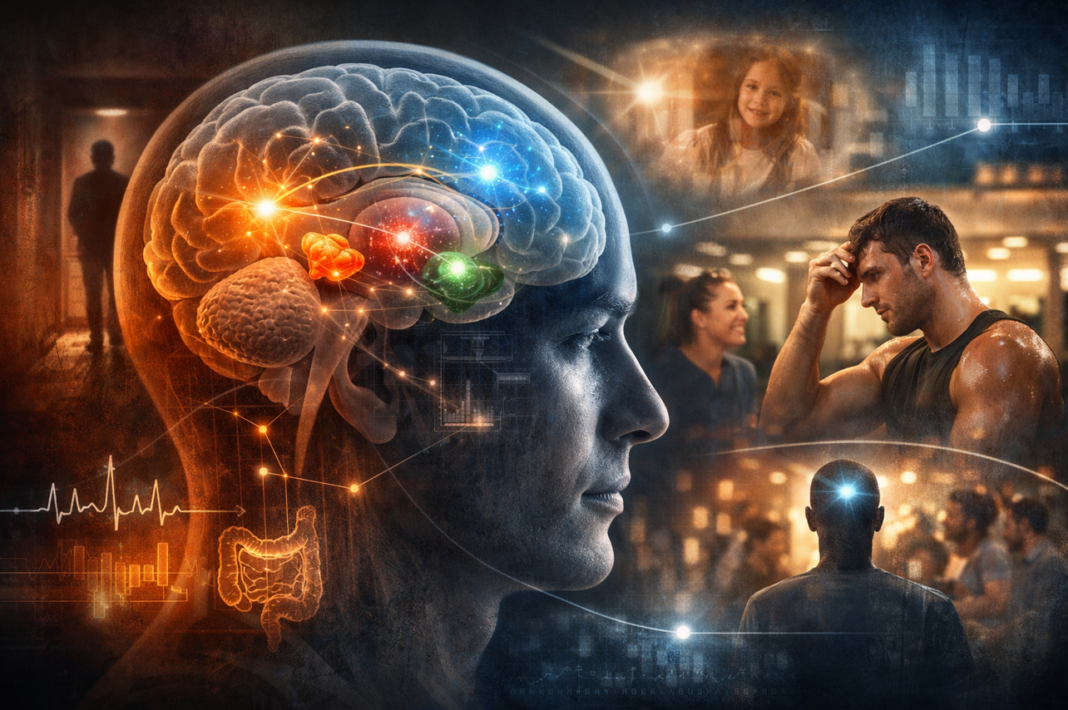

Emotions often feel like inner waves that rise beyond our control; yet neuroscientific research shows that emotions are not passive reactions but experiences actively constructed by the brain. This modern perspective reveals that emotions are not events that simply “happen to us,” but rather multi-layered interpretive processes shaped by bodily signals, past experiences, social cues, and contextual information.
The starting point of this process is interoception, the brain’s ability to monitor the internal state of the body. A slight movement in the gut, a change in skin temperature, a subtle shift in breathing—these signals are all detected by the insula. As Craig (2009) suggests, the insula transforms these sensations into an “internal state map,” forming the biological foundation of emotional experience. Yet these signals alone do not constitute emotion; what grants them emotional meaning is how the brain interprets them.
Neural Interpretation and Emotional Meaning
This interpretive stage involves dynamic interactions among the amygdala, hippocampus, anterior cingulate cortex (ACC), and prefrontal cortex (PFC). These regions place bodily sensations into context, activate relevant memories, and apply learned meanings to produce an emotional outcome. Pessoa’s (2017) network model demonstrates that emotions do not arise from fixed circuits but from flexible neural patterns that are reconfigured in each situation.
For that reason, the same bodily signal can generate entirely different emotional experiences in different people—or even within the same person at different moments.
Everyday life provides clear illustrations of this mechanism. For instance, stepping into a crowded elevator and feeling a warm rush of air on your face is, in itself, a neutral sensation. However, if you previously had an unpleasant experience in that environment, the amygdala may instantly interpret it as “threat.” If you are hurrying to an important meeting, the same warmth may generate “excitement.” If you are standing next to someone you like, it may even feel like “attraction.” The sensation remains the same, but the emotional meaning shifts—because emotion arises not from the sensation itself but from the interpretation assigned to it.
Predictive Processing and Emotional Meaning
A striking illustration of this process is the “unexpected shadow” phenomenon. Imagine walking down a dim hallway at night and noticing a faint shadow on the wall. The shadow is harmless—simply light spilling from a slightly open door. Yet the amygdala, guided by evolutionary survival mechanisms, may interpret it within milliseconds as a potential threat. A subtle tension appears in the body. Moments later, the hippocampus recalls that you are in a familiar environment, and the PFC integrates this information, dissolving the fear response.
The shadow itself never changed—only the brain’s interpretation did. This demonstrates that emotion emerges not from external reality, but from predictive and interpretive brain processes.
A similar dynamic occurs in everyday settings such as the gym. Seeing your face turn red in the mirror may be interpreted as “I’m pushing myself effectively” by an athlete, as “I look embarrassing” by someone self-conscious, or as “something is wrong with my body” by someone prone to health anxiety. The physiological state remains identical, yet the emotional experience differs entirely.
Cognitive Regulation and Emotional Construction
Beyond immediate interpretation, higher-order cognitive regulation plays a central role in shaping emotional experience. The PFC functions as a regulatory system that reassesses emotional reactions and modulates their intensity. According to Critchley and Garfinkel (2017), emotions are not automatic bodily reactions but emerge through continuous interaction between bodily signals and cognitive evaluation. Similarly, Farb and colleagues (2013) highlight that attentional and regulatory processes influence both how emotions are felt and how long they persist.
Bu bulgular bir araya getirildiğinde, duyguların yalnızca biyolojik tepkiler değil,biyososyal-bilişsel yapılar olduğunu ortaya koymaktadır. Beyin, her duygusal durumu oluşturmak için bedensel duyumları, kişisel geçmişi, sosyal bağlamı ve öğrenilmiş anlamı bütünleştirir. Bu nedenle duygu, gerçekliğin sabit bir yansıması değil, deneyimle şekillenen dinamik bir yorumdur.
Sonuç: Duygu Yapıcı Bir Süreçtir
Duygu, bedensel aktivitenin otomatik bir yan ürünü değildir; beyin tarafından üretilen yaratıcı ve esnek bir süreçtir. Bunu anlamak, bireylerin duygusal yaşamlarına daha fazla netlik ve kontrolle yaklaşmalarını sağlar. Duyguları bastırmaya çalışmak yerine, duyguların nasıl oluştuğunu anlamayı öğrenebiliriz; duyguların nesnel gerçekler değil, zihin tarafından şekillendirilen yorumlar olduğunu kabul edebiliriz.
Referanslar
Barrett, LF (2017).Duygular Nasıl Oluşur: Beynin Gizli Yaşamı . Houghton Mifflin Harcourt.
Craig, AD (2009). Şimdi nasıl hissediyorsunuz? Ön insula ve insan farkındalığı.Nature Reviews Neuroscience, 10 (1), 59–70.
Critchley, HD, & Garfinkel, SN (2017). İçsel algı ve duygu.Current Opinion in Psychology, 17 , 7–14.
Farb, NA, Segal, ZV, & Anderson, AK (2013). Farkındalık meditasyonu, içsel algısal dikkatin kortikal temsillerini değiştirir.Social Cognitive and Affective Neuroscience, 8 (1), 15–26.
Pessoa, L. (2017). Duygusal beynin bir ağ modeli.Trends in Cognitive Sciences, 21 (5), 357–371.