


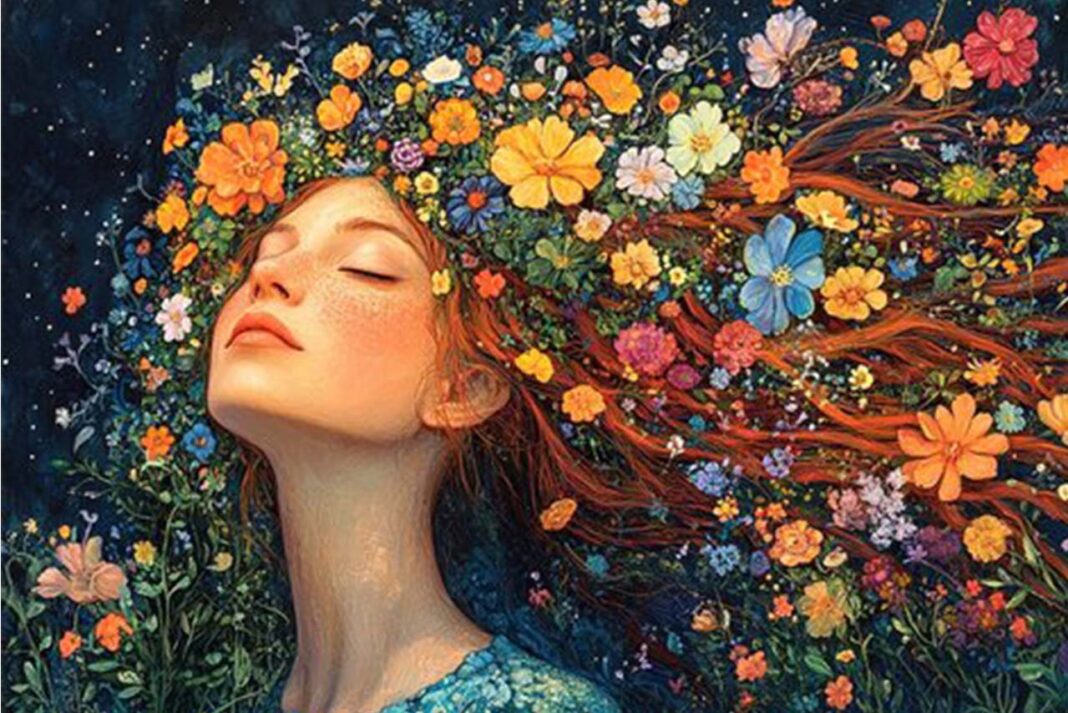

The flowering psyche. Jung likened the unconscious to fertile soil and its images to blossoms: “as a plant produces its flower, so the psyche creates its symbols.” (Jung, 2012). Across cultures, people find flowers inherently beautiful and meaningful, making them apt carriers of unconscious meaning. In dreams and myths, flowers abound, from Mary’s lilies to Aphrodite’s roses, appearing as universal tokens of the collective unconscious. In this light, the bouquet we favor may mirror our inner archetypes, hinting at the complex interplay of anima/animus, shadow, persona, and Self within us (Huss et al., 2017).
Roses: Passion, Anima, And The Beloved
The rose is perhaps the most archetypal flower of love and passion. Jung himself called the rose “a symbol of the beloved” in poetry, linking it to primal love and psychic reunification (Kandeler & Ullrich, 2009). Mythic and religious traditions reinforce this symbolism: the rose has been associated with the Virgin Mary, divine Wisdom (Sophia), and heart-opening love in alchemical imagery. Contemporary flower-personality interpretations likewise portray roses as symbols of romance, devotion, and emotional depth. A person drawn to roses often values profound emotional bonds and heartfelt expression, qualities associated with the anima and its role in mediating inner feeling and relational depth within the psyche.
Lilies: Purity, The Soul’s Ascent, And The Anima
Lilies evoke innocence, renewal, and spiritual striving. In a notable Jungian dream account, a radiant white lily grew from a man’s mouth as he prayed, symbolizing the “striving of his own soul toward the divine” (Serrican, 2015). Christian symbolism similarly presents the lily as the flower of the soul; the Madonna is frequently linked to lilies, representing purity, devotion, and transcendence. In Germanic mythology, the lily appears as a royal and elevated anima figure, often surrounding heroic characters as a protective spiritual presence. A fondness for lilies may therefore suggest a psyche oriented toward ideals, moral clarity, and higher emotional or spiritual values rooted in the unconscious.
Orchids: Exotic Allure And Mystery
Orchids represent refinement, rarity, and mystery. Their elegance conveys a sense of defined beauty and subtle eroticism. The Greek origin of the word orchis, meaning testicle, reflects ancient associations with fertility and potency. Classical traditions believed orchid tubers could enhance virility and sensual power. Modern symbolism continues this legacy by linking orchids to luxury, individuality, and inner strength. Psychologically, a preference for orchids may point to the activation of animus qualities, such as autonomy, creative force, and assertive vitality, contributing mystery and energy to the outward persona of the psyche.
Peonies: Splendor, Romance, And The Persona
Peonies are lush, abundant, and visually opulent, often referred to as the “king of flowers” in Chinese culture. There, they symbolize honor, prosperity, and social rank. In Western traditions, peonies have been linked to romance, bashfulness, and affluence. The Greek myth of the nymph Paeonia, transformed into the flower, and Victorian floriography both associate peonies with honor and affectionate love. Individuals drawn to peonies may present warmth, generosity, and social grace, reflecting a persona that values visibility, abundance, and creative self-expression within the broader development of the psyche.
Wildflowers: Freedom, The Shadow, And The Untamed Self
Wildflowers grow untamed along fields, mountainsides, and margins, symbolizing freedom, adaptability, and resilience. They are often associated with independence, creativity, and spontaneity. Unlike cultivated garden flowers, wildflowers thrive through instinct and chance, aligning them symbolically with the shadow. They may represent neglected potentials, raw impulses, or aspects of the unconscious that resist structure and control. In dreams and myths, wild meadows invite an encounter with spontaneity and authenticity. A preference for wildflowers may indicate an inner Self that embraces uncertainty, diversity, and psychological openness within the evolving psyche.
Mystic Blooms And The Collective Unconscious
Jung emphasized that floral symbols emerge from a shared, collective soil of meaning. Across cultures and historical periods, the same flowers appear repeatedly in myths, religious imagery, and dreams. Lilies recur as symbols of the soul and spiritual purity, while roses consistently signify love, devotion, and transformation. This symbolic continuity reflects the operation of shared archetypes within the collective unconscious. Flowers thus function as bridges between personal emotion and universal image, allowing individuals to access deeper layers of meaning through symbolic resonance (Jacobi, nd.).
The Flowering Self
From a Jungian perspective, choosing, cultivating, or dreaming of flowers can become an act of individuation. Just as a garden requires diversity, balance, and care, the psyche integrates light and shadow, anima and animus, into a coherent whole. One may resonate strongly with the rose yet benefit from the untamed vitality of wildflowers, or feel drawn to lilies while learning from the passion symbolized by peonies. Each floral preference highlights a different face of the Self. Ultimately, the bouquet one cherishes reflects aspects of the Self taking root and unfolding. As Jung suggested, psychic growth mirrors organic growth. In this sense, flowers are not mere decoration but living metaphors of the psyche in bloom.
References
Ece Serrican. Reflexion Of The Archetype Concept In Carl Gustav Jung’s Theory Of Analytical Psychology To The Literature. International Journal of Social Sciences and Education Research. 2015;1(4):1205–1215. doi:10.24289/ijsser.279130
Efrat Huss, Kfir Bar Yosef, Michele Zaccai. The Meaning Of Flowers: A Cultural And Perceptual Exploration Of Ornamental Flowers. The Open Psychology Journal. 2017;10(1):140–153.
Jolande Jacobi. (Nd.) Complex / Archetype / Symbol In The Psychology Of C. G. Jung. Princeton University Press.
Jung, C. G. (2012). Man And His Symbols. Bantam.
Riklef Kandeler & Wolfram R. Ullrich. Symbolism Of Plants: Examples From European-Mediterranean Culture Presented With Biology And History Of Art: October: Roses. Journal of Experimental Botany. 2009;60(13):3611–3613.