


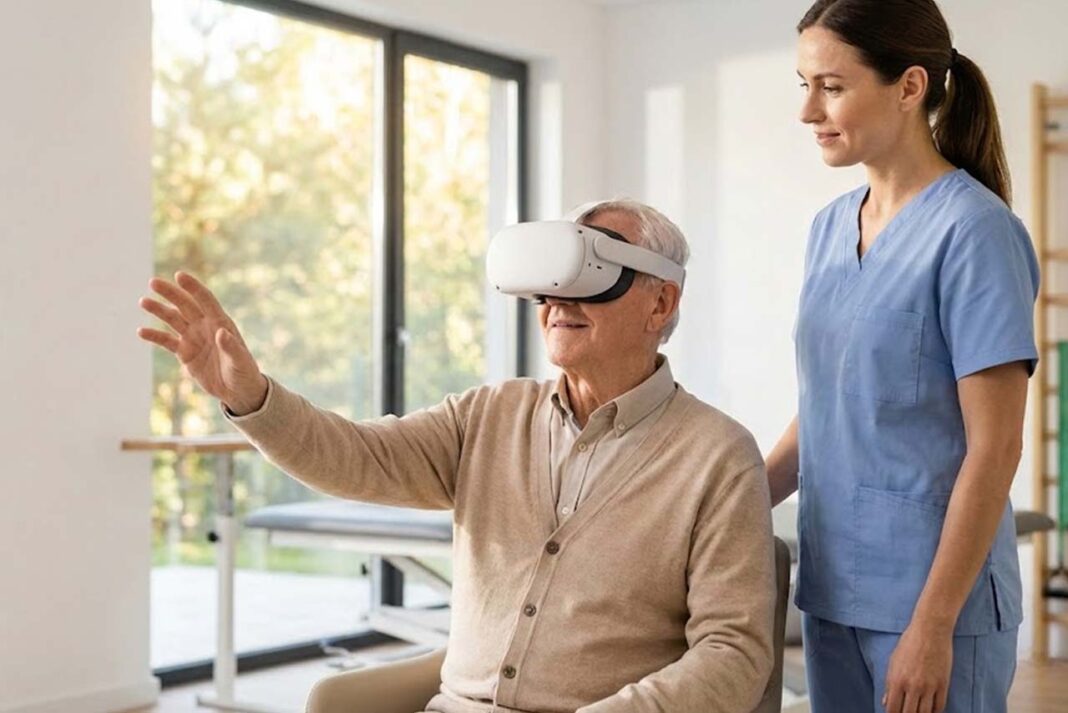

Many cognitive assessments still happen in a quiet office. A patient sits at a desk and completes short tasks that remove movement, noise, and real-time pressure. These tests are useful, but daily life is different. People think while walking, cooking, traveling, and dealing with interruptions. Because of this gap, some patients can look “fine” on a standard test and still struggle with real tasks like following a multi-step routine or finding their way in an unfamiliar place.
Virtual Reality can help close this gap. It can bring real-life demands into a safe, structured setting while keeping tasks consistent across patients.
Embodied Cognition: Thinking Beyond The Head
Embodied Cognition starts from a simple idea: thinking is shaped by the body and the environment. We do not only process information in our heads. We also use perception and action to reach goals, and these actions change what we notice, remember, and decide.
Prof. Francesca Morganti has shown how this view can guide neuropsychological assessment and rehabilitation. In her chapter on VR in clinical work, she describes virtual environments as communicative, interactive spaces where cognition is expressed through exploration and action, not only through static answers (Morganti, 2004). In later work, she discusses embodied space across both natural and virtual environments and explains why spatial cognition depends on the link between the person, the body, and the surroundings (Morganti, 2016).
Following the research of Francesca Morganti on embodied cognition, we must recognize that interaction—not just computation—is the core of human intelligence. VR offers a unique bridge between the laboratory and real life.
From Abstract Tests To Meaningful Tasks
VR can turn abstract skills into meaningful tasks. Memory can be tested as remembering to do something at the right time, not only recalling a list. Attention can be tested while the person navigates and searches, not only by pressing a key when a light flashes. Executive functions can be tested through planning, switching, and resisting distractions inside a realistic routine.
VR is especially valuable for spatial difficulties. A paper test can suggest a problem, but it cannot easily show how a person moves through an environment, uses landmarks, or recovers after getting lost. Morganti and colleagues offered an early example with a feasibility study using a VR-based extended neuropsychological assessment for topographical disorientation (Morganti et al., 2007). Topographical disorientation involves real-life wayfinding problems, and VR allows these problems to be assessed in a controlled and safe setting.
Rehabilitation Through Repetition With Variation
For rehabilitation, VR supports repetition with variation. A route can be practiced again, but the scene can change slightly: more distractions, a different starting point, or a new goal. This is important because patients do not need only one correct answer; they need flexible skills that transfer to daily life.
VR can record a wide range of behavioral data: paths taken, timing, hesitations, and patterns of mistakes. With thoughtful design, artificial intelligence can help summarize this data in ways that support clinicians. It can also adjust task difficulty so challenges remain engaging without becoming demoralizing.
Still, AI should not replace clinical judgment. A pattern cannot explain the person’s reasons. Hesitation may reflect memory limits, anxiety, pain, or fatigue. The clinician’s role is to interpret what the pattern means for that individual and decide what to train next.
Evidence, Ethics, And Practical Considerations
Research on VR interventions is growing, especially among older adults. A systematic review and meta-analysis reported that VR interventions can improve cognitive outcomes in older adults with mild cognitive impairment or dementia, with additional benefits for balance (Zhu et al., 2021). Results vary across programs, making task design, dosage, usability, and accessibility crucial factors.
VR also has limitations, including cybersickness and fatigue, and it generates sensitive behavioral data. Clear informed consent and robust data protection must be central components of any clinical VR program.
Conclusion: Bringing Cognition Back To The World
VR will not replace traditional testing, but it can reduce the distance between clinic tasks and daily life. Cognitive Rehabilitation benefits when assessment and training reflect how people actually think and act in the world. Embodied cognition explains why interaction matters, and Prof. Francesca Morganti’s work demonstrates how VR can connect theory with real clinical needs, particularly in spatial assessment and rehabilitation (Morganti, 2004, 2016; Morganti et al., 2007).
Used responsibly, technology does not pull us away from what is human. It can bring cognition back to the body—and back to the world.
References
Morganti, F. (2004). Virtual Reality as a Communicative Tool in Neuropsychological Assessment and Rehabilitation. In G. Riva, C. Botella, P. Légeron, & G. Optale (Eds.), Cybertherapy: Internet and Virtual Reality as Assessment and Rehabilitation Tools for Clinical Psychology and Neuroscience. IOS Press.
Morganti, F. (2016). Embodied Space in Natural and Virtual Environments: Implications for Cognitive Neuroscience Research. In S. Serino, A. Matic, D. Giakoumis, G. Lopez, & P. Cipresso (Eds.), Pervasive Computing Paradigms for Mental Health (MindCare 2015) (pp. 110–119). Springer.
https://doi.org/10.1007/978-3-319-32270-4_11
Morganti, F., Gaggioli, A., Strambi, L., Rusconi, M. L., & Riva, G. (2007). A Virtual Reality Extended Neuropsychological Assessment for Topographical Disorientation: A Feasibility Study. Journal of NeuroEngineering and Rehabilitation, 4, 26.
https://doi.org/10.1186/1743-0003-4-26
Zhu, S., Sui, Y., Shen, Y., Zhu, Y., Ali, N., Guo, C., & Wang, T. (2021). Effects of Virtual Reality Intervention on Cognition and Motor Function in Older Adults with Mild Cognitive Impairment or Dementia: A Systematic Review and Meta-Analysis. Frontiers in Aging Neuroscience, 13, 586999.
https://doi.org/10.3389/fnagi.2021.586999