


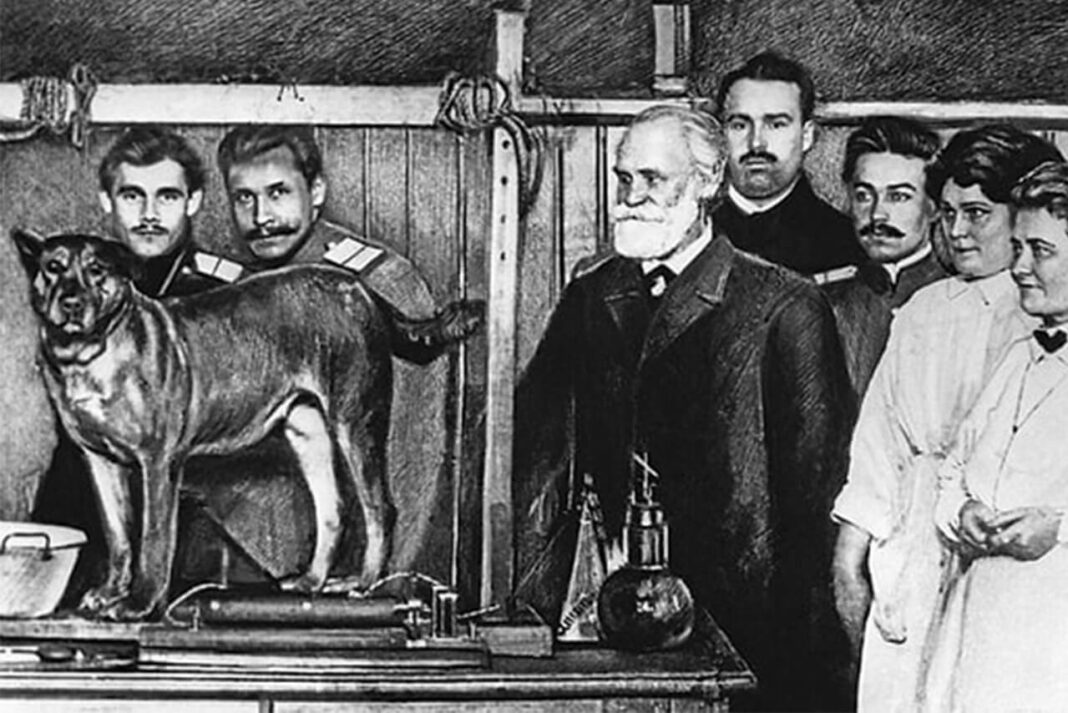

Behavioural learning mechanisms were neither hypothesized nor intentionally researched until Ivan Pavlovaccidentally discovered connections between the environment and animal behaviours that take place within that environment. Pavlov, a physiologist, was conducting experiments on the digestion processes of dogs when he started to recognize the relationship between behaviours (output) and the environment (input). He derived the term “Classical Conditioning” to hypothesize this phenomenon he observed. This unexpected discovery not only demonstrated a single psycho-physiological phenomenon but also delivered a whole new psychology school and branch, which investigates the process of animal learning (humans included) to this day.
Certain environmental stimuli to which an animal is exposed trigger certain physiological reactions. For instance, the sensation of pressure within one’s mouth automatically triggers the secretion of saliva (for healthy individuals). More specifically, putting a portion of food in one’s mouth produces saliva, as has been known for a fairly long time. Another example is when food enters an animal’s stomach, the production of certain gastric secretions is expected consequently. However, Pavlov realized that the dogs were producing gastric secretions even when the food didn’t arrive in their stomach (surgical manipulation was used to achieve this). This finding led him to change his area of study because it implied the arrival of a whole new branch of psychology. This phenomenon was something beyond the expected physiological responses.
A) The Ordinary Physiological Reactions While a Dog Eats Its Meal:
0 – The food is absent in the environment, where the dog is not able to sense it using its five sensory organs.
➡ There is no secretion, as expected.
1 – The dog starts to eat its meal.
➡ Secretion of saliva is expected consequently.
2 – The food arrives in its stomach.
➡ Gastric secretions are expected consequently.
B) Pavlov’s Observation, Which Is Beyond These Ordinary Physiological Reactions:
0 – The dog starts to secrete saliva, even when there is no food in the environment yet.
➡ Unexpected physiological reaction.
➡ However, it happens right before Pavlov is going to feed it (as its meals are given at fixed time periods for the sake of the original experiment about digestion).
1 – The dog starts to eat the meal.
➡ Saliva secretion happens as expected.
2 – Even though the meal never arrives in the stomach due to surgical intervention, the dogs produce gastric secretions.
➡ Unexpected physiological reaction.
As mentioned before, “Certain environmental stimuli to which an animal is exposed trigger certain physiological reactions.” This is a fundamental observation witnessed in laboratories and even in daily life. However, Pavlov discovered that these reactions can be observed even without the presence of the stimulus in the environment at a given time, which was previously thought to be necessary. He understood that this whole process must involve learning to some extent.
What Was Learned by the Dog? When, Why, and How Did Its Body Learn It?
The dog’s brain learned that Pavlov’s feeding routine consisted of strict patterns that could be sensed by the dog’s five sensory organs. Let’s present the last part of the process again, but emphasizing the learning phenomenon:
0 – The dog starts to secrete saliva even before the introduction of the meal/food itself within the environment.
➡ Pavlov hypothesized that the dog must have learned a way to predict the arrival of the meal. Dogs are not as cognitively gifted as humans; therefore, there must be some sensory inputs that consistently emerge in the environment right before Pavlov gives the dog its meal.
➡ The dog might hear “certain noises” that Pavlov’s shoes make while he walks from the other room to give the dog its meal.
➡ The dog might recognize “a certain brightness level” of light at the time Pavlov gives it its meal. (For example, the morning, noon, and night have different brightness levels.)
➡ The dog might smell “a certain odor” produced by the bacterial flora of the environment. (The constantly changing humidity of the wooden floor might allow certain bacteria to thrive and produce a specific type of smell at the time Pavlov feeds the dog every day.)
➡ Or there might be some tactile or gustatory stimuli that emerge in the environment at the exact time Pavlov feeds the dog every day.
This means the dog learned that certain noises, brightness levels of the environment, odors, tactile stimuli, and gustatory stimuli (the five types of sensory inputs) are predictors of the arrival of the meal/food. Let’s emphasize the main points to reinforce what we’ve learned today:
-
Irrelevant sensory inputs are presented unintentionally and naturally right before the arrival of the meal every time.
-
The meal is desired enough by the dog to initiate learning the relationship between emerging irrelevant environmental clues and the arrival of the desired outcome (time and place), which is sensed by the dog’s sensory organs.
-
The dog experiences the emergence of the same environmental clues right before the emergence of food several times. This enables it to learn the pattern by understanding the relationship between the predictor variable(e.g., the noise that Pavlov’s shoe produces) and the outcome (the meal).
-
These naturally irrelevant variables (for the species of dogs) are learned as signals that predict the arrival of the desired outcome. Therefore, they become relevant for the specific dog that experiences such intervention repetitively.