


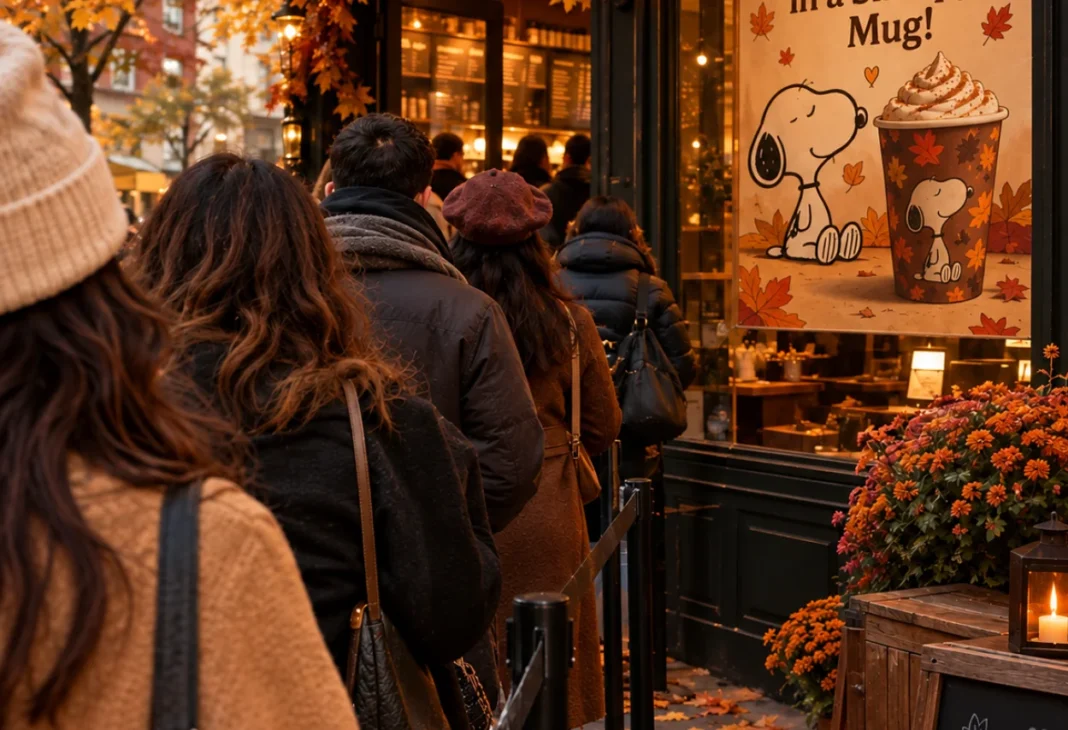

These days, an interesting sight has been appearing on social media: long lines of people waiting outside a coffee company early in the morning to buy products featuring Snoopy and other Peanuts characters…
So, why are we lining up at the crack of dawn for these products?
If we take a closer look at this autumn craze, we may begin to see some of the emotions and behavioral motivations underlying our consumption habits.
Why Does Snoopy Feel So Familiar?
Peanuts characters have been powerful symbols of popular culture, present in the lives of different generations since the 1950s. When we see Snoopy, one of the most beloved characters, certain images, people, periods, or emotions from our past may also come to life.
This is where nostalgia comes in.
Thinking of nostalgia simply as “missing the past” may be an incomplete way of understanding it. Current psychological research suggests that nostalgia is a social emotion and that memories of the past may be associated with feelings of attachment, closeness, and social support (Juhl & Biskas, 2023; FioRito & Routledge, 2020). Research on consumer behavior also suggests that nostalgia can influence our preferences for products and experiences, particularly through feelings of social connection (Weingarten & Wei, 2023).
For this reason, when we look at a Snoopy mug, our minds may not be saying only, “What a nice mug.” Perhaps, they are also saying:
“I used to love this when I was a child.”
“Seeing this reminds me of the old days.”
“So familiar…”
“This makes me feel good.”
In other words, sometimes the value of an object may come less from its material qualities and more from the associations it evokes in us.
Does Our Inner Child Really Want Snoopy?
This naturally brings us to the idea of the “inner child.” Seeing a toy or cartoon character that made us happy as children again in adulthood can bring us joy. Buying something from our childhood with our own money today may even be a small way of giving ourselves something we were unable to have in the past.
This does not necessarily have to carry a deep psychological meaning. Sometimes, we simply really like Snoopy. At other times, we may actually like the feeling Snoopy represents: the joy, curiosity, sense of safety, and belonging we experienced during childhood…
Perhaps, through a small object, we are reconnecting with feelings that we sometimes feel have become lost among the responsibilities of adulthood. For this reason, an adult buying a Snoopy mug should not necessarily be viewed as “childish.” Buying that mug may also be one small way of building a bridge between our past and our present.
However, we cannot say that everyone who buys a Snoopy product is necessarily forming a psychological connection with their childhood. A behavior may have more than one underlying reason. Some of us may want the same product because we genuinely love the character, some because we find the product aesthetically appealing, some because we collect these items, and others because of the interest shown by people around us.
This is where social psychology enters the picture.
One Person Wants It, Then Everyone Wants It
Imagine that we see a friend’s Snoopy mug on social media.
“That’s really cute,” we think.
Then another friend shares the same mug.
“Okay, this really is cute,” we think.
Soon, dozens of people across different social media platforms begin showing the same product.
And suddenly, the thought “I want one too” comes to the forefront.
People can be influenced by the behavior of those around them. Especially when we notice that a product is in high demand, we may begin to perceive it as valuable or desirable. This can be understood as social proof.
Research showing that nostalgia can strengthen feelings of social connection and may be related to consumer preferences is particularly relevant here (Weingarten & Wei, 2023).
Another powerful factor is scarcity.
“Limited stock.”
“It arrived today; it may be gone tomorrow.”
“It won’t be available again.”
Statements like these can change the way we perceive a product. Consumer research suggests that, under certain conditions, limited supply and scarcity messages can increase product desirability and purchase intentions, although this effect does not necessarily occur in every situation (Li et al., 2021).
Now, instead of simply asking, “Do I want this?”, we begin asking, “If I don’t buy it now, will I ever be able to find it again?”
The Fear of Missing Out: FOMO
Social media can accelerate this process even further. We see hundreds of people buying the same product. Posts about the product being sold out also become part of the experience.
“They’re all gone at our store.”
“I went at 8 a.m.; there were only two left.”
“They still have some at this location.”
With posts like these, consumption becomes a social event. A person is no longer simply buying a product; they are also becoming part of an experience.
This can trigger what is known as the “Fear of Missing Out,” or FOMO. FOMO has been extensively studied, particularly in the context of social media (Elhai et al., 2021; Rozgonjuk et al., 2020). In this context, people may believe that others are having rewarding experiences without them and worry that they themselves might miss out on those experiences.
Are we buying the product because we genuinely want it, or does the possibility of not having something that others have make us uncomfortable?
Sometimes, the two can become difficult to separate.
So, Why Do We Want the Entire Collection?
We buy a Snoopy mug.
Then we see the matching tumbler.
“This one is cute too.”
Then a keychain…
“That would look so cute with it.”
Then a bag…
“I already love Snoopy.”
At some point, we may find ourselves looking at the entire collection.
This is where the act of collecting itself comes into play. Completing the pieces of a series may involve more than simply owning objects; it can be associated with different motivations, including completion goals, social belonging, personal memories, and self-expression (Lee et al., 2022).
When the pieces of a collection complement one another, the meaning of a single product can also change. It is no longer simply “a nice mug”; it has become part of a whole.
Recent research even suggests that collections may provide a sense of order and completeness through interconnected pieces, and that the desire to complete a collection may be related to this sense of structure (Park et al., 2025). An incomplete collection can also keep our desire for the next piece alive.
When Does Enjoyable Consumption Become an Urge to Consume?
There is little point in treating consumption as something entirely negative.
Buying yourself a beautiful mug, purchasing a product featuring a character you love, or wanting to enjoy your autumn coffee in a special cup can all be perfectly ordinary and enjoyable experiences.
Perhaps the problem is not the mug.
The real question is:
“Am I buying this because I genuinely want it, or because I am afraid of missing out?”
Asking this question can sometimes help us understand our own consumption behavior.
Before asking, “Do I need this?”, asking “Why do I want this?” may allow us to connect with our own emotions.
Maybe we really do love Snoopy.
Maybe we enjoy bringing a piece of our childhood into our present lives.
Maybe we saw it on our friends and wanted one too.
Maybe its limited availability makes the product seem more valuable to us.
Or perhaps it is a little bit of all of these things.
Maybe It Was Never Really About Snoopy
Seeing adults chasing after a Snoopy mug may seem amusing to us. We might ask, “Why are people lining up at the crack of dawn for a mug?” But perhaps the more important question is: “Why can a mug make us feel so much?”
Human beings do not simply purchase the things they need. Our memories, emotions, relationships, social groups, and the stories we tell about ourselves also accompany our choices. Sometimes, what we purchase is an object; sometimes, it is the feeling that object represents.
A Snoopy mug may not bring childhood back, but it may carry some of the warmth of childhood into the present.
Perhaps that is why, when an adult sees something featuring Snoopy, a little voice inside says:
“I want this.”
And every now and then, listening to that voice can actually be a beautiful thing.
Kaynakça
- Elhai, J. D., Yang, H., & Montag, C. (2021). Fear of missing out (FOMO): Overview, theoretical underpinnings, and literature review on relations with severity of negative affectivity and problematic technology use. Brazilian Journal of Psychiatry, 43(2), 203–209. https://doi.org/10.1590/1516-4446-2020-0870
- FioRito, T. A., & Routledge, C. (2020). Is nostalgia a past or future-oriented experience? Affective, behavioral, social cognitive, and neuroscientific evidence. Frontiers in Psychology, 11, 1133. https://doi.org/10.3389/fpsyg.2020.01133
- Juhl, J., & Biskas, M. (2023). Nostalgia: An impactful social emotion. Current Opinion in Psychology, 49, 101545. https://doi.org/10.1016/j.copsyc.2022.101545
- Lee, C., Brennan, S., & Wyllie, J. (2022). Consumer collecting behaviour: A systematic review and future research agenda. International Journal of Consumer Studies, 46(5), 2020–2040. https://doi.org/10.1111/ijcs.12770
- Li, H., Xu, Y., & Huang, L. (2021). When less is more? The contingent effect of product supply limitation in the release of new electronic products. Journal of Retailing and Consumer Services, 60, 102433. https://doi.org/10.1016/j.jretconser.2020.102433
- Park, S., Lee, J., & Kim, S. (2025). Seeking structure in collections: Desire for control motivates engagement in collecting. Journal of Consumer Research, 52(3), 480–501. https://doi.org/10.1093/jcr/ucae071
- Rozgonjuk, D., Sindermann, C., Elhai, J. D., & Montag, C. (2020). Fear of missing out (FoMO) and social media's impact on daily-life and problematic social media use. International Journal of Environmental Research and Public Health, 17(8), 2867. https://doi.org/10.3390/ijerph17082867
- Weingarten, E., & Wei, Z. (2023). Nostalgia and consumer behavior. Current Opinion in Psychology, 49, 101555. https://doi.org/10.1016/j.copsyc.2022.101555