


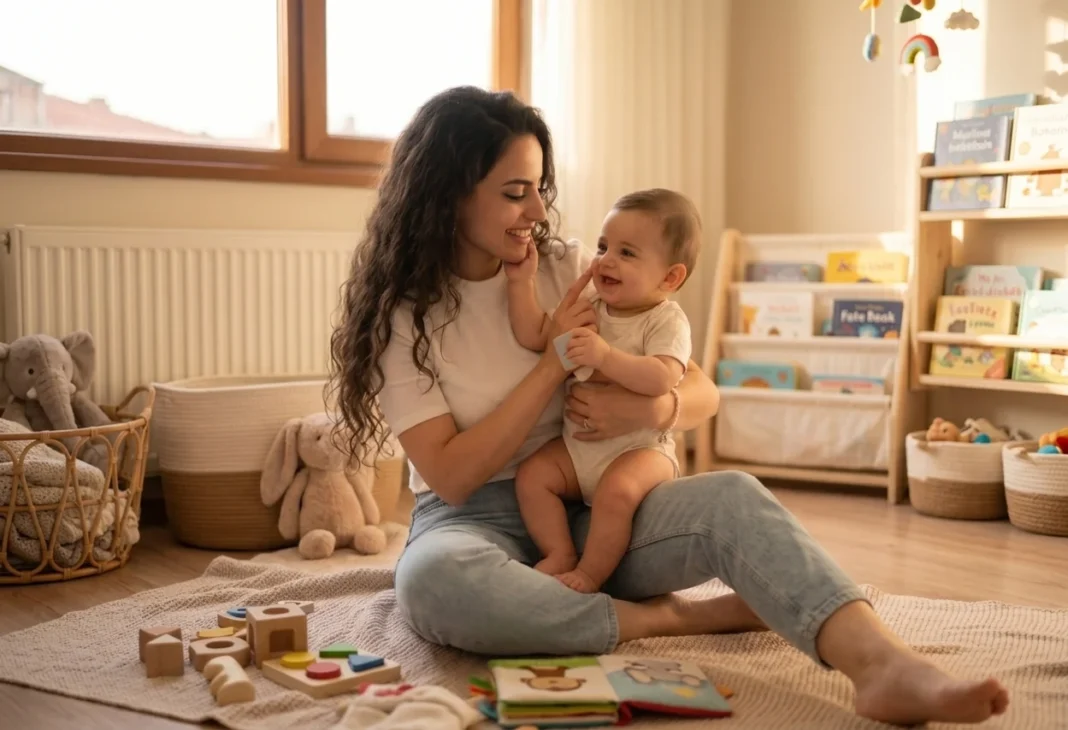

Can a baby’s attachment to a caregiver be explained solely by the fulfillment of their needs, or do these repeated experiences shape the baby’s sense of security over time? Learning theory views attachment not as an innate trait, but as a behavior that develops and is reinforced as a result of the baby’s experiences with the caregiver. Therefore, the baby’s crying, comforting, and repeated interactions with the caregiver are important in understanding how attachment is formed.
The Development of Attachment Through Learning
According to attachment learning theory, it is not an innate biological mechanism. It is a behavior that an individual learns as a result of their experiences with their caregiver. This approach is based on behavioral psychology, which is explained by operant conditioning and classical conditioning. According to classical conditioning, the infant initially experiences satisfaction through food. Over time, this positive experience is associated with the caregiver who provides the food. Thus, the caregiver becomes a conditioned stimulus that creates a sense of comfort and security. According to operant conditioning, a baby’s crying behavior is reinforced when the caregiver rewards it with comfort or feeding. Furthermore, the caregiver views the baby’s calming as a positive outcome, thus continuing the caregiving behaviors (Bosmans et al., 2020).
Strengths of Learning Theory
Regarding the strengths of learning theory, it emphasizes the importance of repeated interactions between caregiver and child, and environmental experiences, in the development of attachment. In particular, when caregivers respond to a child’s needs in an appropriate and consistent manner, it helps to learn and reinforce a sense of security. Current research shows that learning processes play a significant role in attachment formation and that a child’s expectations of their caregiver evolve over time (Bosmans et al., 2020). At the same time, learning theory alone may be considered insufficient to explain attachment. According to Bowlby, attachment is not solely dependent on nourishment. He argued that infants are born with an innate biological attachment system to meet their need for protection and security (Bowlby, 1969). Furthermore, Harry Harlow’s… In experiments on rhesus monkeys, baby monkeys preferred a soft, fabric-covered artificial mother to a wire-structured artificial mother that provided milk. This result suggests that a sense of security and physical contact are more important than nourishment (Harlow, 1958). Therefore, today’s psychologists acknowledge that learning theory makes significant contributions to explaining attachment, but that it should be considered in conjunction with emotional and biological processes (Bosmans et al., 2020).
The Caregiver’s Role and Attachment
However, according to attachment pattern learning theory, the baby develops through repeated experiences with the caregiver. When the baby experiences discomfort, hunger, or fear, they are met with positive responses from the caregiver, such as comfort and feeding. Through these ongoing experiences, the caregiver becomes associated with comfort and security. Accordingly, the baby learns to be close to the person with whom they feel safe. These stages and processes are explained by the combined effect of operant and classical conditioning (Bosmans et al., 2020). Learning theory suggests that responsive and consistent caregiver behavior is crucial in the development of attachment. Responding promptly to a child’s needs enhances positive learning experiences. Conversely, disorganized or inadequate care has been shown to trigger insecure attachment. Therefore, daily interaction during early childhood is thought to have an impact on the quality of attachment. Research shows significant correlations between secure attachment and caregiver responsiveness (Bosmans et al., 2020). Furthermore, learning theory cannot fully explain the developmental journey of attachment. Research shows that infants develop strong bonds not only with the person who provides nourishment, but also with the caregiver who gives them a sense of security. Bowlby (1969) stated that the attachment process is a biologically programmed behavior and that the infant uses the caregiver as a secure base. Moreover, Harlow’s experiments showed that emotional closeness is more important than nourishment, highlighting the limitations of learning theory (Harlow, 1958).
General Evaluation and Implementation
In conclusion, learning theory explains the importance of environmental learning processes and repeated positive experiences with the caregiver in the development of attachment. However, today, it is shown that attachment cannot be explained solely by learning principles. It is stated that caregiver sensitivity, biological predisposition, and emotional interaction should be considered together (Bosmans et al., 2020). Therefore, for healthy attachment development in early childhood, it is important for caregivers to respond sensitively, consistently, and promptly to the baby’s needs. Instead of leaving the baby alone when they are crying or scared, calming them and meeting their needs can help them associate the caregiver with trust and comfort. In addition, it is necessary to consider not only the child’s physical needs but also their needs for touch, closeness, and emotional support. Providing early support to parents and caregivers regarding the importance of attachment can contribute to healthier daily interactions with the child. In my opinion, instead of viewing attachment solely as a learned behavior, it would be a more accurate approach to consider the child’s environmental experiences, the caregiver’s behaviors, and the child’s emotional needs together.
Kaynakça
- References
- Bosmans , G., Bakermans-Kranenburg , M.J., Vervoort , E., Verhees , M., & van IJzendoorn , MH (2020). In search of the attachment system : A review of the empirical evidence for attachment theory . Psychological Bulletin , 146 (9), 783–813. https://doi.org/10.1037/bul0000301
- Bowlby , J. (1969). Attachment and loss : Vol . 1. Attachment . Basic Books .
- Harlow , HF (1958). The nature of love . American Psychologist , 13 (12), 673–685. https://doi.org/10.1037/h0047884