


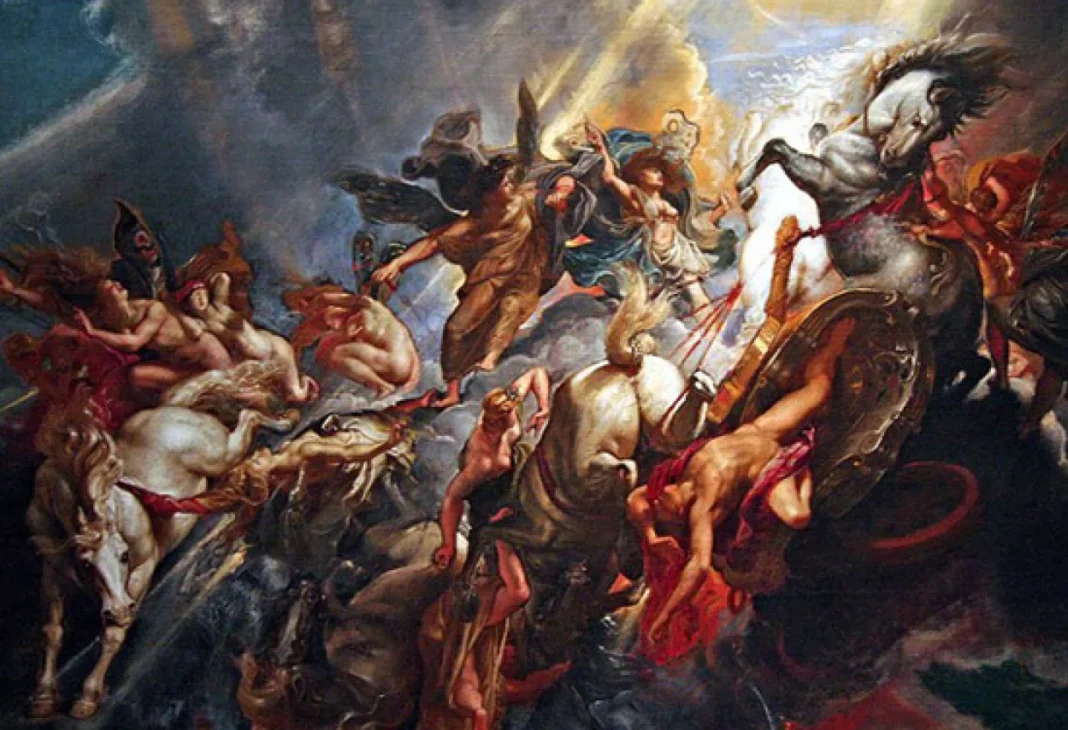

In Ancient Greek mythology, the sun was not simply an ordinary source of light moving across the sky on its own. Each morning, it rose in the east, travelled across the sky throughout the day, and disappeared toward the west in the evening as part of the journey of the god Helios and his fiery chariot.
Helios travelled across the sky in a chariot pulled by horses. He was a god who could see the world from above, witness what was happening below, and undertake the same demanding journey every day. The sun represented his power, light, and constancy. Yet what makes Helios particularly interesting is not simply that he illuminated the world. He was also a figure who saw. From the sky, he watched the world and witnessed the stories of both mortals and gods.
Perhaps for this reason, Helios can be understood not only as the god of the sun, but also through the human need to see and to be seen.
Being seen is an important need for the human mind. It begins with the gaze of a parent during childhood and takes different forms over time through our social relationships, romantic attachments, and achievements. Being noticed, listened to, and acknowledged by another person plays an important role in the development of our sense of self.
However, there is an important difference between wanting to be seen and feeling that we must constantly be seen.
Modern human beings perhaps live in a more visible world than ever before. We place our achievements, relationships, appearance, travels, and even our happiness in front of other people's eyes. Life is no longer simply something we experience; it has increasingly become something we display.
As a result, we are not only watched by others. Eventually, we begin to watch ourselves.
How do I look? Am I successful enough? What do people think of me? Does my life look good from the outside?
As these questions increase, a person may sometimes begin to spend more time evaluating how their life appears than actually living it.
Just as Helios observes the world from above, modern human beings can sometimes begin to live under the gaze of an invisible eye positioned above their own lives. And perhaps this is where the need to be seen begins to transform into the need to prove oneself.
This is where the most psychologically interesting part of Helios's story begins. The tragedy of his son, Phaethon, is not simply the story of a young man who wanted to drive the sun chariot. It is also a story about the need to prove who we are.
Phaethon wants to prove that he is truly the son of Helios. He seeks reassurance about his origins and his worth by approaching his father's power. Helios promises his son that he will grant whatever he wishes. Phaethon's request, however, is extremely dangerous: he wants to drive his father's sun chariot for a single day.
There is also an interesting linguistic detail. Over time, the name Phaethon became associated with the image of a sun chariot and a horse-drawn carriage. The word phaeton, influenced by the mythological name, eventually came to refer to a light, open horse-drawn carriage in European languages and later entered Turkish as “fayton.” Thus, the word we now associate with a nostalgic means of transportation carries traces of the story of Phaethon, who attempted to control the sun chariot.
Helios tries to dissuade him.
Driving the sun chariot is not simply a privilege; it requires extraordinary power and responsibility. The horses are difficult to control, and the journey is dangerous enough to exceed human ability. Helios warns his son about the consequences.
But Phaethon insists.
And eventually, he takes the chariot.
At first, the horses carry him across the sky. But Phaethon soon loses control. He cannot guide the chariot. He becomes frightened. He veers from the proper path, sometimes moving too close to the Earth and bringing the land dangerously close to being scorched.
Eventually, Zeus strikes Phaethon with a thunderbolt to prevent an even greater catastrophe.
Phaethon falls from the sky.
This story is not simply about “the consequences of getting too close to the sun.” It also reflects a very familiar psychological conflict:
The tension between our desire to prove ourselves and our perception of our own capabilities.
Phaethon's motivation is not simply adventure or a desire for power. He feels the need to prove that he belongs to his father's world. Knowing that he is the son of Helios is not enough; he also wants to demonstrate that he can carry his father's power.
This is surprisingly familiar to modern human beings.
Sometimes success is not simply success. It becomes a way of proving ourselves to others.
Getting higher grades, attending a better university, obtaining a more prestigious job, becoming more productive, or becoming more visible may all be things we genuinely want. But sometimes our real motivation is not “I want this,” but rather, “I need to prove that I am good enough.”
This is where Helios's theme of being seen intersects with Phaethon's desire to prove himself.
We want to be seen. Then we want to be appreciated. Eventually, however, we may begin to believe that simply being seen for who we are is not enough. We start to think that we need to be more successful, more attractive, more productive, or more powerful in order to be noticed.
At some point, the fundamental question may change.
Instead of asking, “Who am I?” we begin asking:
“Am I good enough in the eyes of others?”
From this perspective, Phaethon's decision to ride the sun chariot is not simply an act of power. Perhaps his greatest desire is to rise into the sky and accomplish something that everyone can see.
Yet this brings us to an important psychological distinction: self-confidence and realistic self-efficacy are not the same thing.
A person can believe in themselves while still lacking the skills required for a particular task. Confidence alone is not always enough. Realistic self-efficacy involves being able to recognise both our strengths and our limitations.
This is where Phaethon's tragedy becomes particularly significant.
He simply wants to rise higher.
But rising higher and being able to remain there are not the same thing.
Sometimes we invest so much energy in reaching a goal that we fail to consider whether we will have the strength to sustain what comes after it. We want more responsibility, more success, more visibility, and greater expectations.
But power is not only about attaining it.
It is also about being able to carry it.
Modern culture often tells us the opposite.
“Do more.”
“Push beyond your limits.”
“Become the best version of yourself.”
“Never give up.”
These messages can be motivating under certain circumstances. However, constantly believing that we must push beyond our limits can lead us to see rest as failure, asking for help as weakness, and accepting our limitations as evidence of inadequacy.
The sun chariot of Phaethon therefore becomes a powerful psychological metaphor.
We all have a “sun chariot” in our lives.
A career. A relationship. An academic goal. An expectation of success. Or a version of ourselves that we are trying to prove to others.
Sometimes we want to drive these things because we genuinely desire them. Sometimes, however, we want them because we want to demonstrate to others that we are good enough.
And perhaps the most dangerous point begins precisely here: when we stop separating our own worth from the thing we are trying to achieve.
If I succeed, I am valuable.
If I win, I am enough.
If they see me, I exist.
Yet when the fundamental question is no longer “What have I achieved?” but “Am I enough?”, no achievement may ever feel sufficient for long.
Every goal we reach is followed by another.
Every achievement is followed by the need for a greater one.
And the sun always seems to remain just a little farther away.
Perhaps Phaethon's real mistake was not getting close to the sun.
Perhaps the real problem was that he never stopped to ask himself why he wanted to get so close to it.
Sometimes we rise because we genuinely want to.
Sometimes we rise because we believe that staying below would mean we are not valuable enough.
From the outside, these two motivations may look identical. Both involve goals, effort, and achievement. Psychologically, however, the difference is enormous.
In one, a person says, “I want to do this.”
In the other, the underlying thought is, “If I do not do this, I am not enough.”
Psychological maturity may involve learning to distinguish between these two thoughts.
Helios carries the sun across the sky every day because he understands the responsibility of the journey. Phaethon, however, wants to possess the same power for a single day. The difference between them is not simply experience. It is the difference between possessing power and having the capacity to carry it.
Perhaps one of the greatest misconceptions of modern life is believing that wanting something automatically means we are capable of achieving it in the way we imagine.
We do not have to achieve every goal.
We do not have to surpass every limit.
We do not have to perform at our highest level every day.
And perhaps most importantly, we do not have to keep rising higher simply to remain visible.
Because a person's worth is not measured by how high they can climb.
Sometimes looking at the sun from a distance does not mean that we have failed to reach it. Sometimes it means learning how to benefit from its light without allowing ourselves to be burned by it.
The story of Phaethon may have been told thousands of years ago. Yet perhaps the reason it still feels familiar today is precisely this.
Because there is a little Phaethon in all of us.
Sometimes we want to be seen.
Sometimes we want to prove ourselves.
Sometimes we believe that we must carry the same power that others possess.
Sometimes we ignore our own limitations.
And sometimes, in an attempt to feel worthy enough, we get too close to the sun.
Yet psychological strength is not simply about how high we can rise. It is also about understanding why we want to rise and recognising when we need to stop.
The sun is still there.
We do not have to possess it to receive its light.
Perhaps all we sometimes need to do is look up at the sky and remember that we can still live beneath the light while remaining within our own limits.