


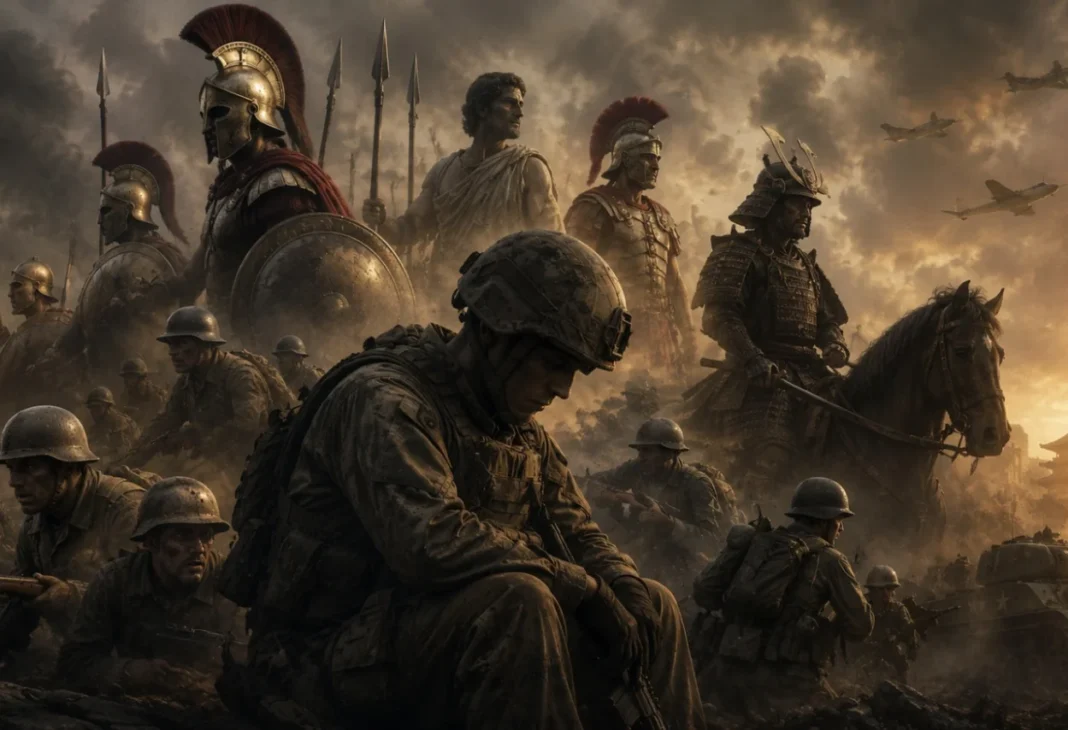

The Invisible Frontline: War And The History Of Soldiers’ Mental Health From Antiquity To The Present
In the Hope of a World Without War; with my deepest and most sincere respect to all honorable soldiers who walk hand in hand with death to protect their homelands, honor, families, and countless unknown lives; to those who fell to the earth, those left half-standing, and all who served their countries…
As the battle raged fiercely on the Plain of Marathon, the Athenian soldier Epizelus raised his shield and charged forward. Amid the dust, screams, and clashing spears, he hesitated for a brief moment. Then, before him appeared a terrifying figure taller than any man, its beard reaching down to its chest. Its gaze pierced through Epizelus and fixed upon the soldier behind him. In a single motion, the creature split the man in two and swept past Epizelus like the wind. Epizelus did not flee. No blood was shed, nor had any steel, stone, or club touched his body — yet in that instant, the light vanished from his world; darkness descended upon his eyes and never lifted again. When the battle ended, he was still alive, but Marathon left him only an endless night. For years, behind his sightless eyes, the same moment echoed endlessly: that silent and chilling encounter which never touched his body, yet stole his life away.
Throughout history, wars have left more than bodies and weapons fallen upon the soil; what remained incomplete were not merely limbs and shattered armor, nor were the wounded only soldiers and animals… Alongside them, countless intangible possessions — minds, souls, and relationships — were orphaned as well. Yet unlike physical wounds, these psychological consequences remained largely invisible and were for centuries either misunderstood or entirely ignored. Conditions that today are explained through concepts such as trauma, anxiety, and depression were once described under very different names and meanings. This article examines the psychological effects of war on soldiers from antiquity to the present day, tracing the historical transformation of these “invisible wounds.”
Antiquity: The First Traces of War Upon the Mind
Although the ancient world possessed neither a systematic theory nor a precise concept regarding the psychological effects of war upon the human mind, indirect descriptions of remarkable mental changes experienced by soldiers after battle can be found in Mesopotamian, Egyptian, and Greek sources. These texts portray conditions such as restlessness after combat, exaggerated startle responses, nightmares, feelings of being cursed by the gods, social withdrawal, and emotional numbness, even if they were not explicitly named. Initially, such disturbances were interpreted through religion and mythology, often regarded as divine punishment or fragmentation of the soul. Later, Hippocrates’ understanding of melancholia — though not specifically war-related — contributed to the emergence of broader psychological interpretations.
From Rome to the Early Modern Era: Melancholia, Soldier’s Fatigue, and Unnamed Trauma
Following Antiquity, during the Roman, Medieval, and early modern periods, the psychological effects of war still lacked a unified scientific framework. Consequently, symptoms among soldiers such as withdrawal, hopelessness, fear, and emotional collapse were generally interpreted under the concept of melancholia and often viewed as weakness or indiscipline. Rooted in the Hippocratic tradition, this understanding continued to explain psychological suffering through bodily imbalances. From the Roman era onward, the exhaustion and functional decline observed in soldiers returning from prolonged campaigns were occasionally described as soldier’s fatigue. Rather than a modern diagnosis, this term represented an observational acknowledgment of the chronic wear inflicted by warfare. During the early modern era, especially amid increasingly destructive conflicts, expressions such as war melancholia and the more literary powder melancholy emerged. These concepts referred less to the physical consequences of war than to the prolonged psychological deterioration experienced by soldiers.
“Nostalgia”: Homesickness as Illness
In the 17th century, nostalgia, first defined by Johannes Hofer, was recognized as a severe condition particularly common among mercenary soldiers. Unlike the modern understanding of simple homesickness, it described a grave syndrome characterized by loss of appetite, insomnia, hopelessness, emotional collapse, fatal exhaustion, intense longing for home, melancholia, hallucinations, and even suicidal desires — at times ending in death. What soldiers experienced was, in many respects, a combination of trauma, separation, and chronic stress. Nostalgia remains significant as one of the earliest attempts to medically name the psychological consequences of war.
The 19th Century: “Soldier’s Heart” and Da Costa Syndrome
During the American Civil War, Jacob Mendes Da Costa described a condition known as Irritable Heart Syndrome (Da Costa Syndrome), characterized by palpitations, shortness of breath, and exhaustion. At the time, it was believed to be a physical cardiac illness; today, however, it is understood largely as anxiety- and trauma-related. This period marked an important transition in recognizing that war trauma could manifest through bodily symptoms.
World War I: “Shell Shock”
During World War I, symptoms such as paralysis-like freezing, loss of speech, blindness, nightmares, aggression, tremors, and sudden reactions to battle sounds following intense bombardments became known as Shell Shock. The term was first introduced by Charles Samuel Myers. Initially, it was believed that artillery blasts caused physical brain damage through pressure waves. However, when similar symptoms appeared even in soldiers who had never approached the front lines, it became clear that these reactions were psychological responses to trauma.
During this period, physicians also began using the term war neurosis, while some cases were classified under contemporary diagnoses such as neurasthenia (“nervous weakness”) or hysteria. Neurasthenia was more commonly applied to officers and regarded as a more “respectable” diagnosis, whereas hysteria was often assigned to lower-ranking soldiers. This terminology reflected the prejudices of the era as much as medical understanding. The devastating atmosphere of the war also revived more literary expressions such as gunpowder melancholia to describe soldiers’ mental suffering. Tragically, many soldiers were accused of cowardice or weakness and were even punished. This period constitutes one of the darkest chapters in the understanding of war psychology, while simultaneously contributing significantly to the later conceptualization of Post-Traumatic Stress Disorder.
World War II: Combat Stress and Early Intervention
With World War II, the psychological struggles experienced by soldiers began to be approached more systematically. The term shell shock gradually gave way to concepts such as battle fatigue and operational fatigue. In later years, particularly during the Korean War, this condition would become more systematically defined as combat stress reaction. This shift reflected a growing understanding that the issue stemmed less from physical injury and more from overwhelming stress and exhaustion.
The principal symptoms observed among soldiers during this period included intense anxiety and panic, difficulties with concentration and decision-making, severe exhaustion and burnout, sleep disturbances and nightmares, heightened startle responses, emotional numbness or excessive emotional reactivity, avoidance of duty, and functional impairment. One of the defining characteristics of World War II was the changing attitude toward these symptoms. Rather than being regarded as signs of weakness, they increasingly came to be viewed as natural consequences of war. The use of the term “fatigued” instead of “ill” was intended to reduce stigma. In line with this perspective, the PIE principles (Proximity, Immediacy, Expectancy) — emphasizing treatment close to the front line, immediate intervention, and the expectation of recovery — became foundational to modern military psychiatry. This period marked a turning point in which war-related psychological disorders were not only identified but also actively managed. These developments directly contributed to the later understanding and treatment of trauma-based disorders, particularly Post-Traumatic Stress Disorder.
From the Post-Vietnam Era to the Present: The Institutionalization of Trauma
Among veterans returning from the Vietnam War, persistent nightmares, flashbacks, emotional outbursts, social withdrawal, and tendencies toward substance use became increasingly recognized under the term post-Vietnam syndrome. This period clearly demonstrated that the psychological consequences of war could continue long after combat had ended. In 1980, with the publication of the DSM-III by the American Psychiatric Association, these symptoms were formally consolidated under a single diagnosis: Post-Traumatic Stress Disorder (PTSD).
Today, trauma is no longer understood solely as a fear-based process but rather within a broader and multidimensional framework. One particularly significant concept is moral injury, referring to the guilt, shame, and loss of meaning experienced when soldiers are exposed to situations that conflict with their moral values during or after war. In the modern perspective, PTSD is no longer viewed merely as an isolated illness but as part of a broader trauma spectrum. History demonstrates, in every era and every war, that some battles never truly end — even after one returns home.
Kaynakça
- American Psychiatric Association. (1980). Diagnostic and statistical manual of mental disorders (3rd ed.). Author.American Psychiatric Association. (2013). Diagnostic and statistical manual of mental disorders (5th ed.). Author.Da Costa, J. M. (1871). On irritable heart: A clinical study of a form of functional cardiac disorder and its consequences. The American Journal of the Medical Sciences, 61(121), 17–52.Glass, A. J. (1967). Military psychiatry. In S. Arieti (Ed.), American handbook of psychiatry (Vol. 2, pp. 520–522). Basic Books.Grinker, R. R., & Spiegel, J. P. (1945). War neuroses in North Africa: The Tunisian campaign. Josiah Macy Jr. Foundation.Herman, J. L. (1992). Trauma and recovery: The aftermath of violence–from domestic abuse to political terror. Basic Books.Herodotus. (2003). The Histories (R. Waterfield, Trans.). Oxford University Press. (Original work published ca. 440 BCE).Hofer, J. (1934). Medical dissertation on nostalgia (C. K. Anspach, Trans.). Bulletin of the History of Medicine, 2(6), 376–391. (Original work Dissertatio Medica de Nostalgia published 1688).Jones, E., & Wessely, S. (2005). Shell shock to PTSD: Military psychiatry from 1900 to the Gulf War. Psychology Press.Litz, B. T., Stein, N., Delaney, E., Lebowitz, L., Nash, W. P., Silva, C., & Maguen, S. (2009). Moral injury and moral repair in war veterans: A preliminary model and intervention strategy. Clinical Psychology Review, 29(8), 695–706.Myers, C. S. (1915). A contribution to the study of shell shock: Being an account of three cases of loss of memory, vision, hearing, and taste, admitted into the Duchess of Westminster’s War Hospital, Le Touquet. The Lancet, 185(4772), 316–320.Porter, R. (2002). Madness: A brief history. Oxford University Press.Scull, A. (2015). Madness in civilization: A cultural history of insanity, from the Bible to Freud, from the madhouse to modern medicine. Princeton University Press.Shay, J. (1994). Achilles in Vietnam: Combat trauma and the undoing of character. Scribner.Shephard, B. (2001). A war of nerves: Soldiers and psychiatrists in the twentieth century. Harvard University Press.