



Introduction
So what does a holistic, dynamic, relational flow model even mean? Whatever it is, how is it different from the kind of “flow” we already know? And what do I mean when I say “model”? What are its building blocks? Does it have a foundation, a framework? And where exactly am I within all of this?
We’re going to unpack all of these questions together, one by one, and by the end of this piece, we’ll anchor what we’ve explored through a small but meaningful practice.
Before diving into the model itself, I’d like to briefly share how it came into being. In my field, there are certain approaches I’m deeply drawn to psychodynamic perspectives and mind–body integration frameworks that I genuinely enjoy moving within; getting lost, finding my way back, and carving out new paths. Through the questions they’ve sparked in me and the windows they’ve opened, I found myself wanting to disentangle and interconnect some of the core concepts these fields emphasize.
More specifically, I wanted to make sense of the flow a person moves through in life. Their mental, bodily, and relational engagements; the steps they take consciously or unconsciously; the moments where they get pulled into certain themes and deepen their understanding, and the times they circle around the same thoughts again and again, caught in “rumination.” I wanted to map the possible transitions from one point to another and ask: how can we move through all of this without wearing ourselves down, but instead by aligning with it, feeding it, and being fed by it?
From that question, I set out to create a guiding “model” in my own way.
But the purpose of this model is not to categorize possible paths and reduce everything to a single line of causality, narrowing our perspective into a tiny keyhole. Rather, it is to take something that often feels vast, scattered, and overwhelming, and turn it into a space we can work with a map we can carry in our pocket when we feel lost. A kind of playground where we choose both the direction we go and how we get there.
So, if you’re ready, let’s begin.
Let’s Get To Know Our Map:
To understand the model, I’ll start by introducing five core concepts; elements that are quite close to one another, yet fundamentally different in what they represent. If you’d like, you can either imagine this or grab a pen and paper and draw it along with me.
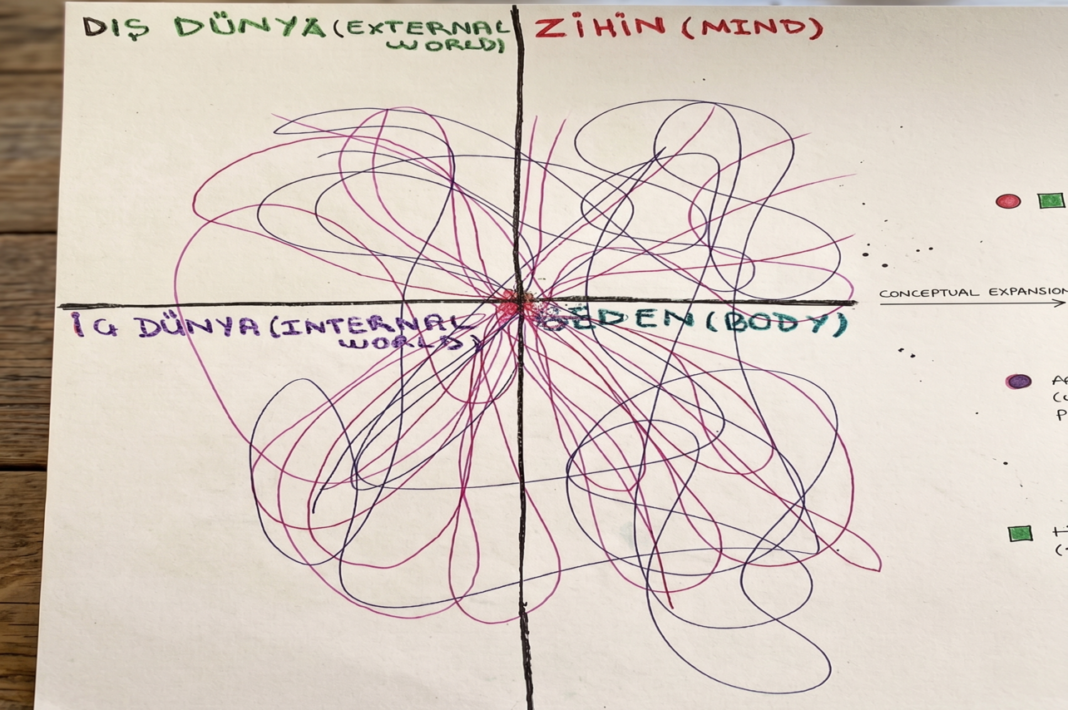
First, take a piece of paper and a pen. Then draw one vertical and one horizontal line so that they intersect exactly at the center of the page.
Now, to make sense of this space, I’ll introduce five elements: four areas formed by the intersection of these lines (starting from the top-left and moving clockwise: External world, Mind, Body, Internal world), and the intersection point itself (Equanimity).
These are concepts that can be approached in infinitely many ways, through infinitely many perspectives. Of course, these perspectives share certain overlaps while also carrying clear differences. That’s why, before defining the terms themselves, I want to clarify the lens I’ll be using so we can avoid confusion.
I will approach the concepts of mind and body through contemporary research, particularly trauma-informed and mind-body integrated psychosomatic frameworks. Internal and external worlds, on the other hand, will be defined through a psychodynamic lens, while equanimity will be explored through mindfulness literature.
Before moving into precise definitions, I want to give a rough sense of what we’re talking about through these four areas: body, mind, internal world, and external world. These are concepts backed by countless studies, books, and entire fields of study; concepts that open up entirely new layers the deeper you go. But if we stay with a simplified version for now:
The signals perceived and regulated by the body operate together with the mind’s processes of meaning-making. This meaning-making is influenced by the relational and emotional patterns offered by the internal world, while at the same time being continuously shaped by the context of the external world.
The point where our lines intersect corresponds to what is called “equanimity” in mindfulness literature. It can be described as a kind of “unshaken inner balance” . A subtle ground of awareness where one remains in contact with body, mind, internal world, and external world, yet without dissolving into or being carried away by them.
And one last thing to underline: we are not fixed at a single point in this space. We are in constant motion. This movement includes all kinds of shifts within and between areas; micro or macro; fast or slow; frequent or rare. In lived experience, this means that as life unfolds, we move from one place to another; sometimes drifting, sometimes getting stuck, sometimes caught in narrowing loops, and at other times finding our way back toward our center.
Our Conceptual Map:
Mind is a dynamic process of regulation and meaning-making, shaped through the organism’s nervous system states, bodily sensations, and relational experiences; it organizes itself around perceptions of safety and threat.
Body is a living system of regulation and memory that registers, organizes, and expresses experience through the nervous system; continuously shifting in response to signals of safety, threat, and connection.
Internal world is the subjective psychological space shaped by early relational experiences; composed of internalized object representations, affects, fantasies, and unconscious patterns of meaning-making.
External world is the physical, social, and interpersonal reality that exists independently of the individual; yet from a psychodynamic perspective, it is always experienced through the filters of the internal world.
Equanimity is the capacity to relate to internal and external experiences without suppressing them or becoming consumed by them; approaching them with a balanced, open, and low-reactivity awareness.
If Our Model Is Ready, Let’s Set It In Motion:
Dear reader, in this final section, I invite you to embody what you’ve just read. Choose a starting point within the space you’ve drawn, and without lifting your hand from the paper, begin to draw a line that represents your movement from one point to another.
As you do this, I have one request: remember that everything in the cosmos ,living or non-living, is inherently dynamic. Even in the moments where things seem still, there is always movement. So let your hand move with that in mind.
To choose your starting point, you can begin with your day today; from the moment you woke up until this very moment of reading.
What path has your system followed? Is there a consistent direction? Are there repetitions? Are there areas where it got stuck? How is the distribution across the fields? Where did you spend more time, and what did you neglect?
With all of this in mind, take a deep breath and begin drawing. Let’s see where your hand takes you.
Now, I invite you to take a new blank sheet of paper and draw the same model again, following the same steps. But this time, I ask you to make every transition between points by passing through the center, through equanimity.
When you finish, pause and notice. When you compare the two drawings, what do you see? What similarities and differences stand out?
Equanimity is not an ideal state you are supposed to permanently be in. Rather, it is a transition point; a center you return to before moving from one point to another. A place where you don’t get lost in the demands of the external world, nor drown in the depths of the internal world; where mind and body are not split apart; where you align with your own flow and the flow of life itself. A center that allows a grounded spontaneity to emerge within these holistic, dynamic, relational movements; a kind of harmonic rhythm.
This is also the point where all fields intersect. You’re not lost in any of them, but you’re directing your attention to how they all move together like a harmonious orchestra. Toward your bodily signals like your heartbeat that you usually forget but couldn’t exist without; toward your thoughts, not by getting pulled into them but by noticing them pass; toward the unconscious patterns in your internal world, allowing them to gently reveal themselves when you’re ready. And while all of this is happening, the external world keeps flowing too; from the wind touching your skin to someone in morning traffic rolling down their window and turning up the music. Everything is in motion. But this flow doesn’t pull you in; you’re simply witnessing it.
And the best part? You don’t need to close your eyes and meditate to access this state. That’s exactly what makes it so flexible; it can happen anywhere. While walking, sitting on your couch in your fourth hour at work, before going to bed when you gently put your phone down, the moment you first open your eyes, in the bathroom, in the shower, while cooking…
Notice these small pauses scattered throughout your day, and try to meet them. Let’s see what happens.
Now take a deep breath in through your nose, and slowly exhale through your mouth. Then you can place this map in your “pocket.”
Remember: this flow is uniquely yours. Only you can truly know which paths to take, how, when, where, and why.
Enjoy the journey!