


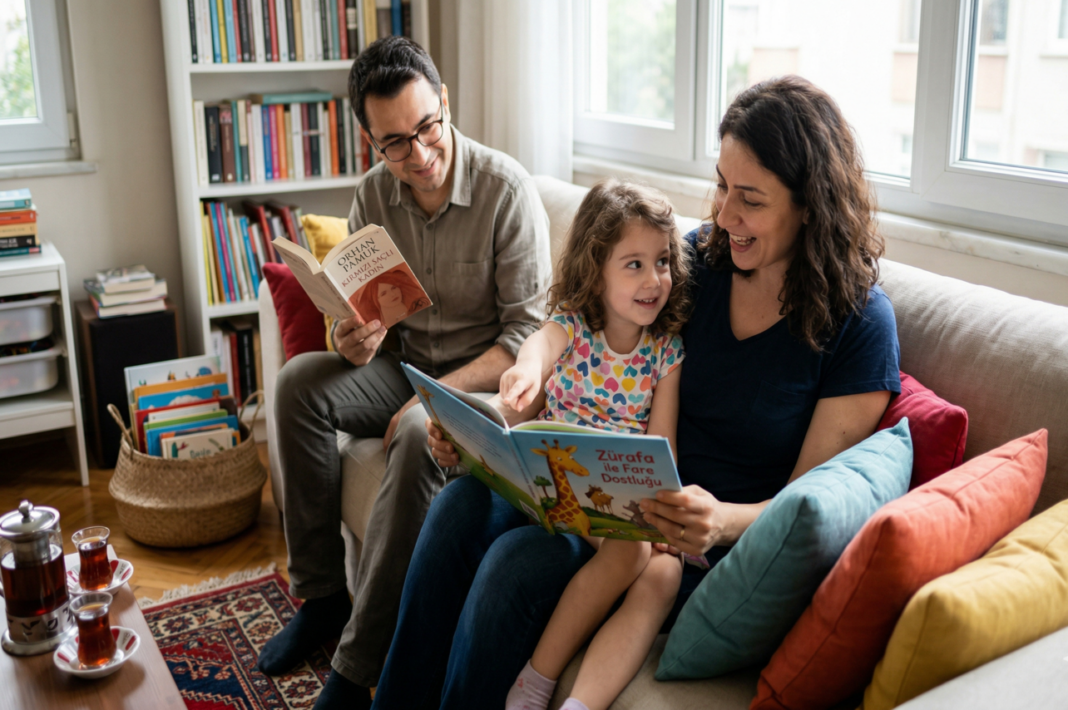

Books are important elements that enrich children’s imagination and emotional world. They not only develop and enrich a child’s imaginative world but also contribute to emotional development and, most importantly, positively impact language development, which is crucial for a child’s overall development. While reading a book, a child’s ability to visualize the events in their imagination and empathize with the characters enriches their mind and emotional world. Therefore, it is very important for a child to read, develop a regular reading habit, and cultivate a love for books. The most critical role in instilling this regular reading habit falls to the parents in the family, where the individual first opens their eyes to the world. Parents precede the social environment in terms of emotional and cognitive development and behavior formation, and the first role models an individual observes are their parents and family members. Therefore, for parents to instill a reading habit in their children, it is crucial for them to serve as role models, establishing reading times at home and engaging in activities together with discipline and routine. Introducing positive habits to children from an early age ensures that these attitudes and behaviors become permanent. At this point, it is essential for parents and household members to set an example for the child. Home reading times will support school reading activities and hours. Thus, students will be encouraged to read daily outside of school, enhancing their love for reading and developing a reading habit. Ultimately, this will positively influence students’ academic success both in school and outside. Supporting the positive development of this reading habit highlights the importance of parents paying attention to certain factors when purchasing books for their children. Selecting works appropriate to the child’s level and interests is a critical consideration, as it will determine the reading culture instilled in the child (Ünal et al., 2014).
The Development Of Reading Skills and Early Childhood Preparation
Observing reading habits in individuals shows that this develops after children acquire reading skills. Therefore, while children should start developing positive relationships with books at an early age, instilling a reading habit alongside learning to read is a critical matter that requires immediate attention. Cultivating a love for books, fostering curiosity for learning, and developing enjoyment in reading are crucial for establishing a lasting positive habit in the child’s later life. Visual reading before learning to read is an important preparatory step for progressing toward this process and establishing a reading habit. The child’s communication and bond with books are significantly reinforced through such activities, especially with parental support at home and in daily life. Therefore, illustrations in children’s books should be appropriate for their interests and age, selecting works that stimulate their imagination and enrich their emotional and cognitive worlds. The most important responsibility in this regard lies with the parents who know their child best. This parental approach can meet children’s emotional, cognitive, achievement, affection, and learning needs. Through this, the child learns to relate imagination with the real world and recognize similarities and differences. Childhood activities, supported and enriched by parents, provide various options for the child’s personality development and behavior, enabling growth in multiple dimensions (Bayram, 2009).
Guidance In Book Selection and School-Family Collaboration
Thus, when choosing books, children should be guided by parents and teachers according to their interests. Parents, in particular, are well-placed to understand their child’s interests and provide proper guidance. School-family collaboration, i.e., communication between parents and teachers, is also significant. Considering the individual’s developmental process, personal characteristics and interests vary at each age level. Therefore, books that capture a child’s interest may also change. Young children particularly enjoy illustrated books. At the primary education level, besides illustrated books, children show interest in novels, informational books, and science/nature-themed books. Parents can make book recommendations to children considering these factors (Tanju, 2010). Reading times shared with children motivate them to develop and sustain a reading habit. Additionally, these activities not only foster a love for reading but also create opportunities for parents and children to spend time together, supporting and positively developing their relationship through various activities and games.
Interactive Reading and Emotional Regulation Benefits
A study with Chinese parents and children observed that as communication between parents and children increased, parents’ confidence in their parenting also grew, and they began to adopt practices suitable for their children (Aslan, 2024). During interactive reading with parents, for example, the child talks about the book, asks questions, comments, and makes explanations, enhancing verbal expression while developing reading, comprehension, and expressive skills (Ergül et al., 2015). Interactive reading in such an environment contributes to language development, thereby supporting cognitive growth (Çelik et al., 2020). Another study examined how reading habits of 11–13-year-old students influenced their emotional regulation skills. It concluded that developing a reading habit positively contributes to children’s emotional regulation. Characters in books can serve as mirrors for children to see themselves and explore empathy and other emotions by placing themselves in the characters’ positions. The experiences, struggles, and challenges of book characters provide positive outcomes for emotional regulation and the development of emotional awareness (Savran et al., 2025).
Conclusion
In conclusion, parents should serve as good guides in children’s book selection while also supporting and being role models in fostering a reading habit.
REFERENCES
Aslan, D. (2024). Effects of an Interactive Book Reading Program on Parental Behavior and Parent-Child Interaction, Ana Dili Eğitimi Dergisi, 12(2), 254-275, p. 268.
Bayram, Z. T. (2009). The Effect of Illustrated Children’s Books on Reading Habits, Istanbul, p. 132.
Çelik, G. H., Er, S., Bıçakçı, M. Y. (2020). The Effect of Interactive Book Reading on Children’s Language Development, Ebelik ve Sağlık Bilimleri Dergisi, 3(3), 1-10, p. 6.
Ergül, C., Sarıca, A. D., Akoğlu, G. (2016). Interactive Book Reading: An Effective Method for Developing Language and Early Literacy Skills, Ankara Üniversitesi Eğitim Bilimleri Fakültesi Özel Eğitim Dergisi, 17(2), 193-204, p. 198.
Savran, E., Akaroğlu, E. G. (2025). The Effect of Book Reading Habits on Emotional Regulation Skills of 11-12-Year-Old Students, Ordu Üniversitesi Sosyal Bilimler Enstitüsü, SOBİAD, Vol. 15, No. 1, 14-29, p. 23.
Tanju, E. H. (2010). A General Overview of Reading Habits, Aile ve Toplum, Year: 11, Vol: 6, Issue: 22, April-June 2010, ISSN: 1303-0256, p. 37.
Ünal, F. T., Yiğit, A. (2014). The Role of the Family in Developing a Reading Culture in Children, International Journal Of Language Academy, ISSN: 2342-0251, Volume 2/4, 308-322, p. 319.