


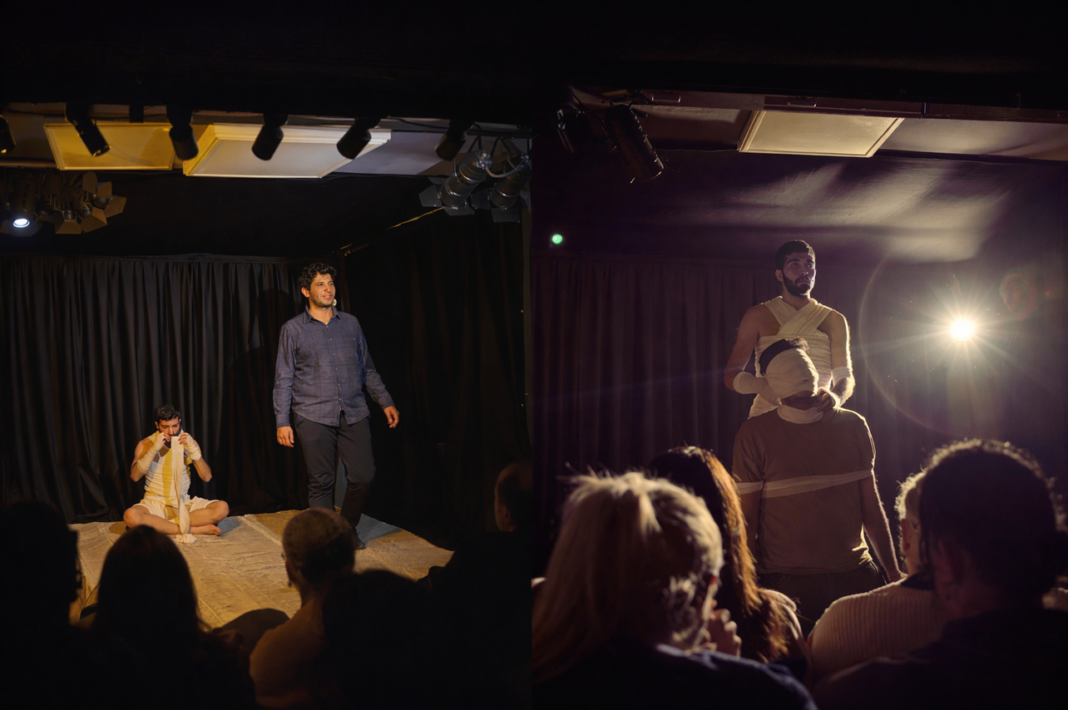

This analytical essay took root at the crossroads where my professional expertise and my personal passion converge. As a psychologist and an active theater practitioner, Boris Vian’s unsettling work has left a profound mark on both my clinical and artistic worlds. Having personally portrayed the character of Leon Dupont, I was afforded the unique opportunity to analyze his massive defense mechanisms, his detachment from reality, and his uncanny bond with the “Schmürz” not merely as an observer, but as someone who “lived” them from within. On stage, the shrinking rooms and the incessant “Noise” serve as the most concrete evidence of how the modern individual’s spiritual sanctuary can ultimately transform into a self-imposed prison.
Boris Vian’s 1959 masterpiece, The Empire Builders (Les Bâtisseurs d’Empire), does more than push the boundaries of the Theatre of the Absurd; it serves as a comprehensive “lexicon of modern defense mechanisms.” The narrative of a family constantly fleeing to higher floors to escape an amorphous “Noise” is not merely a physical relocation. It is a portrayal of the ego’s retreat into itself—a narcissistic withdrawal in the face of threatening reality.
Ontological Anxiety And The Symbolism Of “The Noise”
The central antagonist, “The Noise,” represents a fear without a defined object: pure anxiety. In a Kierkegaardian sense, this is the ontological anxiety arising from the individual’s encounter with their own nothingness. Rather than questioning the nature of the noise, the Dupont family attempts a spatial solution (escaping upward). From a clinical perspective, this is a transition from “emotional regulation” to “acting-out” behavior. Instead of processing internal unrest, the subjects attempt to bypass it through physical movement. However, each subsequent floor represents a layer of defense where the mind becomes increasingly dysfunctional.
The Schmürz And Projective Identification
The most enigmatic figure, the Schmürz, is a silent “Other” who lingers beside the family, constantly beaten but never destroyed. The Schmürz can be elucidated through Melanie Klein’s concept of projective identification. The family projects their “bad,” “weak,” and “guilty” internal parts onto the Schmürz, attempting to alleviate their own psychic pain by inflicting violence upon it.
The Schmürz also signifies the “return of the repressed.” No matter how high they climb, it is always there. The violence directed at the Schmürz is a consequence of the individual’s inability to confront their own Jungian Shadow. The refusal to name it—the silence following the question “What is a Schmürz?”—is a symptom of severe dissociation. Reality has fragmented to such an extent that the family can no longer assign a signifier to the suffering standing right next to them.
Language As A Defense Mechanism
The patriarch, Leon Dupont, utilizes language to distort reality. He presents every flight as a “strategy” and every loss as a “necessity.” This is a textbook case of heavy rationalization. His silencing of his daughter Zenobia, who represents the family’s link to the past, is an assault on memory’s potential to disrupt the mechanism of denial. In a traumatic system, the one who remembers is deemed “dangerous” because memory threatens the foundations of the false empire being constructed.
Narcissistic Isolation And The Death Drive (Thanatos)
The final scene, where the father is left alone on the highest floor, depicts a total psychic bankruptcy. Social bonds (the mother and the maid, Cruche) and object relations have severed one by one. What remains is a man stripped of his escape routes, left alone with a grandiose yet hollowed-out self. The shrinking room becomes a metaphor for a claustrophobic tomb. The end of the flight is an inevitable embrace of the very thing being fled: death and nothingness.
The period in which the play was written (the late 1950s) was a time when France was waging a bloody war in Algeria, and French society was largely in a state of profound denial and silence regarding the conflict. The Schmürz represents the “colonized people” or the “victims of war” whom French society ignored, tortured, but never officially acknowledged. As a staunch pacifist, Vian criticized the French middle class (represented by the Dupont family) for retreating into their small comfort zones—their so-called “Empires”—while a great atrocity (The Noise) was occurring outside, all while systematically dehumanizing the tragedy (The Schmürz) right next to them.
Vian leaves psychologists with a critical question: Which “noises” are our clients trying to drown out through their escapes to “higher floors” (careerism, status, or intellectualization)? The Empire Builders demonstrates that defense mechanisms eventually create a prison rather than a sanctuary. The therapeutic process should not be about moving the client to a higher floor, but rather encouraging them to walk back down the stairs and finally hold the hand of their own “Schmürz.”
References
-
Esslin, M. (1961). The Theatre of the Absurd. Anchor Books. (For the historical and structural context of Vian’s work within the Absurdist movement).
-
Freud, S. (1926). Inhibitions, Symptoms and Anxiety. Standard Edition, Vol. 20. (Foundational text for the mechanics of anxiety and defense).
-
Jung, C. G. (1951). Aion: Researches into the Phenomenology of the Self. (Regarding the “Shadow” archetype and its projection).
-
Kierkegaard, S. (1844). The Concept of Anxiety. (For the philosophical roots of ontological dread and nothingness).
-
Vian, B. (1959). Les Bâtisseurs d’Empire ou Le Schmürz. (The primary source text).