


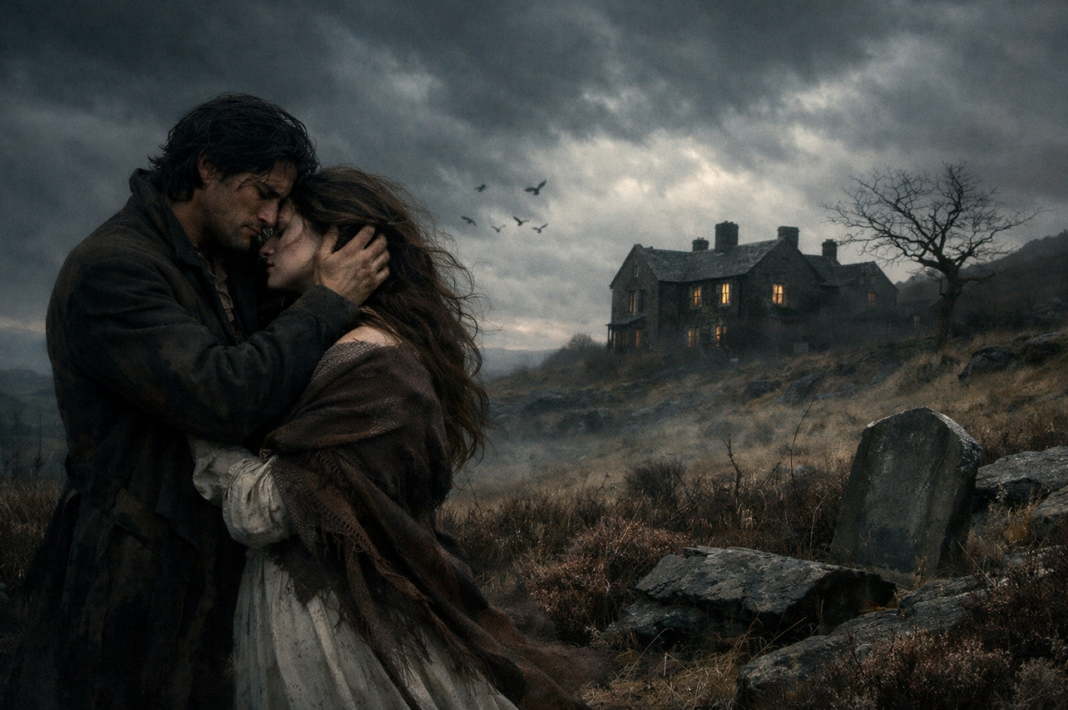

Some relationships appear, from the outside, to be filled with great passion and irreplaceable love. Yet upon closer examination, they reveal themselves as two wounded souls clinging to one another. Wuthering Heights is not merely a Gothic love story; it is a powerful psychological narrative in which trauma, attachment, and identity conflicts intertwine.
A Child In The Shadow Of Trauma: Heathcliff
Heathcliff’s story begins not with love, but with exclusion and humiliation. The neglect and worthlessness he experiences in childhood shape his fundamental attachment patterns. According to attachment theory, early relationships determine how individuals answer the question, “Am I worthy of love?” For Heathcliff, the answer is largely “no.”
A child who grows up unloved may later perceive love not as a secure bond, but as something that must be possessed at all costs. At this point, love is no longer built on intimacy but on control. Heathcliff’s anger, vengeance, and relentless pursuit of power in adulthood are not merely signs of a villainous personality; they are the hardened shell of trauma.
Traumatic Bonding: Passion Or Dependency?
The relationship between Catherine and Heathcliff resembles traumatic bonding far more than a healthy romantic attachment. Traumatic bonds develop in relationships marked by intense emotional highs and lows, fear of abandonment, and mutual wounding. A person may become even more attached to the very figure who causes pain, because the bond is no longer associated solely with love, but also with a sense of survival.
Catherine’s declaration, “I am Heathcliff,” signals a fusion of identities rather than the existence of two separate individuals. In healthy relationships, boundaries remain intact; in traumatic bonds, separation is experienced not as loss, but as annihilation. Heathcliff’s obsessive grief following Catherine’s death reflects the cry of a self that never fully differentiated.
A Soul Torn Between Identity and Status: Catherine
Catherine is not only a lover; she is also an individual divided between social status, belonging, and emotional longing. On one side stands the intense emotional connection represented by Heathcliff; on the other, the security and respectability offered by society. This inner conflict fractures her sense of identity.
Psychologically speaking, Catherine’s choice is not merely a marriage decision; it is her answer to the question, “Who should I be?” Yet repressed emotions threaten the integrity of the self. As internal division deepens, psychological tension intensifies.
Revenge, Power, and Control
Individuals shaped by trauma often attempt to compensate for their vulnerability through the pursuit of power. Heathcliff’s acquisition of wealth, his need to dominate others, and his calculated revenge represent an attempt to reclaim lost worth. Yet control does not bring healing. On the contrary, it perpetuates trauma across generations.
The Intergenerational Transmission Of Trauma: The Burden Of The Second Generation
As the novel progresses, the suffering of the second generation demonstrates the transmissible nature of trauma. An unhealed wound harms not only its bearer, but also those around them. The novel does more than portray the destructive bond between Heathcliff and Catherine; it also reveals how unresolved trauma is passed down through generations. Heathcliff’s anger and vengeance reappear in the next generation as emotional neglect, control, and oppression.
Trauma literature suggests that unprocessed pain can be transmitted within family systems through behavioral patterns, relational dynamics, and emotional responses. In the novel, children become the inheritors of conflicts their parents could not resolve. Thus, the wound created by love affects not only two individuals, but an entire family system. Yet the softer, more reconciliatory dynamics seen in the second generation also open a hopeful window: the cycle of trauma can be broken. In this sense, the novel whispers not only of destruction, but of the possibility of healing.
Romanticized Pain
Perhaps the most striking point is this: the relationship is often labeled a “great love.” Yet psychologically speaking, intensity is not a marker of healthy attachment. Extreme jealousy, possessiveness, and the rhetoric of “I cannot live without you” may signal dependency rather than love.
True love allows two separate selves to exist side by side. In traumatic bonding, however, two individuals cling to each other in order to survive. Even if the relationship ends, the bond may continue in the mind.
Wuthering Heights reveals that love is not only romantic, but also destructive, transformative, and at times deeply traumatic. The real question may be this: Are the relationships that shake us to our core truly great love, or merely the echo of unhealed wounds?
A Love Story In The Shadow Of Traumatic Bonding
In Wuthering Heights, the wind never truly settles. For what blows through that house is not merely the storm of nature, but the echo of suppressed pain. The love between Heathcliff and Catherine is not the voice of passion, but of unresolved trauma. Perhaps this is why the story captivates us; because within each of us, there is a little storm. Yet living in the storm is not destiny. Sometimes the greatest courage lies not in romanticizing the wound, but in choosing to heal it.