


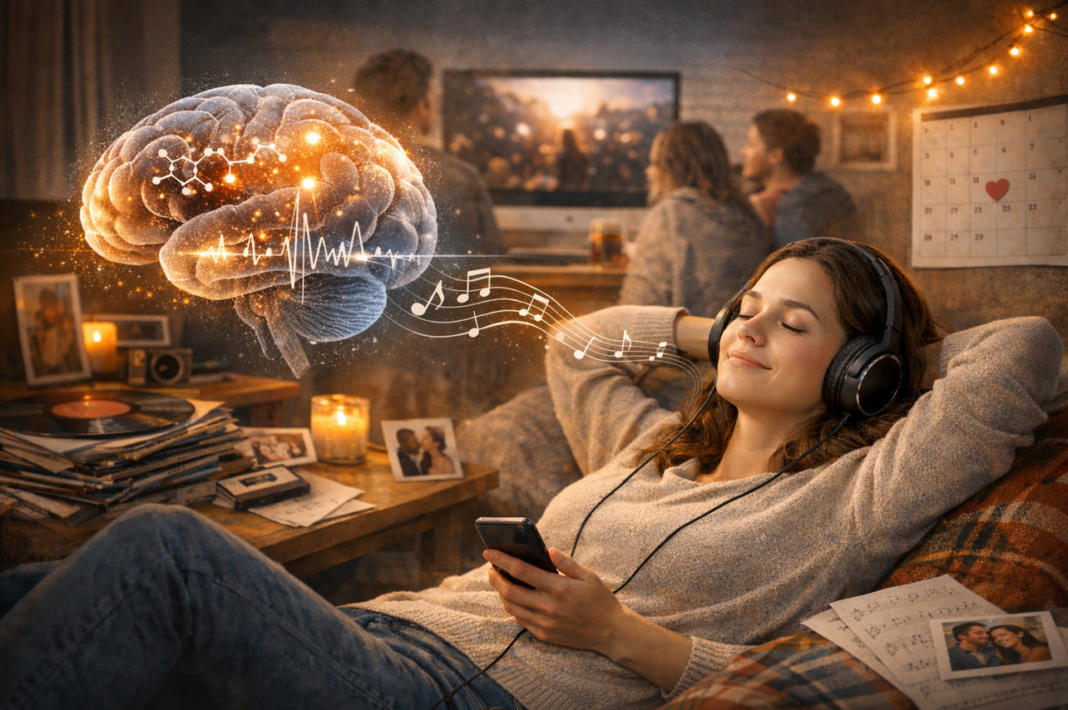

Music occupies a central place in our lives, and it has done so throughout human history. We express love, joy, excitement, sadness, and longing through music. Thanks to music, many emotions do not need to be articulated in words. Have you ever found yourself listening to the same song repeatedly? At times, we play certain songs back-to-back for hours, or even for days. This behavior—commonly referred to as “putting a song on repeat”—has clear psychological and neuroscientific explanations.
Why do we feel compelled to listen to certain songs over and over again? What psychological mechanisms underlie this behavior? This article explores the key factors that drive the desire to repeatedly listen to the same piece of music.
1. Dopamine Release In The Brain
The human brain contains a reward system closely associated with pleasure and motivation. When this system is activated, it triggers the release of dopamine, a neurotransmitter that plays a central role in experiences of pleasure and reward. Dopamine reinforces behaviors that are perceived as enjoyable, increasing the likelihood that they will be repeated.
Listening to music—particularly music that an individual enjoys—stimulatesdopamine release. As a result, the brain becomes inclined to seek out and repeat musical experiences associated with positive emotions. A study by Salimpoor and colleagues (2011) demonstrated that listening to preferred music leads to significant dopamine release in the brain’s reward centers. This finding helps explain why music can be such a powerful source of pleasure and why certain songs are repeatedly sought out.
2. Memory and Familiarity
The brain processes familiar stimuli using less cognitive energy than unfamiliar ones. This phenomenon is often referred to as the familiarity effect. Songs that have been listened to many times become predictable and cognitively “safe,” allowing the brain to experience pleasure with minimal effort. Re-listening to a song is therefore closely linked to the brain’s preference for familiarity.
In addition, music enables strong emotional connections with memory. Certain songs become associated with personal experiences, specific individuals, or particular periods of life. When a song is linked to meaningfulautobiographical memories, listening to it can reactivate the emotions originally experienced during those moments. These emotional associations can significantly increase the desire to listen to the same song repeatedly. Research also shows that music is strongly connected to autobiographical memory. Studies indicate that music can rapidly and vividly evoke emotions tied to past experiences (Janata, 2009), further reinforcing repeated listening behaviors.
3. Emotional Attachment and Catharsis
Music often facilitates emotional release. Depending on one’s current emotional state, repeatedly listening to a particular song can help process emotions and promote emotional relief. This process can be understood through the concept of catharsis, which refers to emotional release and psychological relief.
For example, repeatedly listening to a breakup song may help an individual externalize emotional pain and make it more manageable. Research supports the idea that music serves as an effective emotion regulation strategy, particularly during periods of sadness, grief, or stress (Thayer, Newman, & McClain, 1994).
4. Neuroplasticity and Habit Formation
The brain is shaped by habits, and this capacity for change continues throughout life—a phenomenon known as neuroplasticity. Repeated behaviors strengthen neural connections. Listening to a song on repeat repeatedly activates specific neural networks, reinforcing preferences associated with that song. Over time, this pattern can develop into a habitual listening cycle.
Changes in musical preferences may also be accompanied by changes in brain structure and function, further influencing why certain songs are favored over others.
5. Social and Cultural Influences
In today’s digital age, social media platforms significantly increase exposure to music. Songs used in short videos, television series, or popular online content can become embedded in our minds through repeated, often involuntary exposure.
Many people report initially finding a song unremarkable, only to later realize they are humming it after encountering it repeatedly on social media or within their social circles. Eventually, they may begin listening to the song intentionally and even placing it on repeat. Even in the absence of strong emotional intensity, such songs often feel “familiar” and “comforting.” This phenomenon can be explained by the mere exposure effect and the principle of cognitive economy.
Themere exposure effect, first described by Zajonc (1968), refers to the tendency to develop a preference for stimuli simply because they are familiar. Cognitive economy, on the other hand, reflects the brain’s inclination to conserve limited cognitive resources by favoring predictable and well-known stimuli. As a song becomes more familiar, its melody, rhythm, and lyrics require less cognitive effort to process. This creates a mentally “economical” experience, making familiar songs especially appealing during periods of stress, fatigue, or high cognitive demand.
Together, the mere exposure effect explains why songs become more likable over time, while cognitive economy explains why familiar songs are repeatedly preferred. When considered jointly, these mechanisms suggest that putting a song on repeat is both emotionally and cognitively adaptive. In addition, certain songs may gain popularity due to social or cultural contexts, such as weddings, holidays, or seasonal celebrations, further increasing their likelihood of repeated listening.
Conclusion
Putting songs on repeat is the result of an interplay between psychological, neuroscientific, and cultural factors. Dopamine release, familiarity, emotional attachment, neuroplasticity, and social influences all play a role in shaping this behavior. Each of these dimensions helps explain why we are drawn to listening to the same song repeatedly.
Ultimately, this behavior reflects a natural desire to regulate emotions and seek pleasure. Ongoing research into the effects of music on the brain continues to provide valuable insights into human psychology and emotional experience.
References
-
Janata, P. (2009). The neural architecture of music-evoked autobiographical memories. Cerebral Cortex, 19(11), 2579–2594. https://doi.org/10.1093/cercor/bhp008
-
Salimpoor, V. N., Benovoy, M., Larcher, K., Dagher, A., & Zatorre, R. J. (2011). Anatomically distinct dopamine release during anticipation and experience of peak emotion to music. Nature Neuroscience, 14(2), 257–262. https://doi.org/10.1038/nn.2726
-
Thayer, R. E., Newman, J. R., & McClain, T. M. (1994). Self-regulation of mood: Strategies for changing a bad mood. Journal of Personality and Social Psychology, 67(5), 910–925. https://doi.org/10.1037/0022-3514.67.5.910
-
Zajonc, R. B. (1968). Attitudinal effects of mere exposure. Journal of Personality and Social Psychology, 9(2, Pt. 2), 1–27. https://doi.org/10.1037/h0025848