


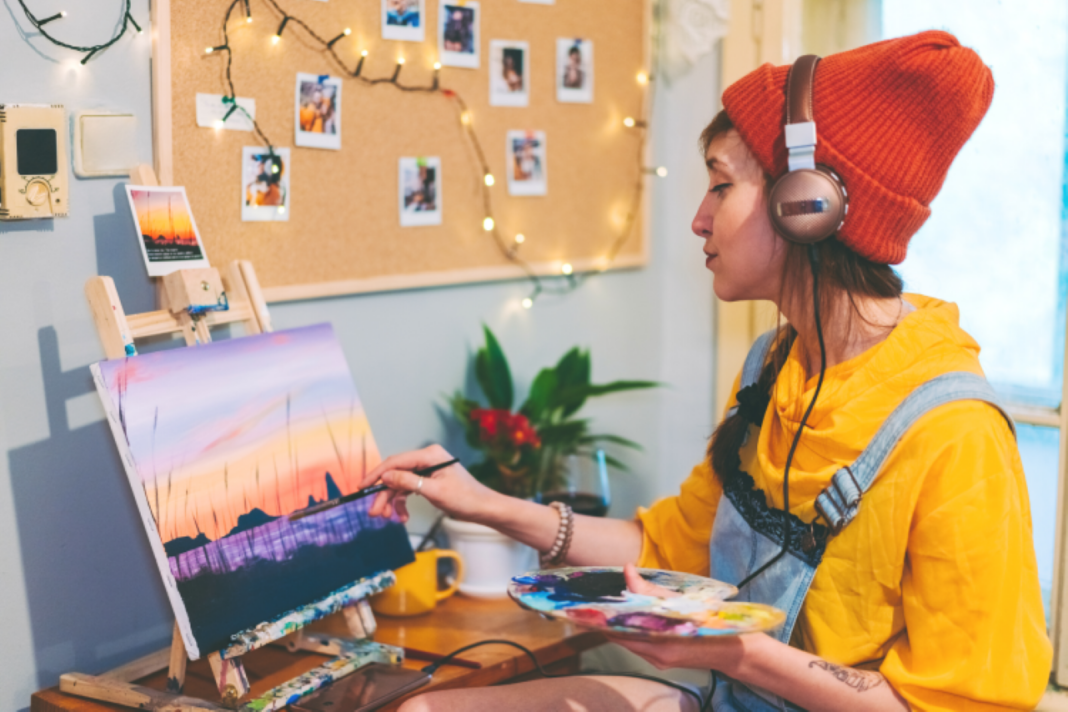

In the rush of modern life, facing a constant stream of stimulation and fast-paced culture, we often experience life as simply a never-ending list of duties. Our minds are constantly busy with daily tasks, schoolwork, career goals, and many other demands. In this chaos, a hobby is often called just a “free time activity” by popular culture. However, psychology defines hobbies not as passive acts, but as “Active Leisure.” It views them as a crucial preventive measure for protecting our mental health (Stebbins, 2007). But why do our minds need these activities that bring no direct financial gain?
The “Why”: The Need to be Ourselves
The answer to this question lies in basic human psychological needs. The Self-Determination Theory (developed by Deci and Ryan) argues that people need three things to stay psychologically healthy: Autonomy (control over our lives), Competence (feeling skilled), and Relatedness (feeling connected to others) (Deci & Ryan, 2000).
In today’s world and work life, we spend most of our time on external demands (work, school, social expectations), which often hurts our sense of autonomy. Hobbies are the space where we take back control. They are fueled by intrinsic motivation—doing something simply because we enjoy the activity itself, without expecting any external reward.
Flow and Recovery: How Hobbies Heal the Brain
The healing power of hobbies is not just about motivation; it triggers a neurobiological process too. When a person is doing an activity where their skill level matches the challenge (like painting, coding, or playing music), they enter a state called “Flow,” or the optimal experience, as defined by Csikszentmihalyi (Csikszentmihalyi, 1990).
In this state, our sense of time disappears, self-awareness fades, and the mind stops its usual cycle of worrying about the past or the future. This process stimulates the brain’s reward center, releasing dopamine, which acts as a natural stress reliever. The DRAMMA Model (Newman et al., 2014) supports this; hobbies help us detach from stress and achieve mastery, renewing our psychological resilience.
The Threat: Hobbies as Marketable Content
Although this process is naturally innocent and restorative, it is now under serious threat. With the rise of social media, hobbies are no longer private refuges; they have become “content that must be marketed.” People now focus less on the joy of painting and more on the engagement (likes and comments) the video of their painting will get.
In psychology, this situation creates the risk of the “Overjustification Effect.” This means that when an external reward (like approval or likes) replaces intrinsic motivation, the original joy of the activity decreases. The safe, private spaces where we are allowed to be imperfect—doing things just for ourselves—are shrinking. The pressure to turn every hobby into a success story or an Instagram post traps us in a constant state of “doing and showing,” moving us away from simply “being.”
Conclusion: Reclaiming the Self
Ultimately, taking up a hobby is the most respected thing modern humans can do for themselves. It is vital for our psychological resilience that this private space is not sacrificed to the digital world’s “showcase culture.”
Scientific data shows that a hobby is not just a pleasant way to spend time; it is a cognitive investment that increases mental flexibility and heals the self. Maybe what we truly need is to return to those silent activities that we keep behind closed doors—not to share, but simply to soothe our soul.
References
Csikszentmihalyi, M. (1990). Flow: The Psychology of Optimal Experience. Harper & Row.
Deci, E. L., & Ryan, R. M. (2000). The “what” and “why” of goal pursuits: Human needs and the self-determination of behavior. Psychological Inquiry, 11(4), 227–268. https://doi.org/10.1207/S15327965PLI1104_01
Newman, D. B., Tay, L., & Diener, E. (2014). Leisure and subjective well-being: A model of psychological mechanisms as mediating factors. Journal of Happiness Studies, 15, 555–578. https://doi.org/10.1007/s10902-013-9435-x
Stebbins, R. A. (2007). Serious Leisure: A Perspective for Our Time. Transaction Publishers.