


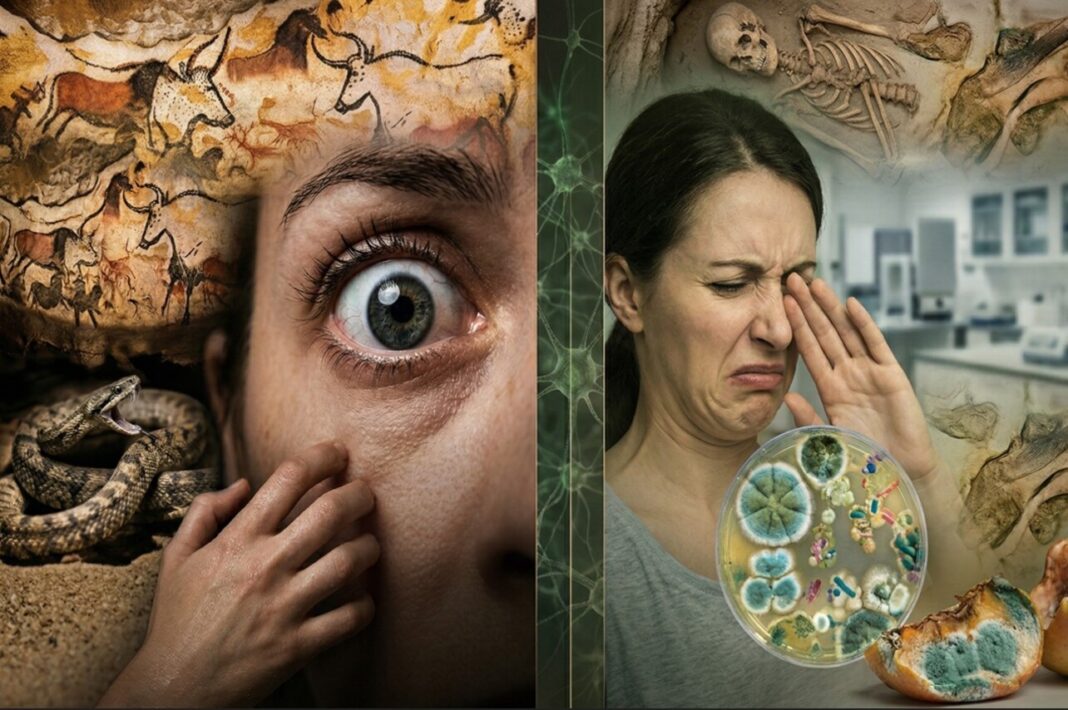

The Mind’s Alarm Systems: The Evolution of Fear and Disgust. At first glance, disgust and fear may seem like closely related emotions. Both can cause us to withdraw, both can accelerate the heart rate, and both are powerful enough to shape our behavior instantly. However, from the perspective of evolutionary psychology, these emotions are not interchangeable. Each is a specialized tool shaped by natural selection to solve very different survival problems. Understanding the distinction between them sheds light not only on human behavior but also on our species’ deep past.
Fear In Response To Immediate Threat
Fear is the human mind’s “emergency response.” Its primary evolutionary function is to manage immediate, macroscopic physical threats. When we encounter a serious danger, it triggers the classic “fight or flight” response. Its purpose is straightforward: to prevent injury or death.
Physiologically, fear is expansive. Our eyes widen to better detect threats, and our heart rate increases to pump oxygen-rich blood to our limbs. It is an action-oriented emotion. Fear is not just a feeling, it is a high-speed survival algorithm. It is highly functional and tends to exaggerate threats, because mistaking a branch for a snake is far less costly than mistaking a snake for a branch.
Disgust In Response To Invisible Threat
Disgust is quieter than fear but just as vital. It represents a sense of contamination and infection risk. While fear protects us from attacks, disgust protects us from disease. Stimuli such as rotting food, bodily fluids, parasites, and signs of illness trigger disgust. Reactions like wrinkling the nose, withdrawal, and even nausea have evolved to prevent harmful pathogens from entering the body.
Long before humans understood bacteria or viruses, disgust served as our primary defense against infection. Unlike fear, disgust deals with delayed threats. Eating spoiled meat may not kill you immediately, but it can expose you to dangerous pathogens. This is where disgust steps in, precisely where fear does not.
Interestingly, the triggers of disgust are far more flexible than those of fear. Fear is typically linked to universal dangers such as heights, predators, or sudden movements, whereas disgust is highly sensitive to cultural context. Something considered revolting in one society may be perfectly normal, or even delicious, in another. Fermented foods, insects, or certain animal parts are good examples. This suggests that while the underlying mechanism of disgust is evolutionary, its specific triggers are shaped by learning and social norms.
That said, there are also universal elements. Across cultures, people tend to find decay, feces, and visible signs of disease disgusting. These are reliable indicators of pathogen risk, and avoiding them has provided a clear evolutionary advantage. Therefore, a broadly shared disgust response toward high-pathogen cues can be observed across human populations.
The Extension Into The Moral Domain
Another key difference between fear and disgust lies in how these emotions have expanded beyond their original functions. Fear has remained largely tied to physical danger, whereas disgust has extended into the moral domain. People often describe unethical behavior as “disgusting,” even in the absence of physical contamination. This moral disgust likely arises from the repurposing of our pathogen-avoidance system. Just as we avoid spoiled food, we may also avoid individuals who violate social norms, perceiving them as socially “contaminating.”
This extension has important consequences. It suggests that some of our strongest moral reactions are rooted in emotional systems that evolved for entirely different purposes. Disgust can shape our judgments about purity, taboo, and social boundaries. In some cases, we may struggle to rationally justify these judgments. For example, people may feel intense disgust toward harmless but unfamiliar practices because they activate the same avoidance mechanisms as genuine disease threats.
Fear, too, can be misdirected. Phobias and exaggerated risk perceptions are examples of this. However, fear’s domain is more limited. The spread of disgust into social and moral life makes it both a powerful and, at times, problematic emotion.
Adaptive Trade-Offs and Survival
From an evolutionary perspective, both fear and disgust are products of adaptive trade-offs. They are not perfect systems; they are biased, often overly sensitive, and prone to false alarms. Yet these “errors” are often the price of survival. An overly sensitive fear system may lead to unnecessary anxiety, but it reduces the risk of fatal mistakes. An overactive disgust system may contribute to social prejudice, but it also minimizes exposure to pathogens.
Conclusion
In conclusion, fear and disgust are not merely emotions. They are traces of evolution embedded in the human mind. They demonstrate that our emotional responses are not random, but functional, deeply rooted, and finely tuned to the challenges faced by our ancestors. Understanding their differences helps us better grasp why we react the way we do, and how ancient survival mechanisms continue to shape modern life.