


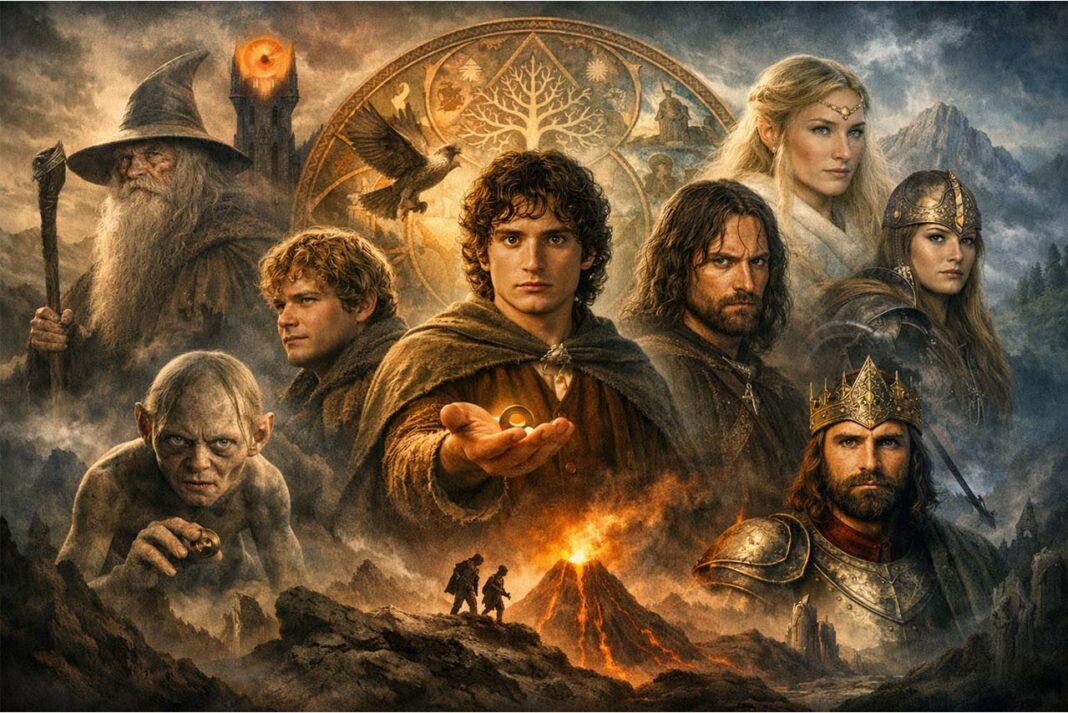

J.R.R. Tolkien’s The Lord of the Rings trilogy is not merely a masterpiece of fantasy literature, but also a symbolic narrative that reaches deep into the human psyche. The work presents universal psychological themes centered on confronting darkness, transforming the self, and the search for meaning. In this sense, it functions as a powerful map of the unconscious. The epic can be read as a dramatic stage upon which the archetypes described in Carl Gustav Jung’s analytical psychology come to life. According to Jung, myths, fairy tales, and epic narratives do not arise from individual consciousness, but from the collective unconscious (Jung, 1968). Tolkien’s Middle-earth, in this context, renders the inner conflicts of modern humanity visible through ancient symbols.
Tolkien’s words encapsulate the essence of this journey:
“Even the smallest person can change the course of the future.” (Tolkien, 1954)
This statement represents the underestimated yet transformative power of the self within the psychological development of the individual.
Frodo Baggins: The Journey Of The Ego (Individuation)
Frodo Baggins’ journey is a literary reflection of Jung’s concept of individuation. Individuation refers to the integration of unconscious aspects of the psyche into a unified whole (Jung, 1966). Frodo begins his journey as an ordinary hobbit, yet he is tasked with carrying the Ring—a profound psychological burden. The Ring is not merely an object; it symbolizes repressed impulses, the desire for power, and the shadow.
Tolkien expresses this burden through Frodo’s words:
“I will take the Ring… though I do not know the way.”
This statement echoes the fear of the unknown often voiced by clients in therapy, while simultaneously reflecting the courage to assume responsibility. Frodo’s increasing isolation throughout the journey illustrates how trauma can turn the individual inward and highlights the psychological cost of transformation.
Samwise Gamgee: The Supportive Self And Secure Attachment
Within a Jungian framework, Sam represents the helper archetype or the loyal companion. From a clinical psychology perspective, Sam embodies secure attachment. At moments when Frodo can no longer bear the psychological weight of the Ring, Sam’s presence demonstrates how essential an “other” is in the healing process.
“I can’t carry it for you, but I can carry you.” (Tolkien, 1955)
This line reflects the core of the therapeutic relationship: the therapist cannot remove the client’s pain, but can walk alongside them.
The Shadow Archetype: The Ring And Gollum
One of Jung’s fundamental archetypes, the Shadow, represents the rejected and repressed aspects of the self (Jung, 1959). In The Lord of the Rings, this archetype is most vividly embodied in the character of Gollum. Gollum represents Frodo’s potential future—a self entirely consumed by the Ring.
“The Ring had given him power according to his stature.” (Tolkien, 1954)
This statement suggests that power can be either destructive or transformative depending on the individual’s psychological resilience. Gollum stands as one of the most dramatic representations of the Jungian archetypes, illustrating how denied desires can fracture the self. His split into “Sméagol” and “Gollum” evokes dissociative processes.
According to Jung, individuals who fail to confront their shadow tend to externalize it and perceive it as an enemy (Jung, 1969). Frodo’s compassion toward Gollum marks the first step toward psychological integration. From a clinical standpoint, Gollum symbolizes addiction and ego disintegration.
Gandalf: The Wise Old Man (The Self Archetype)
Gandalf is a powerful embodiment of Jung’s Wise Old Man archetype. He symbolizes inner guidance and contact with the Self. Rather than offering direct solutions, Gandalf allows individuals to make their own decisions, paralleling the principle of autonomy emphasized in modern psychotherapy.
“All we have to decide is what to do with the time that is given to us.” (Tolkien, 1954)
This perspective aligns with existential psychology’s emphasis on responsibility and meaning-making (Yalom, 1980). Gandalf functions as a therapeutic figure who activates the client’s inner strength.
The Self And The Throne: Aragorn’s Identity Formation
Aragorn represents the Self archetype—the center of psychological wholeness. His journey toward kingship is not merely a struggle for external power, but a process of internal acceptance and identity integration.
“A man that flies from his fear may find that he has only taken a shortcut to meet it.” (Tolkien, 1954)
This insight aligns with contemporary psychological views suggesting that avoided trauma often reemerges in different forms (APA, 2020).
Anima And Feminine Power: Éowyn And Galadriel
Éowyn symbolizes the individual’s struggle to break free from restrictive social personas, while Galadriel represents the anima archetype in its highest form—intuition, beauty, and formidable power. By rejecting the Ring, Galadriel overcomes the danger of inflation (the ego’s intoxication with divine power) and remains faithful to her true nature.
The Pathology Of Power: The One Ring
From a Jungian perspective, the One Ring embodies the collective shadow. Its power of invisibility symbolizes escape from social responsibility and conscience. The Ring severs moral bonds and drives the individual into narcissistic isolation. Boromir’s vulnerability to the Ring illustrates how even good intentions can be corrupted by the desire for power, presenting a clinical case of moral disintegration.
Tolkien emphasizes that hope resides not in great heroes, but in the humble and ordinary (the Hobbits), pointing to the psychological source of resilience:
“The wheels of the world are turned by small hands while the great are elsewhere.” (Tolkien, 1954/2001, p. 285)
Purification At Mount Doom
At the journey’s end, Frodo cannot relinquish the Ring through sheer willpower—an admission of human vulnerability. The Ring is destroyed through Gollum’s intervention, revealing the paradoxical nature of individuation: sometimes the very darkness we fear becomes the means of salvation.
As Tolkien reminds us:
“Not all those who wander are lost.” (Tolkien, 1954/2001, p. 182)
Psychologically speaking, Middle-earth exists within us all. Dragons are our fears, the Ring our ambitions, and the Shire the innocence we long to return to. This epic teaches that heroism is not about physical strength, but about inner wholeness.
The Universality Of Archetypal Narrative
The universal resonance of The Lord of the Rings lies in its appeal to the archetypes of the collective unconscious described by Jung. The hero, the shadow, the wise guide, the journey, and the return form a trans-cultural psychological map. Tolkien’s narrative offers modern humanity a promise of integration in a fragmented world.
The Ring Frodo carries symbolizes the invisible burdens each individual bears. Tolkien’s work powerfully reminds us that one cannot reach the light without confronting the darkness. Jung argued that many psychological problems arise from a failure to integrate the shadow. Facing it requires courage. Yet, as The Lord of the Rings teaches us, no matter how frightening the shadow may appear, hope always remains.
“There may come a day when the courage of men fails… but it is not this day. There is always hope.”
— J.R.R. Tolkien
References
Jung, C. G. (1959). The archetypes and the collective unconscious. Princeton University Press.
Jung, C. G. (1969). The structure and dynamics of the psyche. Princeton University Press.
Jung, C. G. (1966). The practice of psychotherapy. Princeton University Press.
Jung, C. G. (1968). Man and his symbols. Doubleday.
Tolkien, J. R. R. (1954). The Fellowship of the Ring. George Allen & Unwin.