


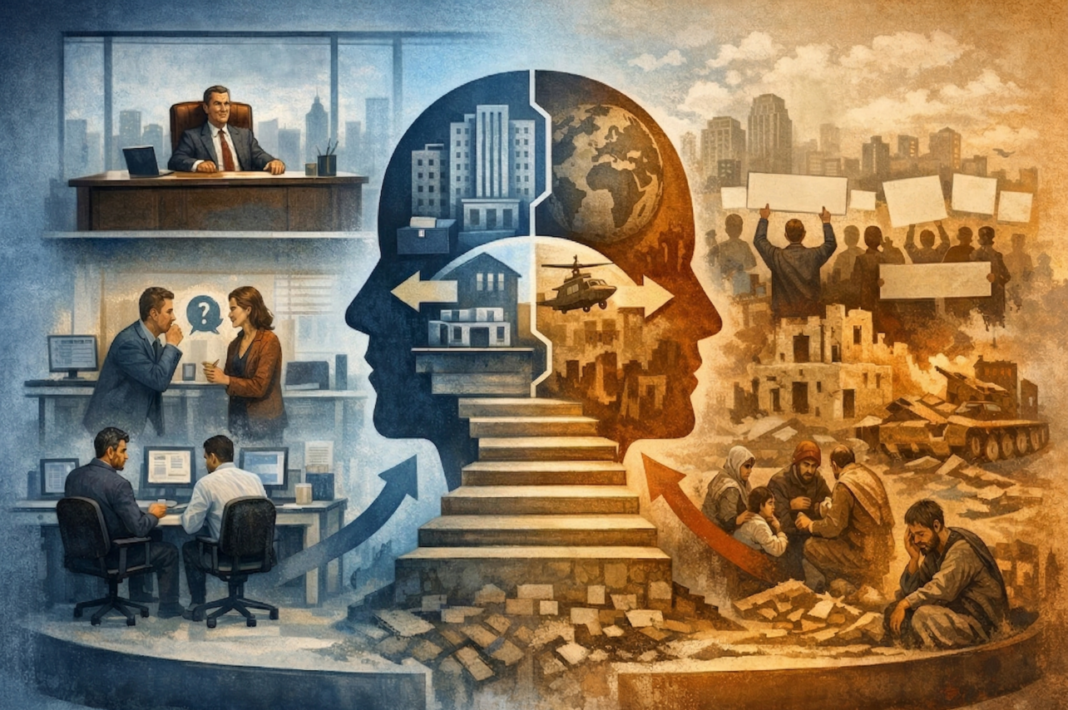

Human social systems frequently operate through hierarchical structures that determine authority, recognition, and legitimacy. These hierarchies exist not only within political institutions and global power relations but also in everyday bureaucratic organizations. Observations of workplace dynamics often reveal that individuals react strongly to symbolic indicators of status—such as office space, titles, or privileges—even when these markers bear little relation to actual competence or contribution. At first glance, such conflicts may appear trivial. However, they illuminate a deeper psychological process: individuals rely on symbolic signals to interpret legitimacy within complex systems. The same cognitive mechanisms that shape status competition in bureaucratic environments may also influence how societies interpret international conflicts and distribute empathy toward different populations. In both contexts, symbolic hierarchies can guide perception more strongly than objective conditions.
Symbolic Status And Bureaucratic Legitimacy
Bureaucratic institutions are structured through formal hierarchies in which authority is allocated according to rank rather than expertise. This arrangement often produces a structural tension between administrative authority and technical competence. Specialists frequently possess the knowledge required to perform the substantive work of an institution, while managers hold formal authority over decision-making processes. When authority is not fully grounded in demonstrated competence, individuals occupying higher positions may rely more heavily on symbolic indicators of status to reinforce their symbolic legitimacy.
Organizational psychology research suggests that individuals evaluate their social standing through relative comparison rather than through objective conditions (Festinger, 1954). Spatial arrangements within institutions—such as office size, private rooms, or location within a building—therefore become visible markers of institutional hierarchy. These markers function as status signals that communicate rank to both occupants and observers. When such signals appear inconsistent with individuals’ expectations about their position, they can trigger strong reactions because they challenge perceived legitimacy within the organizational order.
Conflicts over symbolic privileges often persist even when material conditions improve. Improvements in workplace environments frequently produce only temporary increases in satisfaction due to hedonic adaptation, the psychological tendency for individuals to quickly adjust to improved conditions and resume comparison with others (Brickman & Campbell, 1971). As a result, dissatisfaction shifts from absolute conditions to relative differences between individuals. The symbolic structure of the hierarchy therefore remains the primary focus of attention.
These dynamics also interact with self-serving cognitive biases. Individuals tend to interpret their own status and rewards as justified while attributing disparities affecting others to structural necessity (Ross & Sicoly, 1979). Managers who benefit from hierarchical privileges may therefore perceive these privileges as natural reflections of responsibility, even when subordinates perceive a disconnect between authority and actual contribution. In such contexts, symbolic markers of status—titles, office arrangements, or spatial privileges—serve as psychological reinforcements of legitimacy within the organizational system.
Hierarchical Cognition and Moral Perception
The psychological reliance on symbolic hierarchy extends beyond organizational environments. Social identity theory suggests that individuals organize social perception around group membership and hierarchical categorization (Tajfel & Turner, 1979). These cognitive structures help individuals navigate complex social environments by simplifying judgments about legitimacy, authority, and belonging. However, they also influence moral hierarchies and emotional responses.
Research on moral inclusion and exclusion demonstrates that individuals tend to extend empathy and moral concern primarily to groups perceived as belonging within their moral community (Opotow, 1990). Groups positioned outside this boundary may receive less moral attention, even when they experience comparable suffering. This phenomenon does not necessarily require conscious hostility; rather, it reflects the operation of cognitive schemas that shape perception and emotional response.
Within international politics, hierarchical perception may operate through narratives that implicitly rank societies according to cultural proximity, perceived stability, or historical legitimacy. These narratives influence how conflicts are interpreted and how public empathy is distributed. Violence affecting populations perceived as culturally closer or more legitimate within the global order may evoke stronger emotional reactions than violence affecting populations positioned lower in symbolic hierarchies.
Narrative Framing and Global Legitimacy
The construction of global hierarchies is reinforced by political discourse and media framing. Agenda-setting theory demonstrates that political and media institutions influence not only which issues receive attention but also how those issues are interpreted (McCombs & Shaw, 1972). Through repeated narratives, institutions can shape public perceptions of legitimacy, threat, and moral responsibility.
Historical narratives also play a role in structuring these perceptions. Edward Said’s concept of Orientalism describes how Western discourse historically constructed the Middle East and Muslim societies as culturally distinct, irrational, or inherently conflict-prone (Said, 1978). These representations contributed to a symbolic hierarchy in which certain societies were positioned as central actors within global order while others were portrayed as peripheral or unstable.
Such narratives influence contemporary interpretations of international conflict. When populations are implicitly framed as occupying lower positions within global moral hierarchies, violence affecting those populations may be perceived as less exceptional or less morally urgent. The result is not necessarily explicit prejudice but rather a pattern of selective empathy shaped by historical and cultural narrative framing.
Symbolic Legitimacy and The Maintenance Of Hierarchy
The parallels between bureaucratic status dynamics and global political narratives reveal a shared psychological mechanism: the maintenance of hierarchy through symbolic legitimacy. In organizational settings, symbolic privileges reinforce the authority of individuals whose competence may not fully justify their rank. In international politics, narrative frameworks reinforce the perceived legitimacy of powerful actors within the global order.
These symbolic structures help stabilize hierarchical systems by providing visible cues that guide interpretation. When individuals encounter complex environments—whether bureaucratic institutions or geopolitical conflicts—they often rely on these cues rather than evaluating underlying realities directly. Symbolic markers therefore become powerful filters through which legitimacy, authority, and moral concern are interpreted.
However, this reliance on symbolic hierarchy can also obscure contradictions within systems of authority. When competence and authority are misaligned within organizations, symbolic privileges compensate for the resulting uncertainty. Similarly, when global power structures contain moral or political contradictions, narrative framing may reinforce the legitimacy of dominant actors while shaping perceptions of others.
Conclusion
Human cognition relies heavily on symbolic signals to interpret complex social systems. Hierarchical markers—whether office arrangements in bureaucracies or narrative frameworks in international politics—serve as cues that guide judgments about legitimacy, authority, and moral concern. Observations of workplace dynamics reveal how strongly individuals react to symbolic status differences even when material conditions improve. These reactions illustrate a broader psychological tendency to interpret reality through hierarchical cues rather than objective conditions.
The same mechanisms can influence public responses to international conflicts. Historical narratives, cultural stereotypes, and media framing contribute to symbolic hierarchies that shape perceptions of legitimacy and empathy. As a result, societies may respond unevenly to comparable forms of suffering depending on how the actors involved are positioned within global moral structures.
Understanding these psychological processes highlights the importance of examining not only material conditions but also the symbolic frameworks that shape perception. Hierarchies within organizations and hierarchies within international politics both rely on symbolic legitimacy to maintain stability. By recognizing how these structures influence moral judgment, it becomes possible to better understand why perceptions of authority, recognition, and empathy often diverge from objective realities.
References
Brickman, P., & Campbell, D. T. (1971). Hedonic relativism and planning the good society. In M. H. Appley (Ed.), Adaptation-level theory (pp. 287–302). New York, NY: Academic Press.
Festinger, L. (1954). A theory of social comparison processes. Human Relations, 7(2), 117–140.
McCombs, M. E., & Shaw, D. L. (1972). The agenda-setting function of mass media. Public Opinion Quarterly, 36(2), 176–187.
Opotow, S. (1990). Moral exclusion and injustice: An introduction. Journal of Social Issues, 46(1), 1–20.
Ross, M., & Sicoly, F. (1979). Egocentric biases in availability and attribution. Journal of Personality and Social Psychology, 37(3), 322–336.
Said, E. W. (1978). Orientalism. New York, NY: Pantheon Books.
Tajfel, H., & Turner, J. C. (1979). An integrative theory of intergroup conflict. In W. G. Austin & S. Worchel (Eds.), The social psychology of intergroup relations (pp. 33–47). Monterey, CA: Brooks/Cole.