


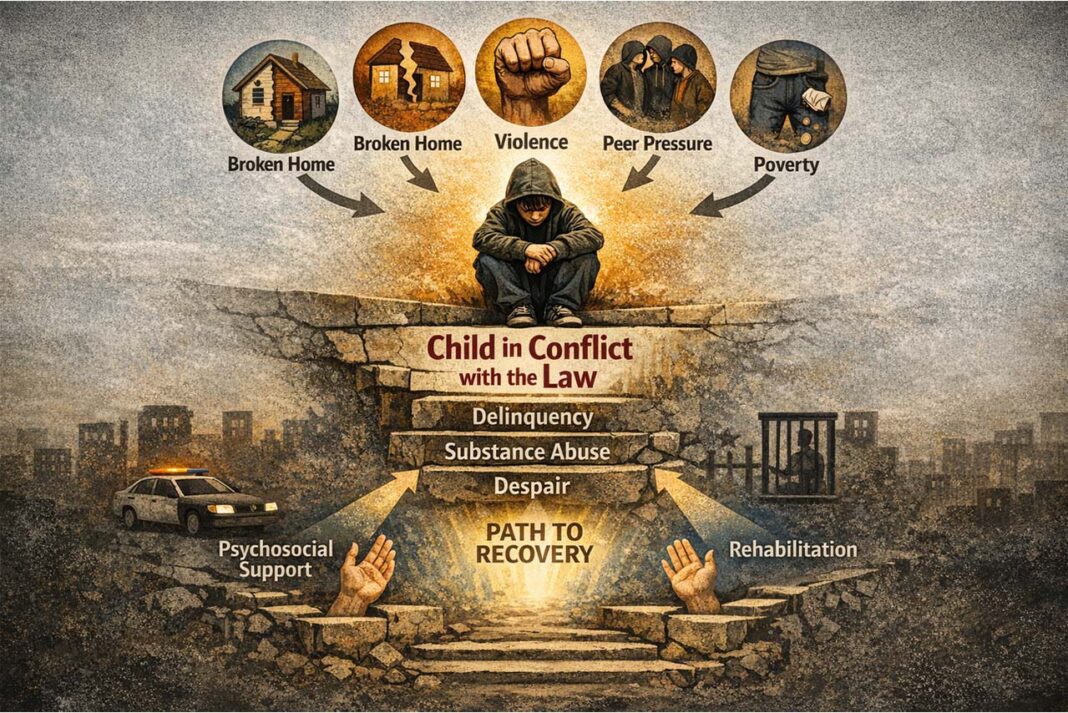

Children in conflict with the law constitute a complex social phenomenon that cannot be explained solely through individual psychopathology or personal choice. This study aims to examine the issue of children drawn into crime within the context of social decay, using social psychology and forensic psychology perspectives. Rather than focusing on sensational cases or media narratives, the article emphasizes environmental, psychosocial, and developmental risk factors, as well as psychologically grounded intervention and rehabilitation approaches. It is argued that delinquent behavior in childhood is not a deliberate preference, but rather a consequence of trauma, neglect, social exclusion, and structural failures. The study highlights the importance of trauma-informed, environment-focused, and rehabilitative practices in preventing and addressing juvenile delinquency.
Keywords: Children in conflict with the law, social decay, social psychology, forensic psychology, environmental risk factors
Introduction
The phenomenon of children in conflict with the law represents one of the most fragile and ethically sensitive issues in contemporary societies. Although childhood is widely recognized as a developmental period that requires protection and support, many children are exposed at an early age to neglect, violence, poverty, and social exclusion. These experiences not only disrupt psychological development but also increase vulnerability to delinquent behavior.
From a social psychology perspective, individual behavior cannot be understood independently of the social context in which it emerges. Forensic psychology, on the other hand, approaches criminal behavior by considering the individual’s developmental history, psychological structure, and environmental conditions alongside legal responsibility. At the intersection of these disciplines, juvenile delinquency emerges not merely as a legal issue, but as a reflection of broader social decay and systemic failure.
This article aims to analyze children in conflict with the law through a psychological lens, focusing on environmental risk factors and evidence-based intervention strategies rather than event-based or media-driven narratives. In doing so, it seeks to contribute to a more ethical, preventive, and rehabilitative understanding of juvenile delinquency.
Social Decay And Childhood
Social decay refers to the gradual erosion of social institutions and mechanisms that are responsible for protection, regulation, and socialization. Family disintegration, inequality in education, insufficient social services, and weakened justice systems constitute key indicators of this process. Children, as the most vulnerable members of society, are disproportionately affected by these structural deficiencies.
According to social psychology, individuals internalize the norms, values, and behavioral patterns of their social environments. In contexts where violence is normalized, neglect is invisible, and social control mechanisms are weak, delinquent behavior may become a learned and adaptive response rather than a deviant act. Bandura’s social learning theory explains how children acquire behaviors through observation and imitation, particularly when such behaviors appear to be rewarded or normalized within their surroundings.
In disadvantaged environments, childhood often shifts from a protected developmental stage to a struggle for survival. Within such contexts, social decay creates the conditions under which children are increasingly exposed to risk factors associated with delinquency.
Psychological Dimension: Trauma, Attachment, And Identity Development
Empirical studies in forensic psychology consistently indicate that a significant proportion of children in conflict with the law have histories of early trauma, chronic neglect, or abuse. Experiences such as emotional deprivation, exposure to domestic violence, parental loss, and inconsistent caregiving significantly impair emotional regulation and identity formation.
Attachment theory emphasizes the role of early caregiver-child relationships in shaping emotional security and social functioning. Children who develop insecure or disorganized attachment patterns are more likely to experience difficulties in impulse control, empathy, and anger regulation. These psychological vulnerabilities increase the likelihood of externalizing behaviors, including aggression and delinquency.
From a forensic psychological perspective, delinquent behavior in children is often interpreted as a maladaptive coping mechanism rather than an expression of criminal intent. Crime may function as a means of expressing suppressed emotions, asserting control, or gaining visibility in an environment where emotional needs remain unmet. Consequently, punitive approaches fail to address the underlying psychological determinants of behavior.
Environmental And Psychosocial Risk Factors
Environmental factors play a central role in the development of delinquent behavior among children. Family dysfunction, parental neglect, inconsistent discipline, low socioeconomic status, and exposure to violence constitute major risk factors. In such environments, children often lack opportunities to develop effective problem-solving and emotional regulation skills.
The school environment also serves as a critical protective or risk domain. Academic failure, peer rejection, bullying, and school disengagement weaken children’s sense of belonging and increase susceptibility to antisocial peer groups. Social psychology research emphasizes that unmet belonging needs often lead individuals toward alternative groups that provide identity and acceptance, even when these groups engage in harmful or illegal behavior.
Peer influence, particularly during adolescence, further amplifies environmental risk. When delinquent behavior is reinforced within peer networks, it becomes normalized and self-sustaining.
Labeling, Social Exclusion, And Psychological Consequences
Labeling theory suggests that individuals internalize the identities imposed upon them by society. Children who are defined early on as “problematic,” “dangerous,” or “delinquent” are at risk of adopting these labels as core aspects of their self-concept. This process undermines self-esteem and increases feelings of shame, anger, and alienation.
From a psychological standpoint, stigmatization intensifies emotional distress and weakens motivation for prosocial change. Forensic psychology literature indicates that labeling significantly hinders rehabilitation efforts and increases the likelihood of reoffending. As a result, the child experiences not only primary harm related to environmental adversity, but also secondary victimization through social exclusion.
Avoiding stigmatizing language and focusing on children’s needs rather than their offenses is therefore essential in both clinical and legal settings.
Intervention And Rehabilitation: Psychology-Based Approaches
The recovery and rehabilitation of children in conflict with the law require comprehensive interventions grounded in psychological science. Legal sanctions alone are insufficient to produce sustainable behavioral change. Social psychology and forensic psychology emphasize the necessity of transforming both the child’s internal world and the surrounding environment.
Trauma-informed therapeutic approaches are particularly effective in improving emotional regulation, reducing aggression, and enhancing coping skills. Interventions that provide consistent, supportive relationships contribute to the repair of disrupted attachment patterns and promote prosocial development.
Family-based interventions aim to strengthen parent-child relationships, establish consistent boundaries, and enhance caregiving capacities. School-based psychosocial programs increase children’s sense of belonging and academic engagement, thereby reducing exposure to delinquent peer networks.
Conclusion
Children do not enter the path of crime by choice; rather, they are drawn into it by environmental adversity, psychological trauma, and social neglect. Social psychology and forensic psychology perspectives demonstrate that juvenile delinquency is both preventable and reversible when addressed through comprehensive, trauma-informed, and environment-focused strategies.
Effective responses require a shift from punitive models toward rehabilitative and preventive frameworks that engage families, schools, and communities simultaneously. As psychological approaches gain prominence in policy and practice, it becomes increasingly possible to associate childhood not with crime, but with recovery, resilience, and healthy development.
References (APA 7)
Ainsworth, M. D. S., Blehar, M. C., Waters, E., & Wall, S. (1978). Patterns of attachment: A psychological study of the strange situation. Erlbaum.
Bandura, A. (1977). Social learning theory. Prentice Hall.
Becker, H. S. (1963). Outsiders: Studies in the sociology of deviance. Free Press.
Bowlby, J. (1988). A secure base: Parent-child attachment and healthy human development. Basic Books.
Cicchetti, D., & Lynch, M. (1995). Failures in the expectable environment and their impact on individual development. In D. Cicchetti & D. J. Cohen (Eds.), Developmental psychopathology (pp. 32–71). Wiley.
Farrington, D. P. (2005). Childhood origins of antisocial behavior. Clinical Psychology & Psychotherapy, 12(3), 177–190.
Goffman, E. (1963). Stigma: Notes on the management of spoiled identity. Prentice Hall.
Howitt, D. (2015). Introduction to forensic and criminal psychology (5th ed.). Pearson.
Karataş, Z. (2019). Children in conflict with the law and psychosocial risk factors. Toplum ve Sosyal Hizmet, 30(2), 523–545.
Moffitt, T. E. (1993). Adolescence-limited and life-course-persistent antisocial behavior. Psychological Review, 100(4), 674–701.
Polat, O. (2016). Introduction to forensic psychology. Seçkin Publishing.
UNICEF. (2021). Children deprived of liberty: Global report. UNICEF.
Yavuzer, H. (2018). Child psychology. Remzi Publishing.