


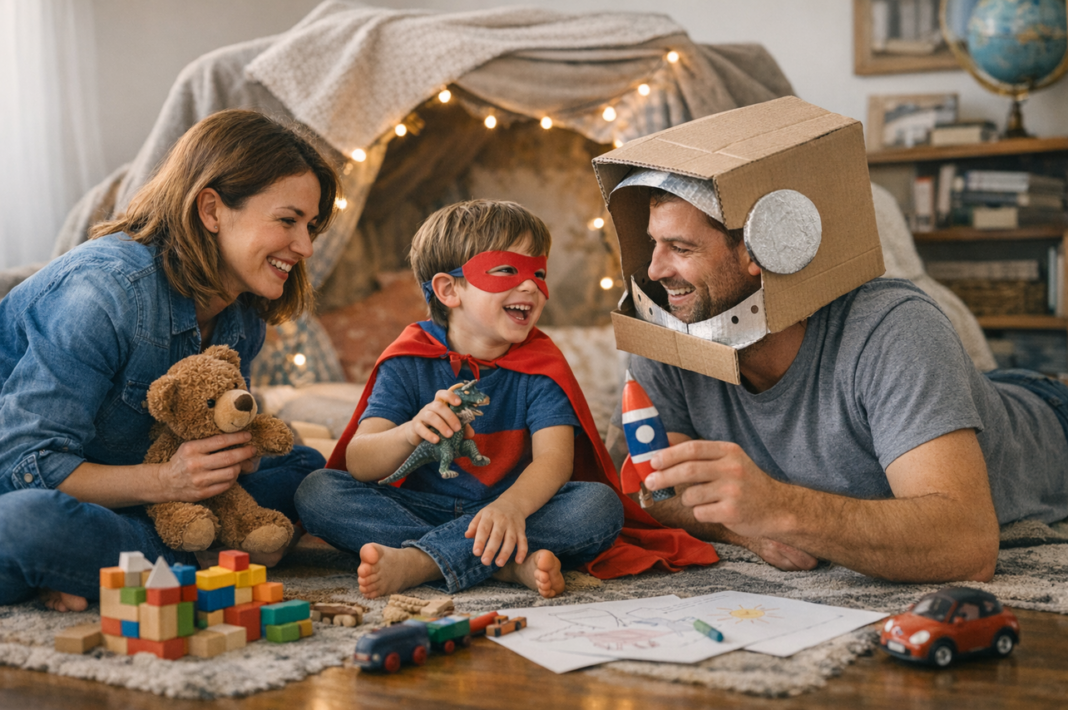

Play is theGateway to a Child’s Inner World
In the fast-paced rhythm of daily life, the value of quality time spent with children is more evident than ever. One of the most powerful tools for this quality time is play. Play is not only an activity where children have fun; it is also a way for them to explore the world, regulate their emotions, and build relationships (Ginsburg, 2007; Russ, 2016).
In this journey, the presence of an adult by the child’s side—someone they can invite into their inner world, generously share their feelings with, and learn from while having fun—is an invaluable gift. When parents engage in play, they offer children the opportunity to express emotions symbolically and to process daily experiences safely (Landreth, 2012).
Adults Also Play
Do you think there is an age limit for play? Actually, we adults also play in our daily lives. Whistling, dancing, laughing with friends, traveling, engaging in hobbies—all are modern versions of play that maintainEmotional health (Brown & Vaughan, 2009). Play supports not only children’s well-being but also the mental and social health of adults by reducing stress and strengthening relationships (Yogman et al., 2018).
Play: The Language Of The Child
Children cannot express their feelings with words as adults do; for them, play is a form of communication (Axline, 1947; Landreth, 2012). The figures they choose, the stories they create, and the patterns they repeat are symbolic doors to their inner world.
When a parent participates in this play:
-
They show respect for the child’s world,
-
They better understand what the child is feeling,
-
They discover the most natural way to bond (Schaefer & Drewes, 2014).
Playing With A Parent Gives The Child Security
Play allows the child to feel happy, loved, and safe. When a parent adapts to the child’s pace during play, the child internalizes the message, “I am valued; I am heard.” This secure interaction builds emotional safety and strengthens attachment (Bowlby, 1988; Siegel & Bryson, 2012).
This sense of safety:
-
Increases a child’s self-confidence,
-
Supports secure attachment,
-
Strengthens family communication (Ashiabi, 2007).
Even a simple shared activity such as building blocks or racing cars can foster a child’s sense of belonging and value.
Play Strengthens Emotional Regulation Skills
Playing with a parent also improves a child’s ability to recognize and manage emotions. For example:
-
The disappointment of losing a game,
-
The impatience of waiting in line,
-
The frustration of a tower collapsing…
All of these moments, when experienced and regulated within the safety of play, teach children emotional resilience (Denham et al., 2003; Hirsh-Pasek et al., 2009). Parents act as emotional co-regulators, modeling healthy reactions and recovery from frustration, which helps children build internal emotional control systems.
Play Supports Creativity and Problem-Solving Skills
Play teaches children to experiment, take initiative, and persist through challenges—critical foundations for creative and cognitive growth (Vygotsky, 1978; Russ, 2016). Through play, children learn cooperation, empathy, sharing, and flexible thinking.
When parents join in open-ended or imaginative play, they enrich the child’s ideas, introduce new perspectives, and model curiosity (Ginsburg, 2007). Board games, storytelling, and role-playing activities foster critical thinking and social skills, forming a bridge between emotional understanding and cognitiveDevelopment (Piaget, 1962).
Even 15 Minutes A Day Is Enough
One of the most common parental concerns is lack of time. Yet, the benefits of play do not depend on long hours. Research shows that even 15–20 minutes of child-led play per day significantly enhances attachment and behavioral regulation (Guerney, 1964; Landreth, 2012). The essential point is quality over quantity: entering the child’s world with full attention and openness. During this short but meaningful time, parents communicate, “You matter. I am here for you.”
Accompanying, Not Teaching
Sometimes parents feel unsure about how to play with their child—or believe they are playing when in fact they are directing. True play requires joining, not leading (Axline, 1947). It means being fully immersed, following the child’s lead, and suspending adult judgment or instruction.
This kind of play invites genuine emotional connection, mirroring the core principles of child-centered play therapy (Landreth, 2012). It is not about teaching a skill, but about being present and creating a shared emotional space. Such relational play nurtures empathy, patience, and trust—skills that extend beyond playtime into the child’s lifelong relationships (Siegel & Bryson, 2012).
Conclusion
Playing with a parent is far more than a pastime; it is an emotionally rich, developmentally essential process. Through play, children develop secure attachment, emotional regulation, creativity, and resilience. For parents, it offers a chance to reconnect with their own inner child and rediscover the joy of presence.
Every shared play moment becomes a memory that whispers, “I was seen, I was loved.” Even small, consistent doses of play can strengthen bonds and support children’s emotional well-being throughout life (Yogman et al., 2018).
References
Ashiabi, G. S. (2007). Play in the preschool classroom: Its socioemotional significance and the teacher’s role in play. Early Childhood Education Journal, 35(2), 199–207. https://doi.org/10.1007/s10643-007-0165-8
Axline, V. M. (1947). Play therapy: The inner dynamics of childhood. Houghton Mifflin.
Bowlby, J. (1988). A secure base: Parent-child attachment and healthy human development. Basic Books.
Brown, S., & Vaughan, C. (2009). Play: How it shapes the brain, opens the imagination, and invigorates the soul. Avery.
Denham, S. A., Blair, K. A., DeMulder, E., Levitas, J., Sawyer, K., Auerbach–Major, S., & Queenan, P. (2003). Preschool emotional competence: Pathway to social competence? Child Development, 74(1), 238–256. https://doi.org/10.1111/1467-8624.00533
Ginsburg, K. R. (2007). The importance of play in promoting healthy child development and maintaining strong parent-child bonds. Pediatrics, 119(1), 182–191. https://doi.org/10.1542/peds.2006-2697
Guerney, B. (1964). Filial therapy: Description and rationale. Journal of Consulting Psychology, 28(4), 304–310. https://doi.org/10.1037/h0041167
Hirsh-Pasek, K., Golinkoff, R. M., Berk, L. E., & Singer, D. G. (2009). A mandate for playful learning in preschool: Presenting the evidence. Oxford University Press.
Landreth, G. L. (2012). Play therapy: The art of the relationship (3rd ed.). Routledge.
Piaget, J. (1962). Play, dreams, and imitation in childhood. Norton.
Russ, S. W. (2016). Pretend play in childhood: Foundation of adult creativity. American Psychological Association. https://doi.org/10.1037/14934-000
Schaefer, C. E., & Drewes, A. A. (Eds.). (2014). The therapeutic powers of play: 20 core agents of change (2nd ed.). Wiley.
Siegel, D. J., & Bryson, T. P. (2012). The whole-brain child: 12 revolutionary strategies to nurture your child’s developing mind. Delacorte Press.
Vygotsky, L. S. (1978). Mind in society: The development of higher psychological processes. Harvard University Press.
Yogman, M., Garner, A., Hutchinson, J., Hirsh-Pasek, K., & Golinkoff, R. M. (2018). The power of play: A pediatric role in enhancing development in young children. Pediatrics, 142(3), e20182058. https://doi.org/10.1542/peds.2018-2058