


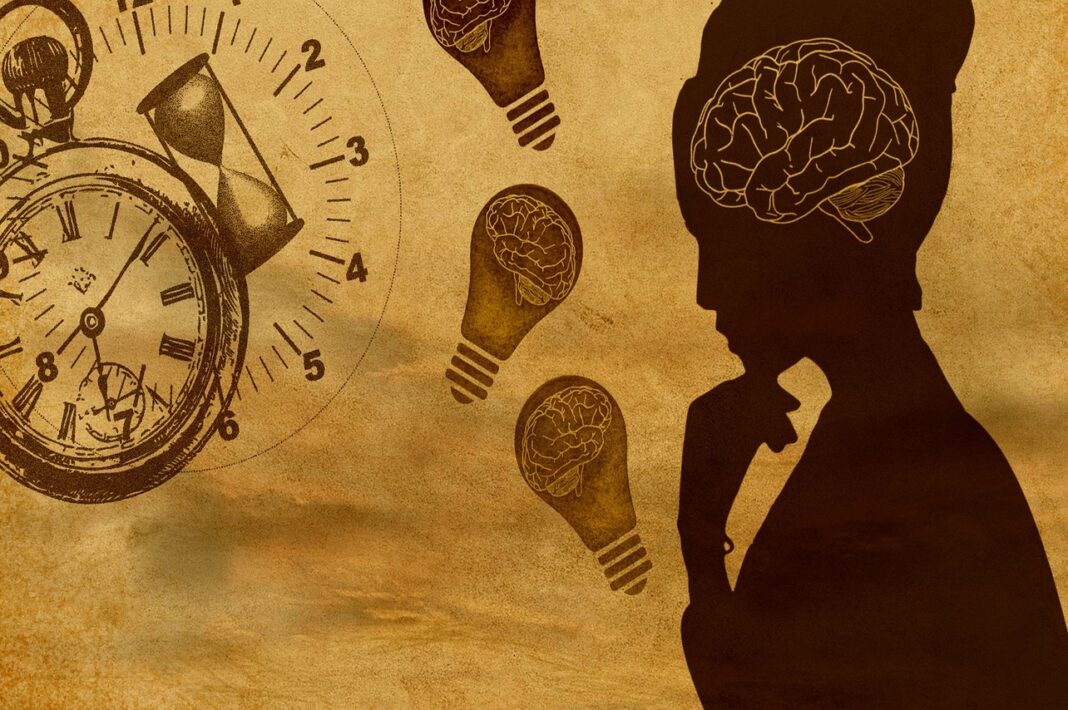

We often assume that our brain passively records the world like a camera, storing memory in a dusty archive. However, modern neuroscience, particularly thepredictive processing model, reveals a whole other story: our brain doesn’t simply perceive the world; it constantly predicts it (Clark, 2013; Friston, 2009).
The Oracle In The Dark
Imagine walking through a dark room; you can find a light switch exactly where it belongs because your brain uses an internal “model of the world” to make predictions (Friston, 2009). Andy Clark (2013) states that the brain is an active predictor, constantly asking, “What will I see or hear next?” In this framework, perception is the clash between external input and internal expectations.
What’s Happening In The Brain’s Boardroom
The brain isn’t governed by a single center; instead, it operates through a layered hierarchy, much like a conglomerate with managers at different levels. The top level sets general strategy (e.g., “I am reading in a safe environment”), while lower levels anticipate specialized sensory inputs like text or page texture. The predictions cascade like a waterfall, and each level signals the one below it: “I am now waiting for this to happen; be prepared” (Clark, 2013).
If something unexpected happens—like a butterfly flitting from your book—the brain, an energy efficiency expert, reacts (Clark, 2013). In this case, the butterfly that came unexpectedly creates a jolt in the hierarchy’s lower levels and sends a prediction error signal upward (Clark, 2013; Friston, 2009). This error signal is the fuel that activates the brain’s learning motor; these moments of surprise force the brain to discard outdated models and reconstruct its world, marking the points where memories are most powerfully updated. This cellular-level updating process is rooted in a biochemical foundation.
Stable long-term memories return to a flexible state when midbrain dopaminergic neurons signal a prediction error (Exton-McGuinness et al., 2014). This process opens a short reconsolidation window, in which existing memories can be updated, and new knowledge can be integrated into long-term stores while maintaining everyday relevance (Exton-McGuinness et al., 2014).
Escaping Chaos Through The Lens Of Neuroscience
Thefree-energy principle posits that the brain’s core objective is to minimize free energy to resist entropy and remain within states favorable to survival (Friston, 2009). In this context, free energy is essentially a mathematical proxy for prediction error; by minimizing it, the brain filters the chaotic noise of the universe into a structured signal. This method is vital because the brain cannot directly evaluate “surprise”—those unlikely sensory states that threaten survival. Instead, it treats free energy as a calculable limit on that surprise (Friston, 2009). This is achieved through a two-fold approach: during perception, the brain updates its internal representations to explain sensory data, and during active inference, the brain engages with its surroundings to gather sensory information to align with its expectations (Friston, 2009).
Within this ‘boardroom’ hierarchy, the top levels provide empirical priors—internal assumptions that act as constraints for the levels below. This framework relies on error units to capture prediction errors while state units store the estimated causes of sensory information (Friston, 2009). Such a recurrent architecture allows prediction errors to ascend the hierarchy to update internal states; meanwhile, descending predictions aim to suppress or explain away these discrepancies (Clark, 2013; Friston, 2009).
Also, as Karl Friston (2009) notes, these rules for minimizing free energy also form the foundation of modern machine learning. Whether in neurons or AI, the goal is to stop being “surprised” by building better models. Ultimately, intelligence is the art of turning an uncertain environment into a predictable one.
Memory As Active Inference
The hippocampus, often known as the brain’s memory core, serves as both a memory index and a generative model that predicts the future (Barron et al., 2020). Memories are dynamic entities that allow us to predict outcomes and inform behaviors (Exton-McGuinness et al., 2014). Through the process of reconsolidation, the brain ensures that the associative power of our memories is updated according to the magnitude of the prediction error encountered, preventing dependence on obsolete internal models (Exton-McGuinness et al., 2014).
The brain achieves a careful balance between efficiency and imagination by transitioning between two separate modes (Barron et al., 2020). In prediction mode, the hippocampus uses SOM+ cells as “brakes” to ignore expected information and focus only on what’s new. In memory mode, VIP+ cells “release the brakes,” allowing old brain patterns to re-emerge so we can relive past events (Barron et al., 2020). Chemical messengers such as acetylcholine (ACh) levels regulate these states: high levels of ACh activate ‘online processing’ to help the brain learn from its current surroundings, while low levels activate ‘offline processing,’ allowing it to step away from the present to recall and ‘sharpen’ its stored memories, especially during sleep (Barron et al., 2020). These transitions allow the brain to distinguish when to learn new information from the environment and when to process the information that it stored.
Conclusion: Refined Predictions For An Uncertain World
Remembering is more than looking back; it is how the brain updates its internal model for better predictions. By performing offline simulations as if they were real-time scenarios, the brain tests various outcomes without new sensory input (Barron et al., 2020). This process filters noise into general principles, ensuring we are less ‘startled’ by an uncertain world (Barron et al., 2020; Exton-McGuinness et al., 2014; Friston, 2009). Ultimately, this drive to minimize surprise is the core mechanism allowing our ‘internal time machine’ to navigate reality.