



Introduction
Emotional regulation is one of the fundamental psychological skills that influences children’s academic adjustment, social relationships, and overall well-being. The school environment represents a critical developmental context in which children experience intense emotions, establish social bonds, and encounter increasing performance expectations. For this reason, supporting emotional regulation skills has become a central focus of school counseling services.
Children’s development is not limited to cognitive growth; their emotional development plays an equally significant role in learning quality, motivation, and psychological resilience. Research consistently indicates that children who can recognize and regulate their emotions tend to demonstrate higher academic achievement, healthier peer relationships, and fewer behavioral difficulties. This article explores the importance of emotional regulation in school-age children and evaluates school-based practices from the perspective of a school counselor.
What Is Emotional Regulation?
Emotional regulation refers to an individual’s ability to recognize emotions, respond to them appropriately, and manage emotional experiences when necessary. This process includes the onset of emotions, their intensity and duration, and the ways in which they are expressed.
From a developmental standpoint, emotional regulation skills are still maturing during childhood. In elementary school years, children are in the process of developing executive functions such as impulse control, delayed gratification, and problem-solving. Consequently, environmental support, modeling, and structured guidance are essential. Schools provide one of the most influential social settings where emotional regulation skills are learned, practiced, and reinforced.
Emotional Challenges During The School Years
During elementary school, children encounter numerous emotional stimuli, including exams, academic expectations, teacher feedback, and peer relationships. Common emotional challenges observed in this period include:
-
Test and performance anxiety
-
Difficulty managing anger and frustration
-
Fear of making mistakes and perfectionistic tendencies
-
Conflicts in peer relationships
-
Limited ability to verbally express emotions
These challenges are often developmental in nature and signal areas where children may benefit from structured support. When emotional regulation skills are insufficient, difficulties such as attention problems, withdrawal, aggressive behaviors, or decreased academic motivation may emerge. Therefore, early intervention constitutes an essential component of preventive mental health services within schools.
School-Based Emotional Regulation Practices
School counselors implement preventive and developmental interventions to support emotional regulation skills. Several practices have been observed to be effective within school settings:
Emotional Awareness Activities
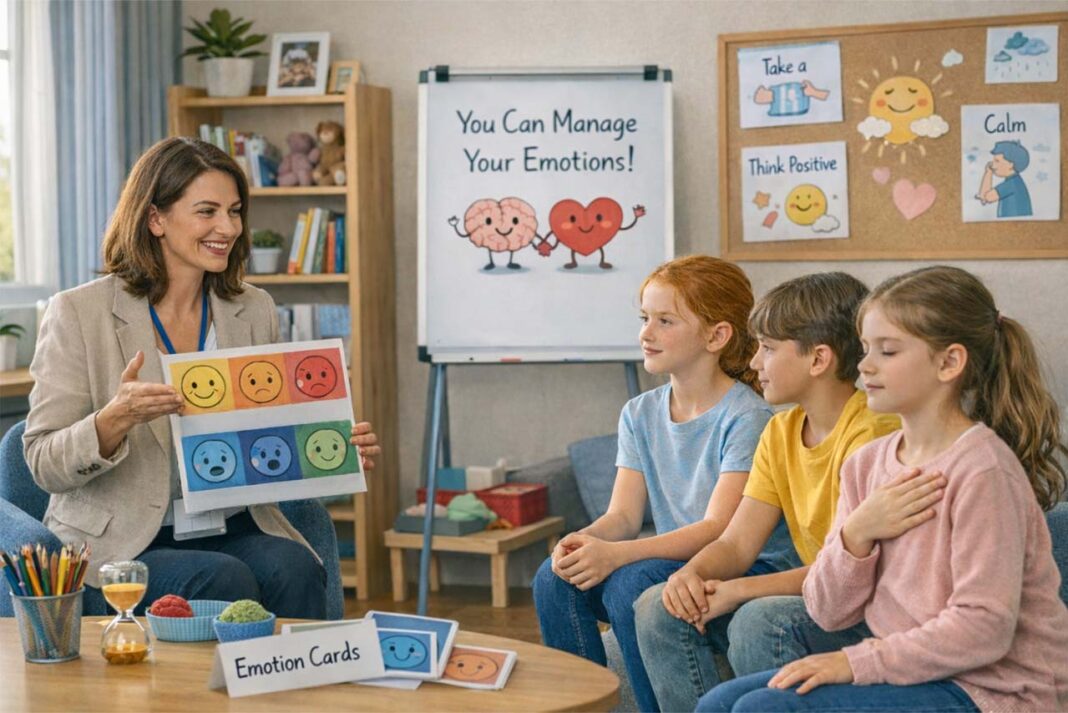
Through guidance lessons and classroom-based activities, children are supported in identifying and labeling basic emotions. Stories, visual materials, emotion cards, and short videos are frequently used as practical tools. Being able to name emotions represents the first step toward regulating them.
Normalization Of Emotions
Students are taught that all emotions are natural and acceptable, although not all behaviors are. This approach encourages children to understand and process their emotions rather than suppress them. Normalizing “difficult” emotions such as anger, jealousy, or anxiety reduces feelings of shame and guilt while fostering emotional acceptance.
Basic Regulation Techniques
Breathing exercises, short relaxation practices, mindfulness-based activities, and attention-focusing techniques help children cope with intense emotions. These strategies are particularly functional before exams, during performance-related situations, and after interpersonal conflicts. When practiced consistently, such techniques strengthen self-regulation capacity over time.
Cognitive Reframing
Helping children reinterpret situations from alternative perspectives can reduce the intensity of emotional reactions. Developing adaptive thought patterns—such as viewing mistakes as part of the learning process—plays a protective role, particularly for students with perfectionistic tendencies.
Group Guidance And Counseling
Group interventions conducted with students who share similar emotional needs allow children to realize they are not alone in their experiences. Group settings encourage peer learning, empathy development, and social problem-solving. Role-playing activities and collaborative exercises are especially effective during this developmental stage.
Collaboration With Teachers And Families
Consistency between school and home environments enhances the sustainability of emotional learning. School counselors work collaboratively with teachers and parents to provide holistic support. Offering psychoeducational training to teachers on classroom-based emotional strategies and equipping parents with practical tools to apply at home significantly increases intervention effectiveness.
The Role Of The School Counselor
The role of the school counselor extends beyond responding to problems after they arise. A preventive and developmental approach aims to foster emotional resilience, self-awareness, and healthy coping strategies before significant difficulties occur. Identifying at-risk students early, designing needs-based intervention programs, and contributing to a supportive school climate are integral components of this role.
Creating an emotionally safe school environment means establishing a culture in which students feel comfortable expressing themselves, are not afraid to make mistakes, and perceive consistent support from adults. Such an environment cannot be achieved solely through individual counseling sessions; it requires collaboration among all school stakeholders.
Conclusion
Emotional regulation is a foundational skill that enables children to navigate the emotional demands of school life effectively. It significantly influences academic success, social adjustment, and psychological well-being. School-based counseling and guidance practices provide children with structured opportunities to develop emotional awareness and express themselves within a safe environment.
Investing in emotional regulation during early years does not only reduce current difficulties but also contributes to raising psychologically resilient, emotionally healthy individuals equipped with adaptive coping skills. For this reason, emotional regulation should be regarded as an integral component of educational systems and positioned at the core of school counseling practice.