



Introduction
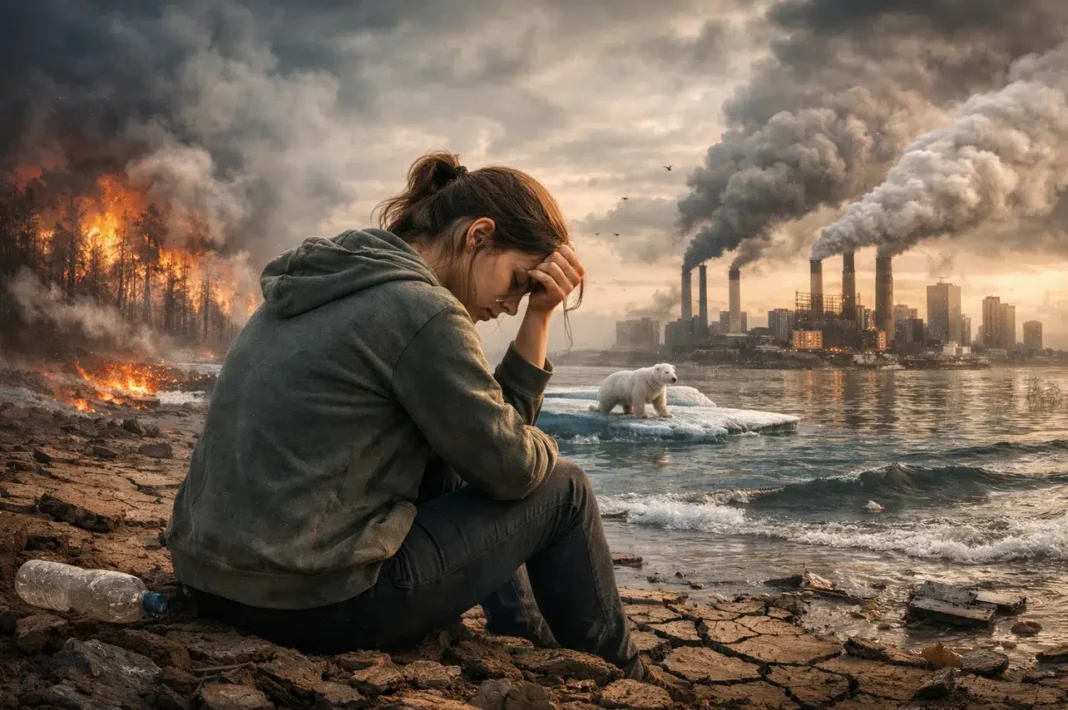
Climate change is the most critical global challenge of the 21st century. Scientific data continuously documents irreversible changes in ecosystems and the devastating impacts of human activity. Alongside this physical reality, it is increasingly recognized that the climate crisis has profound and complex effects on human psychology. The American Psychological Association (APA) defines the psychological impacts of climate change as a “chronic environmental stressor” (Clayton et al., 2017).
This article will examine, in light of the literature, the definition, clinical presentation, underlying cognitive and emotional processes, and individual and collective coping strategies related to this psychological phenomenon known as eco-anxiety.
Eco-Anxiety: Definition And Clinical Framework
Eco-anxiety can be defined as the chronic feelings of fear, helplessness, guilt, and uncertainty about the future caused or exacerbated by climate change and ecological crisis (Albrecht, 2011). While the APA and leading global psychiatric associations do not classify this condition as a formal diagnosis (a disorder listed in the DSM-5), they acknowledge its impact on human well-being as a real and widespread experience that should be addressed under the heading of “climate-related distress” (Doherty & Clayton, 2011).
Clinical symptoms may overlap with traditional anxiety disorders: restlessness, difficulty concentrating, sleep disturbances, and a persistent state of worry. However, the distinctive feature of eco-anxiety is that its trigger is not a personal or internal threat, but rather a global, systemic, and largely uncontrollable-seeming crisis. This adds an existential dimension; the individual experiences deep uncertainty about their own future, their children’s future, and the continuity of the species (Pihkala, 2020).
Psychodynamic And Cognitive Foundations
The psychological processes underlying eco-anxiety are multi-layered:
1. Feeling Of Helplessness And Loss Of Control
The scale and complexity of climate change can lead to an overwhelming sense of helplessness that paralyzes the individual. This parallels the learned helplessness model (Seligman, 1972). When repeated exposure to uncontrollable stressors occurs, individuals may withdraw psychologically, believing that no action will make a difference.
2. Ecological Grief
Cunsolo and Ellis (2018) define “ecological grief” as the deep sorrow and mourning felt in response to ecosystem loss, species extinction, and the transformation of familiar landscapes. This grief is complex due to the uncertainty and inevitability of the loss. The concept of ecological grief captures the mourning process linked not to a single event, but to ongoing environmental degradation.
3. Moral Conflict And Guilt
Being aware of their own carbon footprint, an individual may experience moral tension between personal consumption habits and global responsibility. This can lead to an emotional state referred to as “climate guilt” (Macy & Johnstone, 2012). The internal conflict between values and behavior intensifies psychological distress.
4. Existential Threat
The climate crisis threatens our basic needs for security and continuity, triggering existential anxiety (Yalom, 1980). Future plans may seem meaningless, and a sense of “solastalgia” (Albrecht, 2011) may emerge—a distress caused by environmental change close to one’s home. In this way, eco-anxiety intersects with fundamental questions about mortality, meaning, and belonging.
Resilience And Coping Strategies: From Individual To Collective
It is important to frame eco-anxiety not as a pathological condition but as an understandable psychological response to an ecological threat. This enables a solution-focused approach. Effective coping strategies may include:
Meaningful Action (Active Hope)
As emphasized by Macy and Johnstone (2012), transforming anxiety into action is empowering. Individual actions (changing consumption habits) or collective engagement (joining climate movements) reduce feelings of helplessness and increase self-efficacy. Meaning-centered engagement strengthens psychological resilience.
Building Community Connections
Knowing one is not alone and being in solidarity with others who share similar anxieties lightens the burden. Climate support groups and community initiatives provide validation and shared coping resources.
Reconnecting With Nature
Spending time in nature (ecotherapy) not only reduces stress but also strengthens emotional bonds with the environment. Reconnection fosters both hope and motivation to protect what remains.
Psychological Flexibility
Principles from Acceptance and Commitment Therapy (ACT), which emphasize accepting frightening thoughts and emotions rather than fighting them, show promise in managing eco-anxiety (Fraser et al., 2022). Acting in alignment with personal values while acknowledging distress enhances adaptive functioning.
Media Diet Regulation
Limiting constant exposure to catastrophic news and choosing reliable, solution-focused sources can prevent emotional exhaustion and secondary trauma.
Conclusion
Eco-anxiety is not a pathological disorder but rather a psychological manifestation of awareness and care for a threatened planet. It reflects the human capacity to respond emotionally to systemic risk.
Clinical psychology and psychiatry must develop frameworks to understand this new collective stressor and provide supportive interventions. However, the ultimate solution extends beyond individual coping mechanisms. Systemic climate action and just socio-ecological transformation are essential.
The role of psychology is to help individuals transform anxiety from a paralyzing force into a catalyst for meaningful engagement. Building the psychological foundations for a life aligned with planetary boundaries is one of the most urgent tasks of 21st-century mental health practice.
References
Albrecht, G. (2011). Chronic environmental change: Emerging “psychoterratic” syndromes. In I. Weissbecker (Ed.), Climate change and human well-being (pp. 43–56). Springer.
Clayton, S., Manning, C. M., Krygsman, K., & Speiser, M. (2017). Mental health and our changing climate: Impacts, implications, and guidance. American Psychological Association.
Cunsolo, A., & Ellis, N. R. (2018). Ecological grief as a mental health response to climate change-related loss. Nature Climate Change, 8(4), 275–281.
Doherty, T. J., & Clayton, S. (2011). The psychological impacts of global climate change. American Psychologist, 66(4), 265–276.
Fraser, J., Pakenham, K. I., & Scott, A. J. (2022). Psychological flexibility moderates the relationship between climate change concern and climate-related distress. Journal of Contextual Behavioral Science, 25, 1–9.
Macy, J., & Johnstone, C. (2012). Active hope: How to face the mess we’re in without going crazy. New World Library.
Pihkala, P. (2020). Anxiety and the ecological crisis: An analysis of eco-anxiety and climate anxiety. Sustainability, 12(19), 7836.
Seligman, M. E. (1972). Learned helplessness. Annual Review of Medicine, 23(1), 407–412.
Yalom, I. D. (1980). Existential psychotherapy. Basic Books.