



The Invisible Architect of Human Behavior
When we see someone in tears and feel a sudden ache inside…
When the happiness of a loved one makes us feel joyful as well…
These experiences are usually described with a single word: empathy.
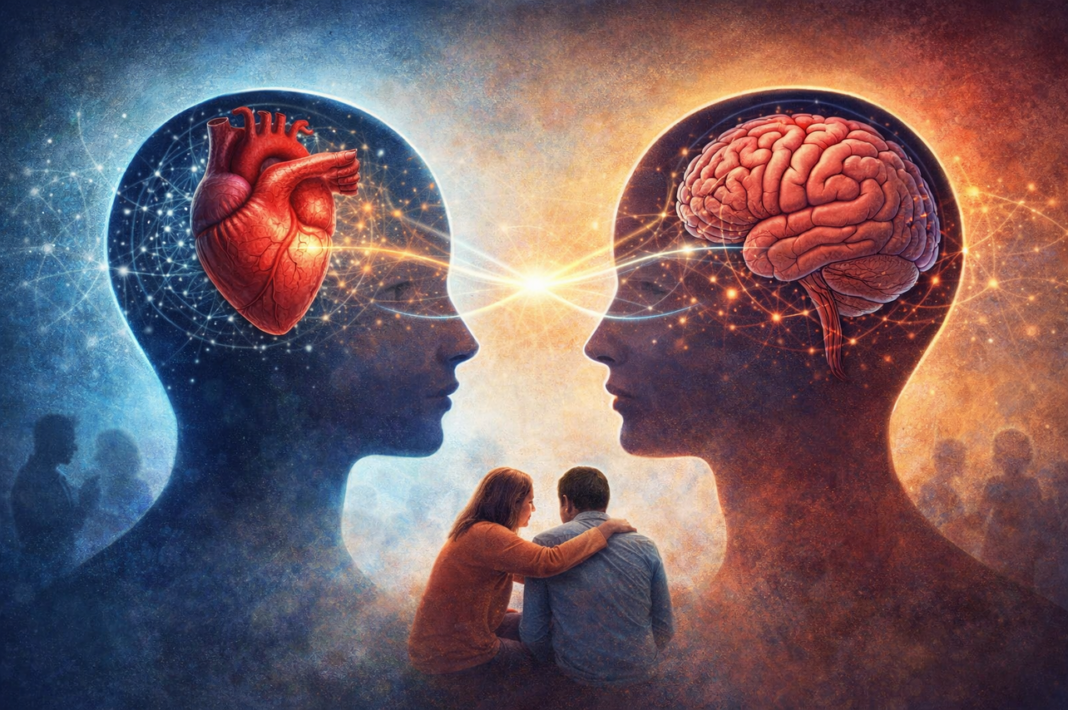
In everyday life, empathy is often considered a feeling that comes from the heart. However, research in psychology andneuroscience suggests that empathy is not merely an emotional reaction; it is also a complex cognitive process. This raises an important question: Does empathy really come from the heart, or is it a product of the brain?
The Two Faces Of Empathy
Modern psychological research shows that empathy is not a single, uniform emotion. Instead, it consists of two fundamental components: affective empathy and cognitive empathy.
Affective empathy refers to the ability to emotionally resonate with another person’s feelings. For example, feeling distressed when we see a child crying or sharing the happiness of someone we care about are expressions of affective empathy. Neuroscientific studies suggest that this process is largely associated with the brain’s limbic system, particularly structures such as the amygdala, which are involved in emotional processing.
Cognitive empathy, on the other hand, involves understanding another person’s emotional state rather than directly sharing it. It is the ability to ask, “What might this person be thinking or feeling in this situation?” This dimension of empathy relies more on higher-order cognitive processes, especially those associated with the prefrontal cortex and neural networks responsible forperspective-taking.
In other words, empathy is not solely an emotional experience arising from the heart; it is also a mental capacity to interpret and understand others’ experiences
How Empathy Shapes Human Behavior
Empathy is one of the invisible architects of social life. Trust, cooperation, and mutual support among individuals are largely made possible through empathic understanding. When people are able to perceive and interpret each other’s emotional experiences, social bonds tend to become stronger.
Research indicates that individuals with higher levels of empathy are more likely to engage in prosocial behaviors, such as helping, sharing, and respecting the needs and rights of others. Empathy also plays a significant role across many professional domains. Teachers attempt to understand their students, doctors seek to comprehend their patients’ concerns, and psychologists try to grasp the emotional worlds of their clients. In each of these contexts, empathy becomes a fundamental tool for effective communication and human connection.
The Balance Of Empathy: Too Much Or Too Little
Although empathy is generally considered a positive human capacity, an excess or imbalance of empathy can sometimes create psychological challenges. Professionals working in helping fields may experience what is often described as empathy fatigue or emotional burnout, resulting from constant exposure to the suffering and emotional burdens of others.
Conversely, a lack of empathy can also lead to significant social and interpersonal difficulties. Individuals who struggle to recognize or understand others’ emotional states may experience problems in communication and relationships. In extreme cases, low levels of empathy have been associated with aggressive or antisocial behavior.
Healthy empathy therefore involves not only emotional sensitivity but also the ability to regulate emotions and maintain appropriate psychological boundaries.
A Bridge Between The Heart and The Mind
Viewing empathy solely as a “voice of the heart” or purely as a cognitive function of the brain would both be incomplete perspectives. Empathy can be better understood as a bridge between emotion and cognition. While affective empathy allows individuals to emotionally connect with others, cognitive empathy enables them to interpret and regulate these emotional responses.
A well-balanced empathic capacity emerges from the subtle harmony between emotional sensitivity and cognitive understanding. Perhaps this is why empathy remains one of the most powerful yet often invisible psychological mechanisms shaping human behavior.
Ultimately, empathy is neither only the heart nor solely the mind. It is a uniquely human ability that arises from the interaction between emotion and thought.