


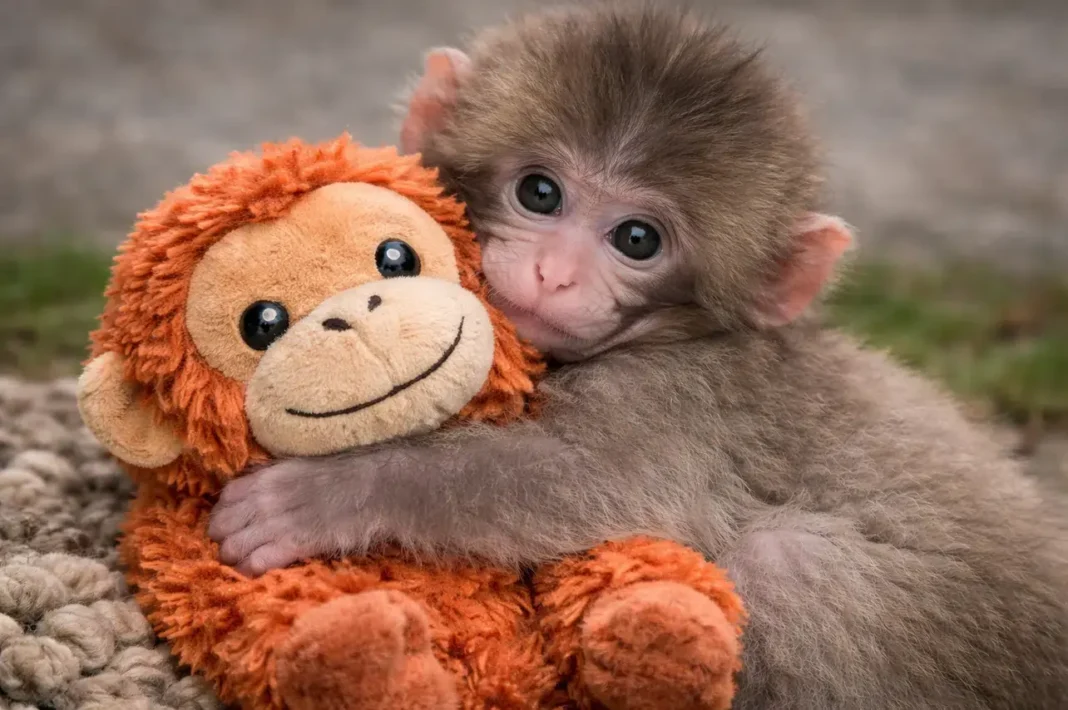

The images of Punch, the baby monkey that has recently circulated on social media platforms, have led many of us to pause for a moment and sigh quietly in front of our screens. Rejected by his mother, struggling to find a place within his own species, and seeking comfort in a plush toy, this small creature’s story has become much more than a simple zoo anecdote. The story of Punch and the widespread resonance it has created in society may, in fact, offer some clues about the emotional world of modern humans.
A Plush Toy As A Symbol Of Security
After being deprived of his mother, Punch’s tight embrace of the plush toy given to him evoked a strong sense of compassion in viewers. Considering expert interpretations and classical observations on primates, this behavior can be understood as a natural response to the need for contact and closeness. In particular, the well-known experiments conducted by psychologist Harry Harlow with rhesus monkeys demonstrated that infant primates require not only nourishment but also a figure that provides warmth and tactile comfort. This need, which Harlow described as “contact comfort,” points to the biological foundations of attachment.
For Punch, the plush toy may not be merely a soft object. It may function as a kind of “safe space” to retreat to in the face of exclusion and uncertainty. Psychoanalyst Donald Winnicott described children’s attachment to objects such as blankets or toys as “transitional objects.” These objects can help individuals soothe themselves and re-establish a sense of security, especially during challenging periods. From this perspective, the images of Punch clinging to his plush toy resemble a deeply familiar psychological pattern.
Collective Empathy: Why Were We So Affected?
So why did we, on the other side of the screens, respond so emotionally to Punch’s story?
Human psychology is highly sensitive to the emotional experiences of others. As social beings, we are inclined to recognize and respond to others’ suffering. Punch’s loneliness, his exclusion, and the subsequent process of being accepted echo themes that are frequently encountered in human life: the search for belonging, the fear of rejection, and the need for acceptance.
Psychiatrist John Bowlby, one of the founders of attachment theory, emphasized that humans need others not only for physical survival but also for emotional security. From this perspective, Punch’s story transforms into a universal narrative with which viewers can easily connect through their own experiences. Perhaps many people saw in this small monkey their own moments of loneliness or their desire to be accepted.
Another important moment in Punch’s story was his acceptance by another monkey. This scene created a noticeable sense of relief among viewers, as it became a small yet powerful symbol that loneliness does not last forever.
Consumption And Emotion: The Symbolic Value Of The Toy
The rapid transformation of Punch’s plush toy into a social media symbol—and the swift depletion of similar toys—reveals another dimension of the story. Many young people created videos with the toy, while others adopted it as a kind of “Punch symbol.”
Viewing this solely as a form of consumer behavior may be insufficient. Research in social psychology shows that people sometimes share emotional meanings through certain objects. An object can become a symbol of a story or a feeling.
Punch’s plush toy may have served exactly such a function. By possessing that object, people may not only be purchasing a toy but also expressing their participation in the compassion and solidarity represented in Punch’s story. In the often distant environment of the digital world, such symbolic objects can become a way for individuals to say, “I am part of this feeling too.”
Conclusion: A Window Of Awareness
Punch’s story reminds us of something simple yet essential: living beings do not exist solely through physical needs; the feelings of security, closeness, and acceptance are also fundamental parts of life. If the image of a small monkey hugging a plush toy has affected so many people, it may be because that scene touches upon a fragile need within all of us.
The amplification of this story by social media may also point to another reality. Even in a fast-paced and often distant world, people can still come together around narratives that contain compassion and empathy.
That moment when Punch hugs his plush toy may ultimately remind us of a simple question:
Do we really need grand solutions to heal, or might a connection that helps us feel just a little safer be enough?
Melis Kümbetlioğlu Psychologist & Attachment Theory Specialist
References
-
Bowlby, J. (1969). Attachment and loss: Vol. 1. Attachment. Basic Books.
-
Harlow, H. F. (1958). The nature of love. American Psychologist, 13(12), 673–685. https://doi.org/10.1037/h0047884
-
Winnicott, D. W. (1953). Transitional objects and transitional phenomena: A study of the first not-me possession. International Journal of Psychoanalysis, 34, 89–97.