
Raise Your Words, Not Your Voice: The Journey Of Parenting Without Shouting

We all know that moment all too well. While the chaos of preparing dinner consumes the kitchen, the sound of something breaking in the living room or the endless bickering of siblings finally pushes our patience to the limit. Somewhere deep inside, a massive wave rises, and suddenly we find ourselves yelling, “Enough already! Quiet down!” In that moment, a silence falls over the house, yes; but it is not the silence of peace—it is the silence of fear and bewilderment. Once the storm passes, we are left with a lump in our throat and the heavy sting of regret, asking ourselves, “What kind of parent am I?” In reality, we all know that, as Rumi famously said, it is rain that grows flowers, not thunder. However, stopping that thunder in the hustle and bustle of daily life is a craft that is far easier said than done.
Shouting is not actually a form of communication; it is a cry of desperation. It is a primitive reflex that kicks in when our words fail and our patience is depleted. From a scientific perspective, we can explain this clearly using Daniel Siegel’s “Hand Model of the Brain.” Imagine your brain as a hand: your thumb is tucked inside, and your other fingers are folded over it. The upper fingers represent the “prefrontal cortex”—the part of the brain responsible for logical thinking, empathy, and weighing decisions. The inner part, the limbic system, is the center of our emotions. When we get angry and shout, we essentially “flip our lid.” The upper brain goes offline, and the lower brain, which operates purely on survival instincts, takes control. When we shout, the child’s brain also instantly switches from “learning” mode to “survival” mode. While you think you are raising your voice to teach them right from wrong, they are actually only thinking about how to escape the danger or where to hide. This situation is akin to trying to teach someone English while pouring ice water over their head; at that moment, the person only wants to escape the water and won’t hear a single word you say.
The biological dimension is not limited to just brain regions. When a child is shouted at, their body is subjected to an intense surge of cortisol and adrenaline. These stress hormones temporarily paralyze the hippocampus, the brain’s memory center. If a child grows up being constantly exposed to shouting, the connections between these regions can weaken, potentially turning them into an adult who struggles to make healthy decisions under stress. Furthermore, we have a system called “mirror neurons.” This system allows us to catch another person’s emotion almost like a Wi-Fi network. When you shout, your child’s mirror neurons copy your anger. In other words, by shouting at them, you are personally providing a practical lesson that says, “This is how you behave when you are angry.”
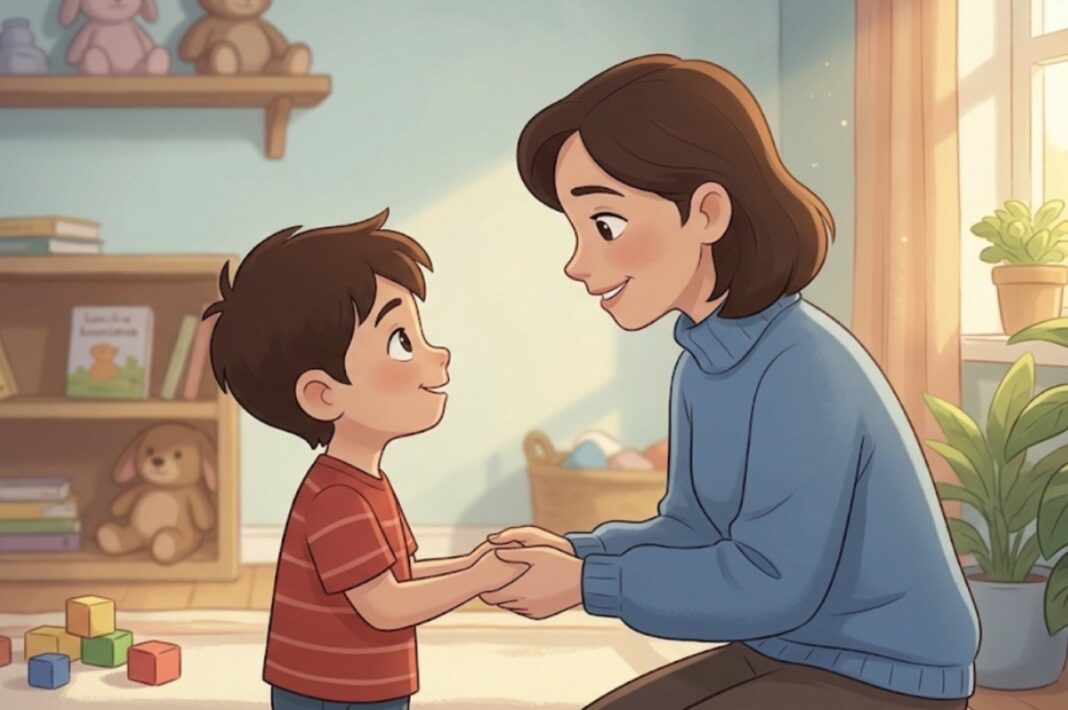
A real-life story summarizes this beautifully: A client once shared a memory involving her seven-year-old daughter. Every morning before school, they would have massive fights over choosing clothes. The mother would shout, the daughter would cry, and they would both leave the house miserable. One morning, just as the mother was preparing to shout, she took a deep breath and knelt down to her daughter’s eye level. She looked into her eyes and whispered: “I know you really want to wear that dress right now, but it’s dirty. I don’t want to fight with you, I love you, and I just want you to be at school on time. Will you help me?” Her daughter’s reaction was surprising; she first looked at her mother in astonishment, then wrapped her arms around her neck and said, “Okay mommy, I can wear the other one.” The magic here is in the whisper. When you lower your voice, the child leans in to hear you. When you shout, they simply close their ears and their hearts.
So, how do we break this cycle? The first step is to apply the famous airplane rule: put on your own oxygen mask first. If you are on the verge of exploding due to fatigue, hunger, or stress, your child’s smallest mistake becomes a ticking time bomb. In that first second when you feel the anger rising, it is not a sign of weakness but a virtue to say, “I am very angry right now and I don’t want to say the wrong thing,” and go to the kitchen to drink a glass of water. If you cannot control your own emotion, you cannot possibly manage the emotion of a child. The sentences you form once you have calmed down will be far more effective than thousands of words screamed in anger.
Simplifying language and turning it into positive reinforcement also makes a huge difference. We usually focus on telling them what not to do: “Don’t run!”, “Don’t shout!”, “Don’t spill your food!”. However, the child’s brain sometimes filters out negative suffixes. Instead, using clear commands that tell them exactly what to do, like “Let’s walk slowly in the house” or “Let’s speak in low voices,” increases cooperation. There is also the magic power of offering choices. Instead of saying “To the bath, now!”, asking “Do you want to walk to the bath yourself or do you want a piggyback ride?” leaves a space for the child’s will. They no longer think about “whether to go or not,” but rather “how to go.” This method activates the child’s developing prefrontal cortex, encouraging logical thinking.
Jane Nelsen, the pioneer of Positive Discipline, has a question I love: “Where did we ever get the crazy idea that in order to make children do better, we first have to make them feel worse?” Shouting makes a child feel bad, and a child who feels bad behaves worse. It is a cycle. However, seeing a child’s mistake as a “teaching opportunity” shifts our perspective. Instead of shouting over spilled milk, bringing a cloth and saying, “Let’s clean this up together; next time it will be easier if you hold the glass with two hands,” gives the child both responsibility and problem-solving skills. Neurologically, this approach triggers the brain’s reward system and instills a sense of “achievement” in the child.
Finally, we must remember that we are not robots. Of course, there will be times when our voices rise and we make mistakes. In those moments, going to your child and saying, “I am sorry I shouted at you just now. I was very tired, but that was my mistake; I shouldn’t have asked you that way,” is the greatest life lesson you can give. You teach them that making mistakes is human, but making amends is true greatness. This transparency triggers the release of oxytocin, the hormone that strengthens the bond of trust between parent and child. Your children may forget what you taught them today, but they will never forget how you made them feel. Their inner voice in the future will be the echo of the external voice you use with them today. To ensure that voice is one of compassion, confidence, and guidance, it is well worth growing our patience and love instead of our volume.
Reference
• Nelsen, J. (2015). Positive Discipline. Ballantine Books.
• Siegel, D. J., & Bryson, T. P. (2012). The Whole-Brain Child. Delacorte Press.
• Faber, A., & Mazlish, E. (2012). How to Talk So Kids Will Listen & Listen So Kids Will Talk. Scribner.
• Runkel, H. E. (2007). ScreamFree Parenting. Broadway Books.