


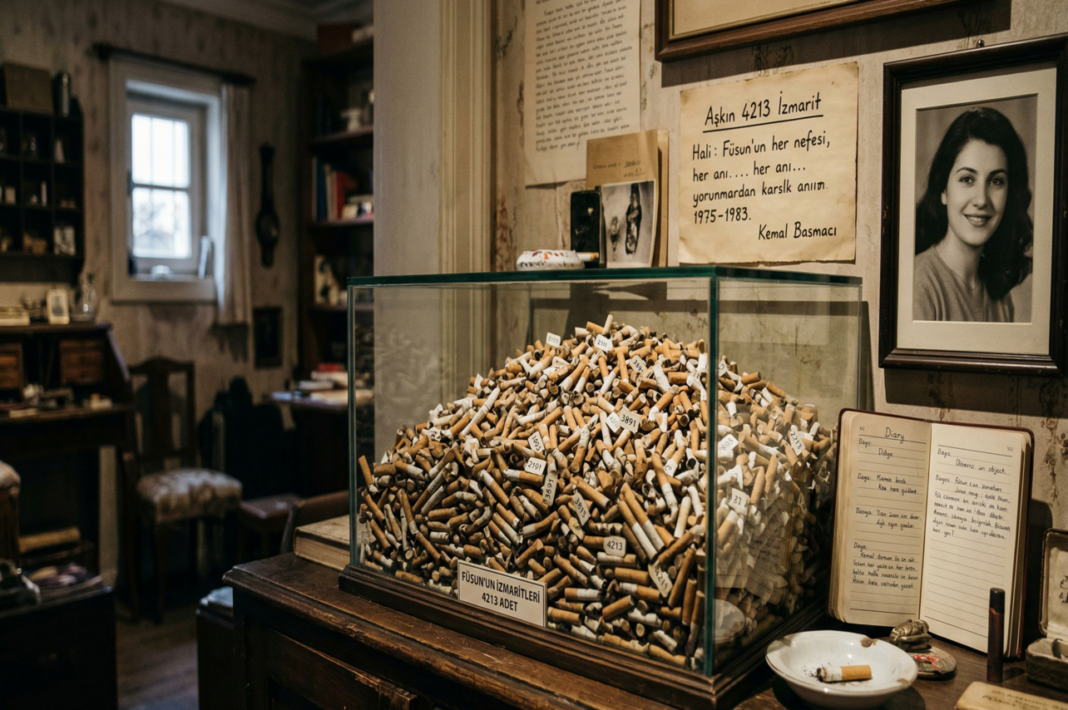

Love often appears in daily life as an experience glorified and romanticized. However, in some cases, love requires a psychological analysis rather than a romantic one. The Museum of Innocence is not just a love novel; it is also a profound publication that examines the impact of obsession on love. Kemal’s love for Füsun is not a classic form of attachment. It is a psychological organization that intensifies and is identified with objects.
Love Or Obsession?
Kemal’s feelings for Füsun appear to be intense love. However, upon closer examination, this love, which extends to objects, exhibits obsessive characteristics. The hoarding of 4213 cigarette butts is not merely a matter of sentimental value. What we see here is an attempt by an individual, unable to tolerate loss, to maintain this relationship through objects.
From a psychodynamic perspective, this situation can be linked to “object relations.” When the loved one is not physically present, the individual cannot maintain a healthy mental representation of that person and therefore seeks a solution in objects. The 4213 cigarette butts Kemal collected are a way of coping with Füsun’s physical absence (Fisher et al., 2005).
Object Relations Theory and The Representation Of Füsun
Object relations theory was developed by Winnicott and Klein. According to this theory, individuals do not only carry the people they have intense feelings for in their external world. They also carry these people internally, placing them in a special place within their inner world. According to this theory, in a healthy psychological structure, these internal representations should function as a coherent whole (Winnicott, 1953).
When Kemal’s situation is evaluated, Füsun has ceased to be an internal or external representation and has transformed into an idealized, frozen image. In this case, love deviates from a healthy, reciprocal relationship and becomes an internal representation experienced alone. Kemal loves Füsun with an intense obsession, in the way he has created her in his mind.
The Objectification Of Love: Establishing Relationships Through Memories
Kemal’s collection of Füsun’s belongings serves as the most concrete example of the objectification of love. The relationship that cannot be established with the unattainable person is established through their belongings. This phenomenon is referred to as “displacement” in psychological literature.
Objects don’t just remain as memories; they also become a tool for emotional regulation. For Kemal, these objects are tools he uses for emotional regulation in Füsun’s absence. Each collected cigarette butt has become a point of emotional contact with the past for him.
The Pathological Boundaries Of Love
The Museum of Innocence demonstrates, with many concrete examples, that love is not always a healing experience. Sometimes, love can evolve into a situation that challenges an individual’s psychological integrity rather than providing healing, and can diminish their quality of life.
The Anatomy Of Heartbreak
Love is not merely an emotional experience. Neurobiological and psychodynamic processes are also highly influential. When a breakup occurs with someone with whom intense feelings are harbored, the dopamine cycle related to the brain’s reward system is disrupted. Additionally, the stress system becomes active. Therefore, a withdrawal-like situation arises; the individual experiences symptoms similar to “withdrawal” both psychologically and physically. When Kemal’s love for Füsun is examined, a picture resembling addiction and withdrawal symptoms is observed. Cigarette butts, memories of Füsun; these are actually attempts to maintain this bond and alleviate the withdrawal. However, this bond continues, becoming chronic instead of healing. Consequently, love ceases to be a healthy emotional experience and transforms into a state that affects the individual mentally and physically (Fisher et al., 2005).
Conclusion
The love depicted in the Museum of Innocence is a narrative that also emphasizes the psychological limits of love. It shows how Kemal’s deep love and longing for Füsun in her absence can gradually turn into obsession, and how attachment can evolve into addiction. The image of love as a collection of 4213 cigarette butts is actually a consequence of being unable to accept the loss of a loved one. While the individual tries to alleviate the emotions and situations they cannot accept through these objects, they also nourish and prolong this healing process. The Museum of Innocence doesn’t only shed light on the beautiful aspects of love. It also clarifies the kinds of defenses the human mind develops in the face of loss and how it sometimes gets stuck. When experienced correctly, love can be a healing and transformative experience. However, if it turns into obsession, it can become a tiring and exhausting process for the individual.
ReferencesÂ
Fisher, H. E., Aron, A., & Brown, L. L. (2005). Romantic love: An fMRI study of a neural mechanism for mate choice. The Journal of Comparative Neurology, 493(1), 58–62. https://doi.org/10.1002/cne.20772
Winnicott, D. W. (1953). Transitional objects and transitional phenomena: A study of the first not-me possession. International Journal of Psychoanalysis, 34, 89–97.