


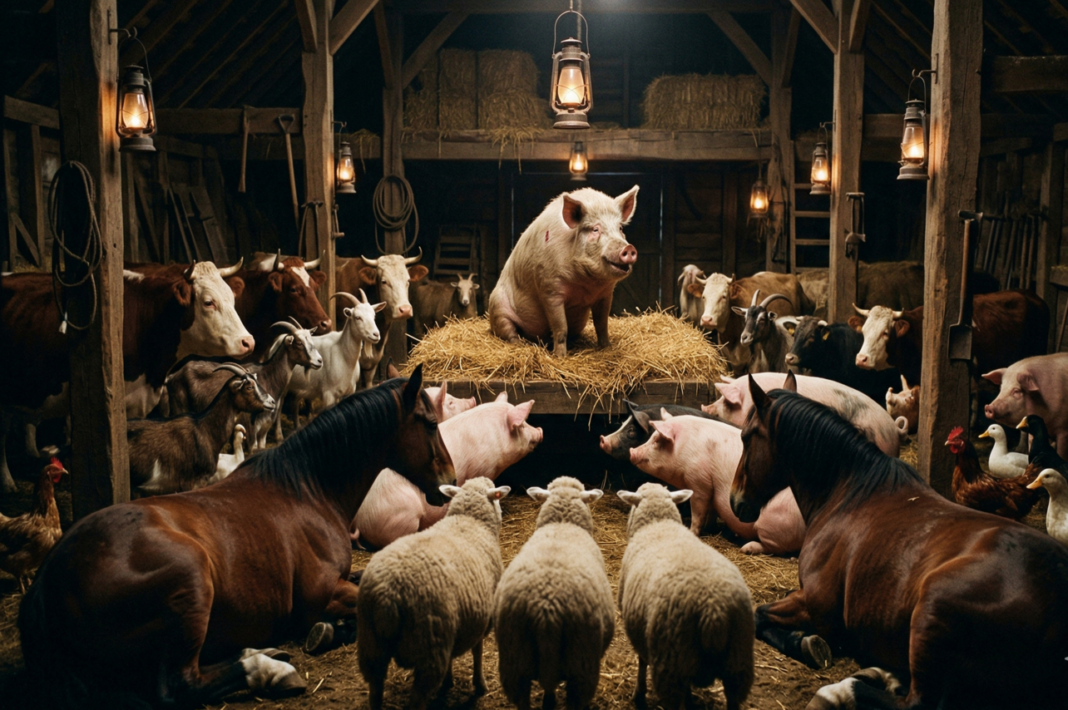

George Orwell’s Animal Farm, a seminal 20th-century political satire, was published the same month as the Hiroshima and Nagasaki bombings. Drawing from Orwell’s Spanish Civil War experiences, theallegory mirrors the Russian Revolution and Stalinist era. Characters represent key figures and social classes: Napoleon as Stalin, Snowball as Trotsky, Boxer as the proletariat, and Moses as the clergy.
This article analyzes Old Major, the visionary pig who inspired the revolution against Mr. Jones, through the lens of Transformational Leadership. By examining his rhetoric and unifying vision, I argue that Old Major embodies the core principles of a transformational leader.
Transformational Leadership
According to Burns (1978, as cited in Bass & Bass, 2008, p.619), transformational leader as one who: “Raises the followers’ level of consciousness about the importance and value of designated outcomes and ways of reaching them” and “Raises the followers’ level of need on Maslow’s hierarchy from lower-level concerns for safety and security to higher-level needs for achievement and self-actualization.”
Old Major seems very concerned about raising his followers’ needs. “You, Boxer, the very day that those great muscles of yours lose their power, Jones will sell you to the knacker, who will cut your throat and boil you down for the foxhounds” (Orwell, 1945/2000, p.5) Moreover, he called out to Clover “Where are those four foals you bore, who should have been the support and pleasure of your old age? You will never see one of them again. In return for your confinements and all your labour in the fields, what have you ever had except your bare rations and a stall?” (Orwell, 1945/2000, p.5). It seems that Old Major cares his followers’ well-being and want them to go beyond their basic needs.
In addition to these common features of the transformational leaders, Bass and Riggio (2010, p.78) define several characteristics of transformational leaders, which are idealized influence, inspirational motivation, intellectual stimulation, and individualized consideration.
Idealized Influence
Idealized influence is related to transformational leaders being respected, admired and trusted (Bass & Riggio, 2010, p.78). “Old Major was so highly regarded on the farm that everyone was quite ready to lose an hour’s sleep in order to hear what he had to say” (Orwell, 1945/2000, p.1). This shows that he is such a respected figure that even the animals are willing to give up their sleep to listen to him.
Inspirational Motivation
Inspirational motivation refers to fact that transformational leaders act in ways that they motivate and inspired those around them (Bass & Riggio, 2010, p.78). Old Major says “That is my message to you, comrades: Rebellion” (Orwell, 1945/2000, p.6). Thus, it can be seen that his call to action worked, since Mr. Jones was driven out. As he sang the song “Beasts of England”, the other animals joined in with enthusiasm, and this excitement turned into arevolution that led to Mr. Jones driven off from the farm “The singing of this song threw the animals into the wildest excitement” (Orwell,1945/2000, p.9)
Intellectual Stimulation
Intellectual stimulation can also be seen in the Old Major. Bass and Riggio (2010, p.78) defined this attribute that transformational leaders’ ability to encourage their followers’ efforts to be creative by questioning assumptions, reframing problems and approaching old situations through the new lens. Therefore, this leadership style encourages the creativity: “Man is the only creature that consumes without producing… He is too weak to pull the plough… Yet he is lord of all the animals” (Orwell, 1945/2000, p.4) After his death, animals gained a new perspective: “Major’s speech had given to the more intelligent animals on the farm a completely new outlook on life” (Orwell, 1945/2000, p.10)
Individualized Consideration
With regard to individualized consideration, transformational leaders often ask “What can we do as a group?” (Bass & Riggio, 2006, p.12). Old Major asked “What then must we do? Why, work night and day, body and soul, for the overthrow of the human race” (Orwell, 1945/2000, p.5)
There are more examples illustrating that the Old Major is a unique transformational leader. First of all, he has his own charisma. Bass (1999) noted that transformational leaders move their followers beyond immediate self-interest through their idealized influence (charisma). Given that Old Major had been exhibited under the name of “Willingdon Beauty” (Orwell, 1945/2000, p.1) he has very strong influence on other animals. Moreover, “his majestic-looking with a wise and benevolent appearance” (Orwell, 1945/2000, p.1-2) makes him a perfect charismatic leader.
Beyond his charisma, Old Major, in line with ability that transformational leaders fosters autonomy (Bass, 1999), strengthened the collective efficacy of his followers “They [animals] saw clearly that it was their duty to prepare for it [rebellion]” (Orwell, 1945/2000, p.10)”. Besides that, provided that transformational leaders help their followers to develop their own leadership potential (Bass & Riggio, 2010, p.77), Old Major has become successful in encouraging the other pigs to lead. “The work of teaching and organizing the others fell naturally upon the pigs, who were generally recognized as being the cleverest of the animals” (Orwell, 1945/2000, p.10)
When all things considered, it can be seen that the Old Major is a unique example of a transformational leader.
References
Bass, B. M. (1999). Two Decades of Research and Development in Transformational Leadership. European Journal of Work and Organizational Psychology 8(1), 9-32. https://doi.org/10.1080/135943299398410
Bass, B. M., & Riggio, R. E. (2006). Transformational Leadership (2nd ed.). Psychology.
Bass, B. M. & Bass, R. (2008). The Bass Handbook of Leadership: Theory, Research, and Managerial Applications. (4th ed.). Free Press.
Bass, B. M. & Riggio, R. E. (2010). The Transformational model of leadership. In G. R. Hickmann (Ed.), Leading Organizations: Perspectives for a New Era (2nd ed., pp. 76-85). SAGE Publications
Orwell, G. (2000). Animal farm. Penguin Classics. (Original work published 1945)