



Social factors significantly influence a child’s development. This article discusses sociology and sociologist Pierre. Child development will be discussed within the context of Bourdieu’s concepts.
Sociology examines many areas at the micro and macro levels, including community, group, family, education, culture, economy, health, and media. These social areas influence a child’s development in terms of physical, cognitive, social-emotional, and language development. Habitus, capital, area Pierre these are Bourdieu’s important concepts. He examined how these concepts affect individuals. These concepts affect not only adults, but fundamentally the lives of individuals, starting from childhood. The quality of the social environment in which a child grows up significantly influences their development. Below, Bourdieu’s concepts are defined and their relationship to child development is discussed.
What Is Habitus?
Habitus is formed by the internalization of the conditions in which an individual is born. A child internalizes the environment in which they grow up. Example: School is an institution. It has become a habit for a child to stand up when they see their teacher and to sit quietly in their seat. These behavioral patterns are learned from the social environment. Habitus is the way in which the invisible rules, values, and hierarchies within the social environment in which a child is born influence and shape the child. The types of capital a family possesses, in particular, determine its habitus and influence its development.
Types Of Capital and Their Impact On Child Development
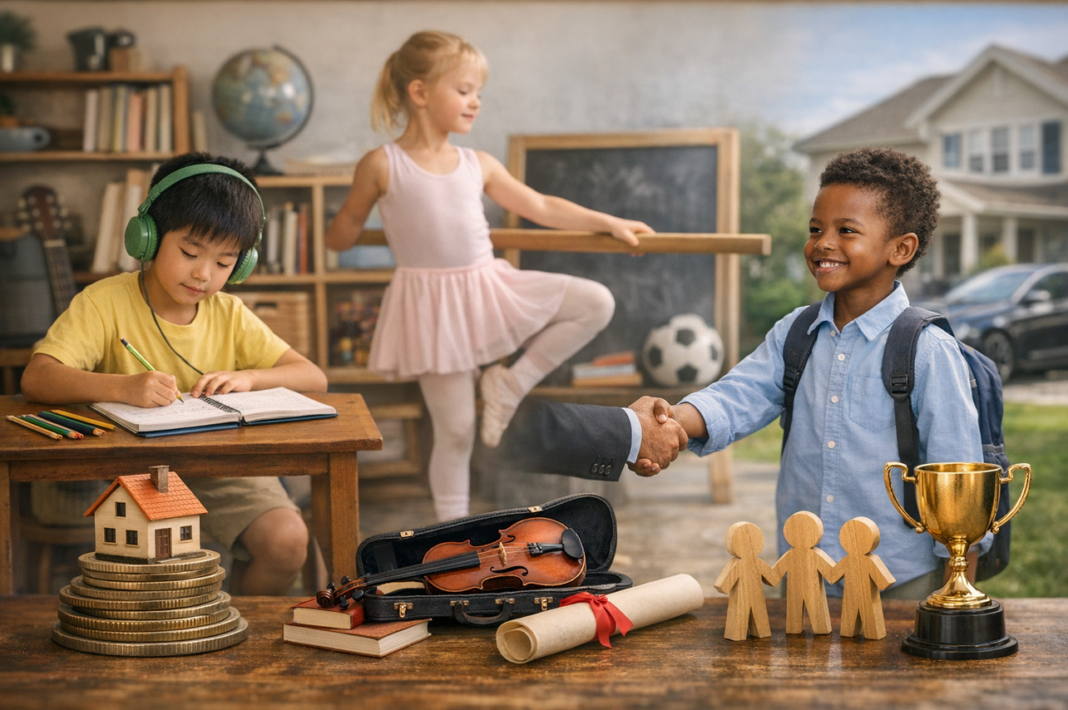
Capital is any resource that determines a child’s “power,” “respect,” and “chance of success” within society. In terms of child development, capital is the “bag of opportunities” that the family provides to the child. The family’s economic, cultural, social, and symbolic structure and characteristics influence the child’s development.
-
Economic Capital – Its Impact on Child Development: A child’s healthy nutrition, upbringing in a safe and positive environment, access to quality toys, and enrollment in specialized courses (piano, foreign languages, sports) are all related to economic capital. The family’s economic situation provides the child with easier access to resources. Example: A family hiring an English-speaking nanny and ensuring the child learns English from a young age is related to economic capital. Economic capital can be transformed into other types of capital. A family with economic capital can also have social capital and cultural capital. This, in turn, affects the child’s development.
-
Cultural Capital – Its Impact on Child Development: This is the most important type of capital with a significant impact on a child’s development. Characteristics such as a child’s speech pattern, vocabulary, general knowledge, and aesthetic taste are learned from the family. Parents’ education, appreciation of art and music, and their speaking style influence the child and contribute to their development in these aspects. Children born and raised with cultural capital are also successful in the educational environment because they have already acquired the necessary knowledge and skills within the family. With the support of the family, the child’s academic success continues to increase throughout the developmental process. Children from families with cultural capital also excel in many areas that support child development, such as sports, art, and music.
-
Social Capital – Its Impact on Child Development: This relates to “who you know.” It encompasses the social connections within the family. The educational level and professions of the people in the child’s environment serve as role models. A child with high social capital will gain access to better schools and career opportunities throughout their life through “references.”
-
Symbolic Capital – Its Impact on Child Development: This refers to the legitimacy and respectability of other forms of capital by society. It encompasses the family’s recognition and prestige within the community. Families with economic, cultural, and social capital are generally regarded with respect in society. The trust that society and teachers have in the child increases. This trust influences the child’s self-confidence.
Conclusion and Solutions
In conclusion, the environment in which a child grows up and the quality of the family positively or negatively affect the child’s development. If families possess the aforementioned capital, the child will show positive development. Children from families lacking economic, cultural, social, and symbolic capital are at a greater disadvantage. The capital possessed affects access to resources. A child growing up in a family without cultural capital is seen as lagging behind children in terms of school achievement compared to children with cultural capital and is generally labeled as “failing – needs improvement.”
Children from families with cultural capital are also more advantageous than children without cultural capital in terms of cognitive, social-emotional, language, and motor development stages. Families with cultural capital generally develop their children in these areas and prioritize their development. Developing these areas requires not only cultural capital but also economic capital. When cultural and economic capital combine, the family influences the child in many ways. It is particularly important for the family to possess both economic and cultural capital for the child’s development.
In terms of solutions and analysis, before labeling children as “failures” or “inadequate” in certain areas, their family and social environment should be examined. Does the child have sufficient resources to succeed in certain areas compared to their peers? What are the family and environment doing for the child’s development? Is the necessary support being provided? Does the family have the means to provide this support? These questions should be asked. If the family does not have the resources to provide the necessary support, the family and the child should be supported. If the resources given to advantaged children are also given to disadvantaged children, social equality will be achieved, and disadvantaged children will be able to reach the developmental levels of their peers. Families of children lacking cultural capital should be given educational support to raise their awareness regarding child development. Families lacking economic capital should be supported by civil society organizations, and education in all areas of children’s development should be provided free of charge.
In Bourdieu’s context, the question of why a child is “inadequate” in developmental areas or school performance may stem from invisible inequalities. Identifying these invisible inequalities and providing the necessary support to families and children will foster the child’s development.
Reference
Palabıyık, A. (2011). Pierre “Habitus”, “capital” and “field” in Bourdieu’s sociology. Liberal Thought, 16(61-62), 121-141.