


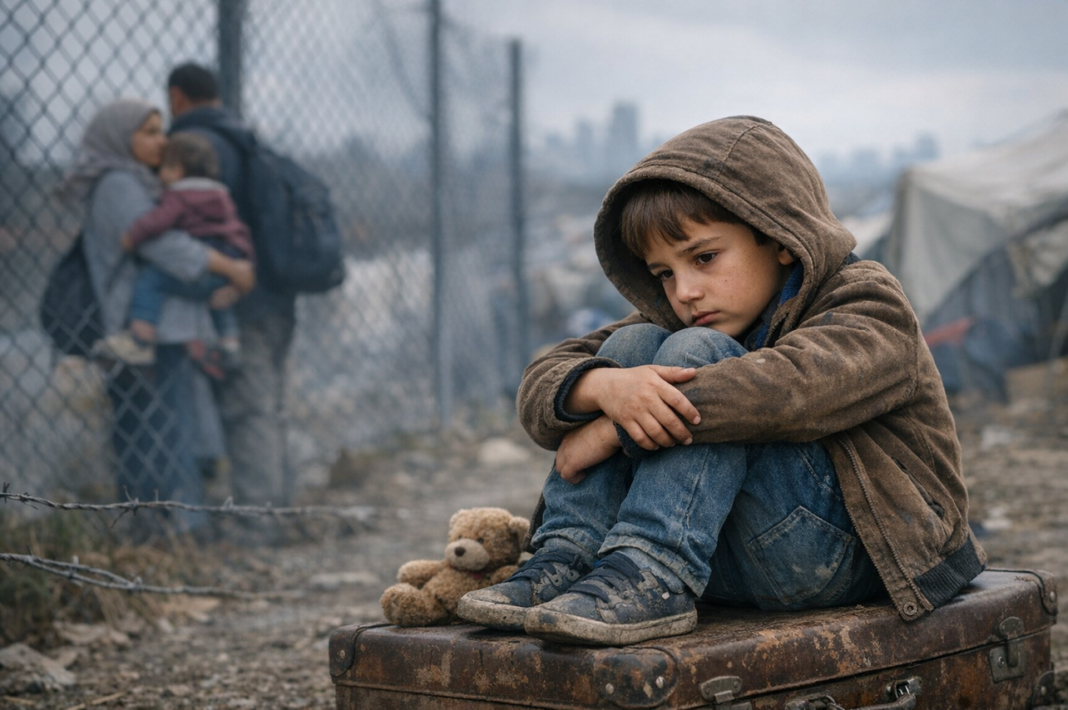

Migration is not merely a geographical relocation from one place to another; it is a multidimensional process that also carries an individual’s identity, past, and life narrative. For this reason, the experience of migration holds different meanings for each individual and is shaped by unique personal experiences. Over time, the concept of “migration” has evolved into a phenomenon increasingly infused with individual experiences and marked by more visible psychosocial dimensions.
At this point, an important question arises: What does migration mean for children, and how does it affect them?
From the perspective of children, migration is a unique and singular experience intertwined with their developmental processes. Each child experiences migration in accordance with their temperament, level of social-emotional development, and coping skills. In addition, the reasons for migration, experiences encountered during the migration process, and the nature of relationships and attachments formed with caregivers are among the key factors that determine the quality of this experience.
When examined from the child’s point of view, it becomes evident that the losses experienced during migration differ for each child. For some children, migration may mean separation from their native language, playmates, and school; for others, it may involve the loss of safe spaces, familiar parks, places defined as “home,” and established routines. These losses can form a sequential and often invisible “chain of grief” in a child’s life (Galdi, 2004). From a developmental perspective, since children’s psychological flexibility and resilience skills are not yet fully mature compared to adults, the rapid and intense changes experienced during migration may lead to deeper and quieter transformations in children (Masten, 2001).
For many migrant children, the world they are accustomed to changes suddenly. While trying to learn the language, social norms, school system, and cultural expectations of a new country, the child simultaneously strives to adapt to this new structure. This process may give rise to emotional and bodily experiences of confusion and distress that the child may not yet be able to express verbally.
Psychosocial Dimensions Of Migration In Childhood
The literature indicates that the mental health of migrant children should be understood in relation to individual, familial, and environmental factors accompanying the migration process. In this context, Berry’s (1997) acculturation model emphasizes that children’s psychological adjustment during migration is shaped not only by individual characteristics but also by their social environment, family dynamics, and relationships established with the host society.
From this perspective, although migration can be a process that creates stress and adaptation difficulties for children, it may also offer significant opportunities for adaptation and resilience development when appropriate environmental and familial support is provided.
Common Challenges Experienced By Migrant Children
Language Loss And Language Barriers
Many migrant children may experience misunderstanding, social exclusion, and academic difficulties due to challenges in expressing themselves adequately in a new language. In addition, fear of losing their native language constitutes a significant source of stress for children.
Repeated Experiences Of Loss
Migration often involves leaving behind play areas, friends, teachers, schools, and daily routines. This situation can lead to an accumulation of sequential loss experiences in a child’s life (Galdi, 2004).
Sense Of Belonging And Identity Confusion
The question “Where do I belong?” may emerge at an early age among migrant children. Feeling like a stranger in a new society while simultaneously becoming distanced from one’s cultural roots can challenge identity development.
Social Isolation And Bullying
Discrimination, exclusion, and peer bullying due to differences in language, culture, and appearance are among the common experiences of migrant children. These experiences may negatively affect children’s self-concept and social-emotional development.
Changes In Family Roles
In a new cultural context, some children may take on the role of interpreter or guide for their parents. This phenomenon, referred to as parentification, places a developmentally burdensome responsibility on the child (Greenberg & Jurkovic, 1999).
Hypervigilance And Insecurity
Uncertainty and economic difficulties accompanying migration may lead to a persistent state of hypervigilance and feelings of insecurity in children. This can negatively affect emotional regulation skills (Perry, 2009).
Pre-Migration Traumatic Experiences
Experiences such as war, poverty, and forced migration may manifest as sleep problems, anger outbursts, withdrawal, and trauma-related responses (Kadir et al., 2018).
Protective Factors And Resilience
Not all migrant children face the same risks. Some studies indicate that migrant children may demonstrate mental health outcomes equal to or even better than those of their non-migrant peers. This phenomenon is described in the literature as the “healthy migrant effect” (Sam & Berry, 2010). Strong family bonds, high motivation, and resilience are among the key factors explaining this effect (Masten & Barnes, 2018).
In conclusion, the extent to which a child can maintain connections with their cultural values plays a critical role in managing the encounter with a new culture with lower levels of stress. Migration in childhood, psychosocial challenges, and resilience must therefore be evaluated within a multidimensional framework.
Resilience does not imply the absence of adversity; rather, it refers to the child’s ability to cope with difficulties, adapt effectively, and build a meaningful bridge between two cultures.
References
Berry, J. W. (1997). Immigration, acculturation, and adaptation. Applied Psychology, 46(1), 5–34. https://doi.org/10.1111/j.1464-0597.1997.tb01087.x
Galdi, G. (2004). Book review: Immigration and identity. turmoil, treatment, and transformation, by Salman Akhtar, Jason Aronson Inc., 1999, 220 pp. The American Journal of Psychoanalysis, 64(2), 215–219. https://doi.org/10.1023/b:tajp.0000027371.70842.90
Greenberg, R., & Jurkovic, G. J. (1999). Lost childhoods: The plight of the parentified child. Family Relations, 48(1), 101. https://doi.org/10.2307/585689
Kadir, A., Shenoda, S., Goldhagen, J., Pitterman, S., Suchdev, P. S., Chan, K. J., Howard, C. R., McGann, P., St Clair, N. E., Yun, K., & Arnold, L. D. (2018). The effects of armed conflict on children. Pediatrics, 142(6). https://doi.org/10.1542/peds.2018-2586
Masten, A. S. (2001). Ordinary magic: Resilience processes in development. American Psychologist, 56(3), 227–238. https://doi.org/10.1037/0003-066x.56.3.227
Masten, A. S., & Barnes, A. J. (2018). Resilience in children: Developmental perspectives. Children, 5(7), 98. https://doi.org/10.3390/children5070098
Perry, B. D. (2009). Examining child maltreatment through a neurodevelopmental lens. Journal of Loss and Trauma, 14(4), 240–255. https://doi.org/10.1080/15325020903004350
Sam, D. L., & Berry, J. W. (2010). Acculturation. Perspectives on Psychological Science, 5(4), 472–481. https://doi.org/10.1177/1745691610373075