


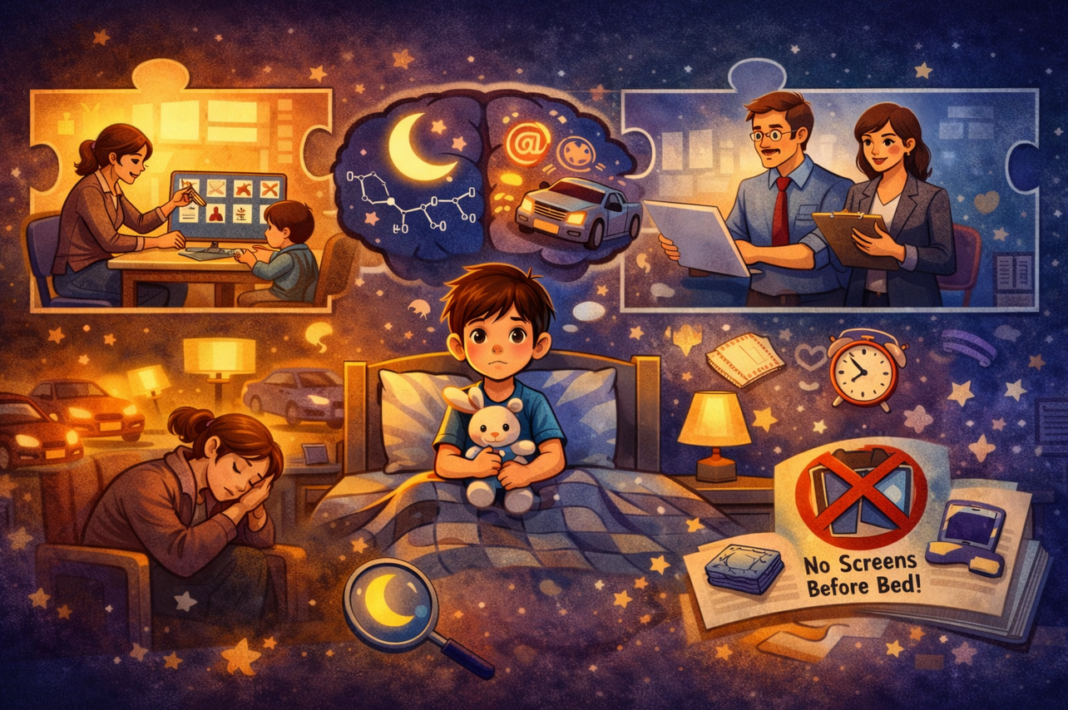

I spent the most instructive years of my professional life working one-on-one, eye-to-eye, with children diagnosed with Autism Spectrum Disorder (ASD). However, there is another side to this story. Together with my spouse, we manage a Special Education and Rehabilitation Center. This means I am a witness to this picture not only as an instructor in the classroom but also as an administrator touching the lives of hundreds of families waiting in the corridors of our institution and managing their children’s educational processes.
Whether in my 2.5 years of individual fieldwork or in the hundreds of cases I encounter every day at our center, there is a common “silent struggle” I see. In our waiting rooms, I have seen mothers falling asleep in chairs while their child is in class, and fathers whose eyes are closing from exhaustion. Back then, as an educator and administrator, my priority was the children’s academic and social development. However, looking at that picture today as a Sleep Consultant, I can see the source of the problem much more clearly: If there is no sleep in those homes, development remains incomplete.
In this article, I want to address you not with cold academic language, but with the same sincerity I use when speaking to the parents who walk through our doors.
Understanding sleep problems in autism, sensory sensitivity, and sleep routine in ASD is essential for supporting both children and families.
Why Do Our Children Struggle To Sleep?
The biggest experience I gained both at our center and in my individual studies is this: Sleep problems in a child with autism are not simple “stubbornness.” This is entirely a neurobiological and sensory difference.
First, let’s talk about the biological reality. Melatonin, the sleep hormone, is often secreted irregularly in children with autism. When we dug beneath the surface of the focus problems I frequently observed in students coming to early morning classes at our institution, we saw that most of them had spent the night awake. Their brains struggled to biologically distinguish between night and day.
But it is not just about hormones. The key point is: The senses.
A bedroom that is “quiet” for us can be a chaotic noise zone for a child with autism. The sound of a car passing on the street, the texture of a pillowcase, or even the tag on their pajamas… As a manager, I personally observe how sensitive children are to these stimuli in the sensory integration rooms at our rehabilitation center. This sensitivity does not leave them alone at night in bed. Their nervous system perceives the details we filter out as a threat, preventing them from falling asleep.
Through The Eyes Of An Administrator And Educator: The Power Of Routine
The clearest truth I have seen, both while working in the field as an educator and managing the general operations at our institution, is this: Children with autism do not like uncertainty. For them, surprises are anxiety-inducing.
I remember the intense anxiety my students experienced when transitioning from one class to another in the past. Now, as a sleep consultant, I know that the same anxiety occurs in the bedroom at night. That is why a sleep routine is not a luxury for these children; it is a vital necessity.
As we always emphasize at our institution, visualization is everything. Do not just say “Go to sleep” to your child. Create a flow with picture cards: Pajamas → Brush Teeth → Book → Sleep. When the child concretely sees what comes next, their brain calms down. I see every day how the children at our center relax with visual schedules; you can bring the same peace to your home.
Why Classic Methods Fail
Standard sleep training books on the market often talk about “crying it out” or leaving the child alone in the room. As a Rehabilitation Center Director and Psychological Counselor, I say this clearly: These methods, which ignore the temperament and special needs of a child with autism, bring harm rather than benefit.
These children may not yet have developed self-soothing skills. Leaving them alone does not teach them to sleep; it only teaches them insecurity. My approach is always to be inclusive. You must guide them into sleep by staying with the child, touching them, and providing reassurance.
“Insider” Suggestions For Parents
As both a center owner and a consultant, my fundamental suggestions that families can apply at home are:
1. Watch Like A Detective
When there is a behavioral problem at our center, we first ask “why?” Do the same for sleep. What is bothering your child? Is it the light, the sound, or the texture?
2. The Need For Deep Pressure
Some of our children want to feel their body boundaries. Weighted blankets or a feeling of being wrapped tightly can give the “you are safe” message to the child’s nervous system, facilitating the transition to sleep.
3. Technology Detox
Melatonin is already low; let’s not suppress it further with tablet light. It is critical to turn off screens at least 1–2 hours before sleep.
You Are Not Alone
Finally, I want to call out to all the mothers and fathers who walk through the doors of our institution carrying the worry, “Am I not enough?” in their eyes. You are not inadequate. You are heroes running a marathon on a very difficult track.
I witness it every day at the center I manage with my spouse; the development of a child with autism is a work of patience. A sleep routine is not established overnight. I believed in their determination to learn in the past, and now I believe they can sleep peacefully.
Every child learns in their own time and in their own language. Take a deep breath tonight, because your calmness is the biggest key to their sleep.