



Introduction
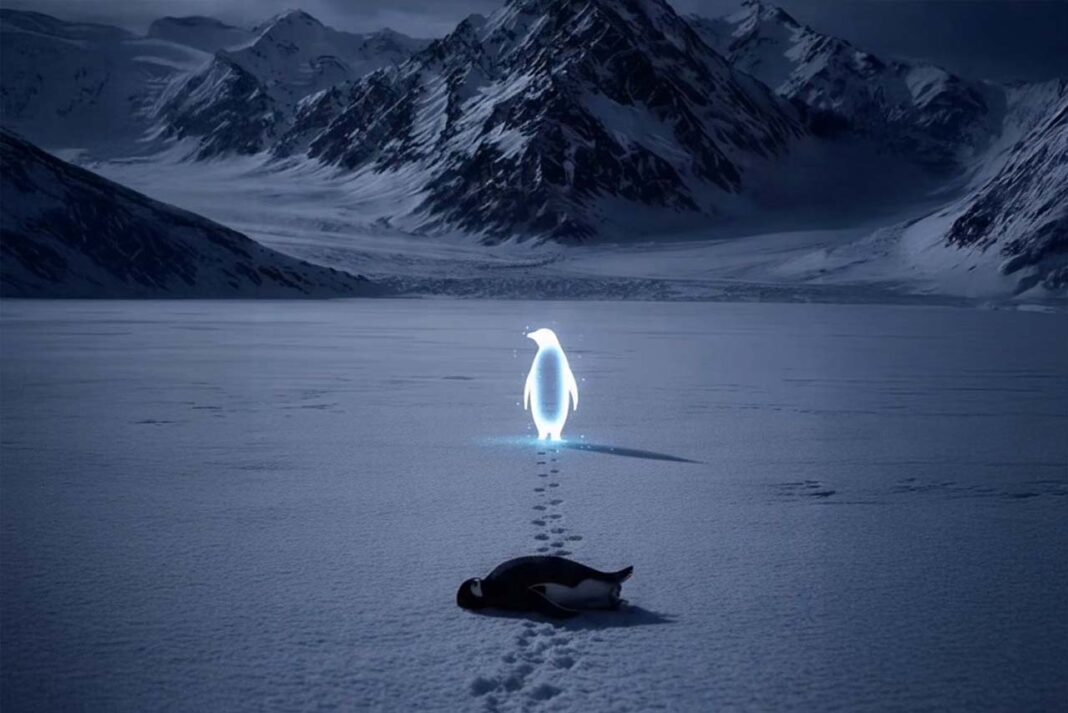
The documentary Encounters At The End Of The World, directed and filmed by Werner Herzog in 2007, has recently resurfaced in public attention. The reason for this renewed interest is a striking segment involving a penguin that deviated from colony behavior. During filming, a penguin leaves its colony, which normally attempts to reach the ocean from the mainland—not to go to hunting grounds or rest at the edge of the ice, but in the opposite direction, heading toward the mountains, a path known to lead to certain death. Although marine ecologist David Ainley, who conducted the research, tried several times to return it to the ocean and its colony, the penguin refused to give up.
Why did the act of a lone penguin—a species known for its survival instincts, colonization, and communal living—stubbornly and persistently separating from its flock and risking death for an unknown reason, find a place to resurface in societies around the world 19 years later and become so widely internalized? Especially when other species, like whales and dolphins, that stray from their groups and beach themselves are known, yet not internalized to this extent?
Philosophical Background
The most frequent explanation for why people have embraced this video so strongly is that this penguin is a “nihilist” penguin. According to Albert Camus, often associated with existential thought, nihilism emphasizes the collapse of meaning in a world stripped of transcendental foundations. Although the statement “everything is permissible but nothing is meaningful” is frequently attributed to him, Camus’s philosophical focus was the experience of the absurd—the tension between humanity’s search for meaning and the silence of the universe.
According to Friedrich Nietzsche, who analyzed nihilism in depth, nihilism is “the loss of value of the highest values.” It is the complete erosion of meaning that once structured moral and social life. Within Nietzsche’s framework, after accepting this meaninglessness, two paths can be chosen:
-
First, if nothing has meaning, life itself becomes meaningless; therefore, one must hopelessly await the approach of death.
-
Second, if nothing has meaning, all restrictive rules are invalid. Each individual can become the creator of their own ruleless freedom, constructing and living a life beyond imposed moral frameworks.
Although Nietzsche advocates the second path—the creative revaluation of values—nihilism is often perceived only through the first interpretation and is presented dramatically as a narrative of despair.
Everyone Has Their Own Reasons To Be That Penguin
Based on interpretations circulating on social media, three major perspectives appear to explain why people have internalized this penguin so deeply.
Lonely March
In this increasingly modern and technologically advanced world, it is possible to observe a paradox: communication tools increase while authentic connection decreases. Individuals who feel the need to express themselves and say “I am here” with their thoughts cannot always find an environment in which they are heard, respected, or accepted. When individuals feel unseen within the society they were born into—or once felt they belonged to—they gradually become alienated from their own people and are pushed into an isolated walk of life.
This existential loneliness, experienced within society rather than outside it, makes it easier for empathetic individuals to identify with even a penguin that has left its flock. The penguin becomes a projection of modern alienation.
A Romantic Perspective
From individuals who live with a romantic lens, another interpretation has emerged: that this penguin may have lost its mate and, due to grief, embarked on a fatal journey. Penguins are often described as monogamous animals; however, scientific data does not conclusively demonstrate that they remain with the same partner for life or exhibit human-like grief responses. The documentary and research team did not record any specific data regarding this penguin’s mating history.
Nevertheless, humans derive belonging from close bonds and strong attachments. For individuals who value commitment deeply in romantic relationships, the imagined grief of a penguin that has lost a partner becomes symbolically powerful. The projection of heartbreak onto the penguin allows empathy and emotional internalization.
Heroic Perspective
Some individuals consistently find themselves at odds with the dominant values of their society. Rather than conforming to values that do not resonate with them, they choose to live according to their own moral compass. They believe they must follow their own path—even if it leads into uncertainty.
In The Alchemist by Paulo Coelho, the shepherd Santiago pursues his recurring “Personal Legend,” embarking on an unknown journey to fulfill it. For many, this narrative reflects an internal calling: despite fear, uncertainty, and social pressure, one must walk one’s own path.
From this perspective, the lone penguin symbolizes the courage to follow an inner drive—regardless of outcome. It appeals to the part of individuals that longs to break from conformity and pursue authenticity.
Conclusion
The penguin that set out on its solitary path 19 years ago and refused to turn back now seems to function less as a biological anomaly and more as a psychological mirror. It reminds individuals of paths in their own lives—paths that may appear dangerous, irrational, or incomprehensible to others.
Whether interpreted through nihilism, romantic grief, or heroic authenticity, the penguin becomes a symbolic canvas upon which people project their own existential dilemmas. Perhaps the reason it resonates so widely is simple: everyone carries within them a moment when they have felt like walking away from the flock—toward love, toward meaning, toward uncertainty, or toward something they cannot fully explain.
Sources
Encounters at the End of the World
The Rebel – Albert Camus
The Will to Power – Friedrich Nietzsche
Are Penguins Really Monogamous? – LiveScience