


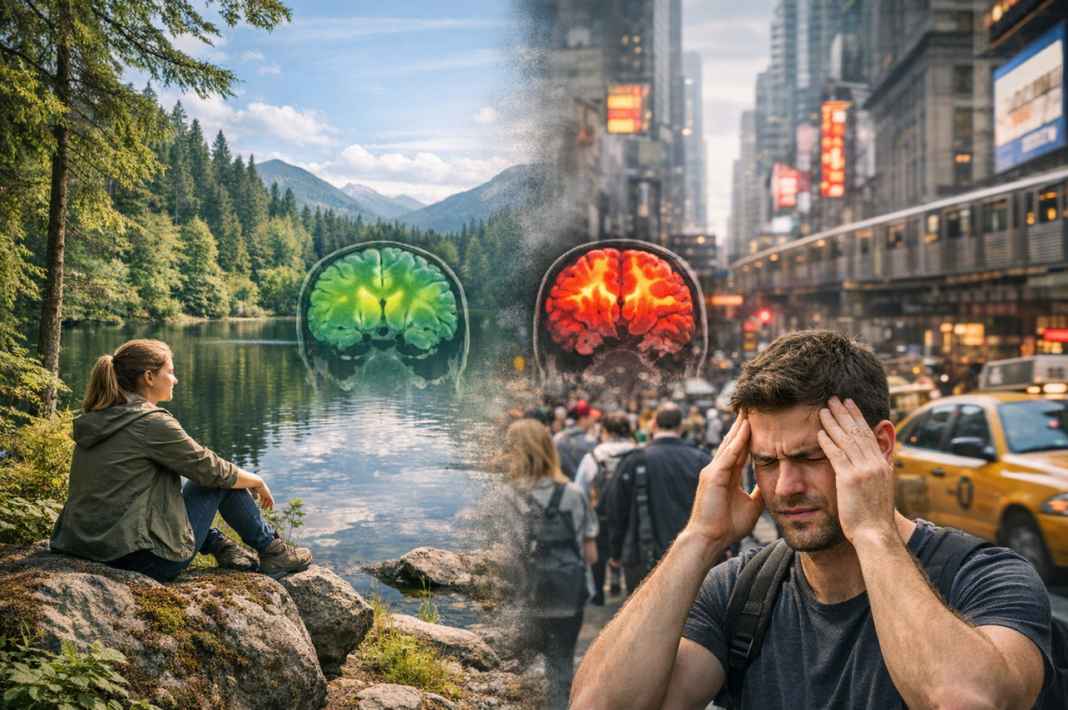

The environment we live in is a direct factor influencing the functioning of our brain and our psychological well-being. From a neuroscientific perspective, if we consider three main environmental factors that affect the human mind, these would be:
-
The effects of the natural environment on brain functioning
-
The neurobiological effects of noise that emerge as a result of urban, artificial, and crowded environments
-
The relationship between spatial design, cognitive functioning, and neuroplasticity
Effects Of The Natural Environment On Brain Functioning
There are numerous studies showing that the natural environment improves individuals’ mental health. Neuroscientific research has clarified how and in what ways this effect occurs. fMRI studies indicate that when individuals look at images of nature, the prefrontal cortex exhibits a more regulated activation pattern and greater cognitive flexibility. This demonstrates that nature reorganizes and restores the human mind.
The natural environment consumes less cognitive capacity in individuals. In other words, exposure to nature can help students and employees enhance their mental capacity by allowing cognitive recovery to occur.
Stress hormones and nature are closely interconnected and can directly influence one another. Spending even a minimum of 20–30 minutes in green spaces has been shown to reduce cortisol levels, slow heart rate, and decrease the activity of the amygdala — the brain’s center for threat detection. In contrast, urban environments tend to cause hyperactivation of the amygdala.
MRI studies have shown that after interacting with nature, individuals experience:
-
A decrease or slowing in amygdala activity
-
An increase in the regulation of positive emotions
Urban Environment, Crowding, Noise, and The Brain’s Neural Responses
In highly urbanized areas, environmental stressors significantly affect individuals’ perception, emotion, cognitive control, and regulation processes.
Effects Of Crowded Environments On The Amygdala And Stress
One of the primary stressors experienced by individuals living in urban environments is social density, or crowding. When a person is exposed to a densely populated social environment, amygdala activity increases, which in turn causes the Cortisol–HPA axis (Hypothalamus in the brain, Pituitary gland in the brain, and Adrenal glands located above the kidneys) to become highly activated. This system is closely associated with chronic stress.
MRI studies conducted on individuals living in cities have shown that:
-
Their amygdala tends to be larger in size
-
Their stress responses are more easily triggered and occur more rapidly
-
The connection between the amygdala and the prefrontal cortex is weaker
For these reasons, urban living is thought to negatively increase the risk of anxiety disorders and depression in individuals.
Urban Structures and Spatial Cognition
In urban life, the complex and irregular architectural layout of buildings places excessive load on the brain’s spatial navigation processes. The hippocampus, a region in the brain, plays a critical role in navigation and memory. Individuals living in disorganized or irregularly developed urban areas generally show:
-
Lower performance in spatial memory
-
Weaker hippocampal connectivity
-
Difficulties in orientation (the ability to determine one’s position, direction, and relation to surroundings based on place, time, or situation)
Spatial Design, Cognitive Mechanisms, And Neuroplasticity
Effects Of Enclosed Spaces On The Brain
Our brain is an organ that depends heavily on sensory input. Many physical features—such as light, temperature, color, the spaciousness of a room, and the quality of ventilation—directly affect the brain and our cognitive capacity. Insufficient lighting in an enclosed environment can disrupt the balance of melatonin and serotonin, potentially leading to depressive mood states. Poor or absent ventilation can weaken the functioning of the prefrontal cortex, which may impair our decision-making and reasoning abilities.
In recent years, a sub-discipline called neuro-architecture has emerged, focusing on how architectural structures influence changes in the brain. Architectural spaces that contain natural and aesthetically pleasing elements can strengthen synaptic connections in individuals. For example, receiving sunlight through the window when you wake up in the morning activates the visual cortex. Structures with aesthetic symmetry stimulate the brain’s reward system. Therefore, we can say that every architectural form our eyes encounter influences the structure of our brain—both positively and negatively.
The Environment Directly Shapes Our Brain
Findings from neuroscientific research clearly show that the atmosphere we inhabit is a biopsychosocial stimulus that directly shapes our brain structure, emotions, cognitive capacity, and stress levels.
The natural environment reduces stress levels and enables cognitive restoration. This allows individuals’ decision-making mechanisms to function in a more active and efficient mode. Specialists recommend that students and employees take at least 20–30-minute walks or engage in light exercise in natural outdoor settings during their breaks.